
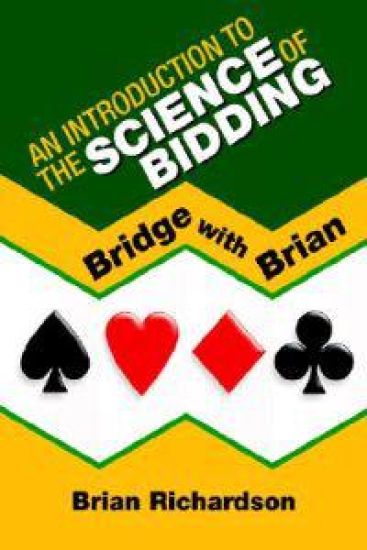
An Introduction to the Science of Bidding – hinnat ja saatavuus
Kirjafiili on kirjojen hintavertailu. Löydä halvin hinta 27 kirjakaupasta. Hintavertailu koskee ISBN-tunnusta 9781425712792 (pokkari).
Muut painokset ja formaatit
Kirjan kuvaus
After some years using published material to teach newcomers the rudiments of bridge bidding, the author became somewhat disillusioned with the approach advocated in the majority of beginning bridge texts. The matters that particularly… Näytä koko kuvaus Piilota kuvaus
After some years using published material to teach newcomers the rudiments of bridge bidding, the author became somewhat disillusioned with the approach advocated in the majority of beginning bridge texts. The matters that particularly concerned him were related to the view espoused by many bridge teachers that it is important to keep all bidding 'natural' so as not to confuse beginners. The author felt that if confusion exists, it is likely to be the teaching approach that causes the confusion, rather than the subject matter itself. The proponents of this 'natural' bidding approach, decline to teach beginning students Jacoby Transfer Bids, Weak Two Opening Bids and, in some cases, Stayman. The reason often given is that teaching 'natural' bidding is difficult enough for beginning bridge students, and we should not confuse them by teaching them conventions or treatments that say something different. These same teachers seem to see no inconsistency in their approach of saying, when the students are doing a second (or third) class with them - "oh, remember when I told you that when your partner makes an opening bid of 1NT and you have 7 points and a five card ♥ suit, that you should bid 2♥? Well, I want you to forget that, because I am going to teach you now that, with that same hand, you should bid 2♦." The author has two problems with that approach. Firstly, it seems to downplay the ability of students to understand these specific bids. The author contends that it is most likely that this is a 'teaching failure' rather than a 'learning failure' The author has found that once students fully understand that it is desirable to have the strong hand as Declarer, most of them have little problem understanding the rationale behind Jacoby Transfer Bids. Putting the bids in context seems to make the task of learning Transfer Bids much easier. Secondly, if teachers are hoping to encourage their students to become duplicate bridge players, it makes sense for them to be using a bidding system that other players are using. As almost all duplicate bridge players use Stayman, Jacoby Transfer Bids and Weak Two Opening Bids, the author's students are introduced to these bids in their first series of lessons. And it is important to note that an understanding of these 3 aspects of bridge bidding will not prove to be a disadvantage in social bridge. The theme throughout the book is one of providing clear, consistent guidelines for a relatively simple modern approach to bidding. The author repeatedly emphasizes that once newcomers have a reasonable understanding of basic bidding, they, and their partner, can 'tweak' the approach taught in this text. The author is an avid duplicate bridge player and encourages all of his students to try that form of the game. However, the reality is that many bridge players enjoy the game in its more social form, and have no real desire to go past that form of the game. This is perfectly understandable, and the bidding style taught in this text is consistent with either form of the game. This book is organized into nine Chapters. CHAPTER 1 - The Basics. This Chapter is really 'Ground Zero'. It recognizes that some people who wish to learn to play bridge have had little, if any, experience of playing card games. The text introduces students to the absolute basics: -the suits -the rank, or hierarchy, of suits -how to count points -what is a 'game' in bridge -dealing -arranging the cards in your hand -the process of bidding -the process of playing -scoring. In this first, very basic, Chapter, students have a hand of bridge to play. At the end of the Chapter there is a brief test to enable students to check their mastery of the material provided in the text. Clearly not all students "need" this Chapter. Nevertheless as the purpose of the book is to provide a text to enable ALL students to be int
Kirjan tiedot
Vertaa kirjan ”An Introduction to the Science of Bidding” hintoja
Vertaa tuotteen hintaa ja arvioitua kokonaishintaa toimitettuna. Kaikki hinnat koskevat ISBN-tunnusta 9781425712792.
Hintoja ei päivitetty automaattisesti. Voit hakea ajantasaiset hinnat painamalla Hae hinnat.

Booky

Suomalainen

Kansallinen Kirjakauppa

Prisma

Finlandia Kirja

Fantasiapelit

Vinhan kirjakauppa

CDON

Kustantamo S&S

Kennys.ie

Kristillinenkirjakauppa.fi

Sacrum

Adlibris

BookOutlet.fi

Kirja.fi

Rosebud
Tälle kirjalle ei ole tällä hetkellä vahvistettua hintaa. Tarkista tilanne myöhemmin uudelleen.
Hintoja ei ole vielä päivitetty.
Hälytys tallennettu!
Ilmoitamme, kun hinta laskee.
Saat sähköpostin, kun hinta laskee asettamaasi rajaan tai sen alle.
An Introduction to the Science of Bidding – hintahistoria
Seuraamme kirjan An Introduction to the Science of Bidding hintakehitystä kirjakaupoissa. Taulukosta näet viime kuukausien alimmat hinnat.
Alin hinta kauppoittain
Kunkin kaupan alin hinta viimeisten 90 päivän aikana.
Hintahistoriaa ei ole vielä kerätty tälle kirjalle.
Hinnat ilman toimituskuluja.