
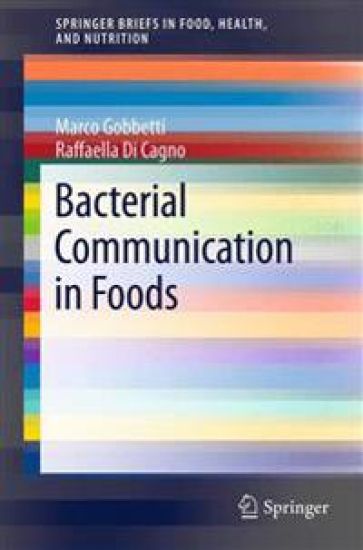
Bacterial Communication in Foods – hinnat ja saatavuus
Kirjafiili on kirjojen hintavertailu. Löydä halvin hinta 27 kirjakaupasta. Hintavertailu koskee ISBN-tunnusta 9781461456551 (nidottu).
Kirjan kuvaus
It is generally assumed that microorganisms synthesize, release, detect and respond to small signaling hormone-like molecules. These molecules are used for a process termed “quorum sensing” (QS), a phenomenon that enables bacteria to sense… Näytä koko kuvaus Piilota kuvaus
It is generally assumed that microorganisms synthesize, release, detect and respond to small signaling hormone-like molecules. These molecules are used for a process termed “quorum sensing” (QS), a phenomenon that enables bacteria to sense when the minimal number of cells, or “quorum,” is achieved for a concerted response to be initiated. Words such as “language” and “behavior” are frequently used to depict QS in the literature. More simply put, language and cross-talk between bacteria, and between bacteria and animal or plant hosts, determines the behavior (e.g., beneficial or pathogenic effects) of bacteria. Currently, the major concern is to understand and decode this language. Overall, bacterial cross-talk was mainly studied on environmental, plant, and human pathogenic bacteria. Few studies considered food-related lactic acid bacteria. The cross-talk between bacteria influences the behavior and, in turn, the environmental adaptation and phenotypes. Therefore, it is understood that bacterial cross-talk has important applicative repercussions. The language spoken between bacteria populating the same food ecosystem may condition the phenotypic traits of starter lactic acid bacteria and, consequently, their performance. This Brief aims to define the basis of cell-to-cell signalling in food fermentation and will highlight: (i) microbiology, nutritional, chemical and functional aspects; (ii) functional properties due to microbial adaptation to the gastrointestinal tract; (iii) principal phenotypes under control of QS circuitries; (iv) quorum quenching. This Brief will be the first reference on this topic and it will highlight the main results for a more productive industrial application. Draft content 1. Signals of food related Gram-negative and Gram-positive bacteria The chapter will describe the different signaling languages used by Gram-negative bacteria (N-acyl-L-homoserine lactones) and Gram-positive bacteria (based on the synthesis ofpost-translationally modified peptides) and the universal chemical lexicon, shared by both Gram-positive and -negative bacteria (autoinducer-2 through the activity of the LuxS enzyme). 2. Phenotypes related to quorum sensing The chapter will describe the bacterial phenotypes, such as virulence, biofilm maturation, bacteriocin synthesis, and secondary metabolite production under control of QS circuitries. 3. Cell-to-cell signalling in fermented food: sourdough The chapter will describe the language spoken between bacteria populating the same food ecosystem (sourdough) and will provide an overview of the conditioned phenotypic traits of starter lactic acid bacteria and, consequently, their performance. 4. Cell-to-cell signalling in fermented food: yoghurt The chapter will describe the language spoken between bacteria populating the same food ecosystem (yoghurt) and will provide an overview of the conditioned phenotypic traits of starter lactic acid bacteria and, consequently, their performance. 5. Probiotic message at the intra-, inter-species and inter-kingdom level The chapter will describe the mechanisms that regulate the interaction between microorganism and host, and the capacity of the microorganism to adapt to environment. Particular reference will also be made to: (i) pathogen inhibition and restoration of microbial homeostasis through microbe-microbe interactions; (ii) enhancement of epithelial barrier function; and (iii) modulation of immune responses. 6. New Perspectives of quorum sensing This chapter will provide an overview of the future perspective regarding quorum sensing, showing that bacterial cross-talk may have important applicative repercussions. It will highlight the interference on the language of QS, which is defined as quorum quenching (QQ). Increasing translation of the bacterial cross-talk has shown that in some environmental circumstances, quenching of the language may occur.
Kirjan tiedot
Vertaa kirjan ”Bacterial Communication in Foods” hintoja
Vertaa tuotteen hintaa ja arvioitua kokonaishintaa toimitettuna. Kaikki hinnat koskevat ISBN-tunnusta 9781461456551.
Hintoja ei päivitetty automaattisesti. Voit hakea ajantasaiset hinnat painamalla Hae hinnat.

Booky

Suomalainen

Kansallinen Kirjakauppa

Prisma

Finlandia Kirja

Fantasiapelit

Vinhan kirjakauppa

CDON

Kustantamo S&S

Kennys.ie

Kristillinenkirjakauppa.fi

Sacrum

Adlibris

BookOutlet.fi

Kirja.fi

Rosebud
Tälle kirjalle ei ole tällä hetkellä vahvistettua hintaa. Tarkista tilanne myöhemmin uudelleen.
Hintoja ei ole vielä päivitetty.
Hälytys tallennettu!
Ilmoitamme, kun hinta laskee.
Saat sähköpostin, kun hinta laskee asettamaasi rajaan tai sen alle.
Bacterial Communication in Foods – hintahistoria
Seuraamme kirjan Bacterial Communication in Foods hintakehitystä kirjakaupoissa. Taulukosta näet viime kuukausien alimmat hinnat.
Alin hinta kauppoittain
Kunkin kaupan alin hinta viimeisten 90 päivän aikana.
Hintahistoriaa ei ole vielä kerätty tälle kirjalle.
Hinnat ilman toimituskuluja.