
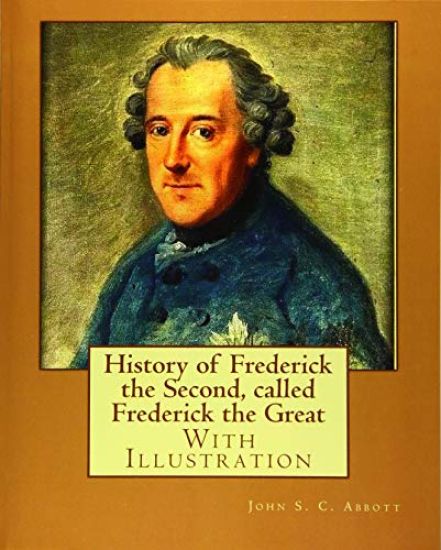
History of Frederick the Second, called Frederick the Great. By: John S. C. Abbott (With Illustration).: Frederick II, King of Prussia, 1712-1786, Pru – hinnat ja saatavuus
Kirjafiili on kirjojen hintavertailu. Löydä halvin hinta 27 kirjakaupasta. Hintavertailu koskee ISBN-tunnusta 9781978263062 (nidottu).
Kirjan kuvaus
John Stevens Cabot Abbott (September 19, 1805 - June 17, 1877), an American historian, pastor, and pedagogical writer, was born in Brunswick, Maine to Jacob and Betsey Abbott. John Stevens Cabot Abbott (September 19, 1805 - June 17, 1877),… Näytä koko kuvaus Piilota kuvaus
John Stevens Cabot Abbott (September 19, 1805 - June 17, 1877), an American historian, pastor, and pedagogical writer, was born in Brunswick, Maine to Jacob and Betsey Abbott. John Stevens Cabot Abbott (September 19, 1805 - June 17, 1877), an American historian, pastor, and pedagogical writer, was born in Brunswick, Maine to Jacob and Betsey Abbott. Early life He was a brother of Jacob Abbott, and was associated with him in the management of Abbott's Institute, New York City, and in the preparation of his series of brief historical biographies.... Frederick II (German: Friedrich; 24 January 1712 - 17 August 1786) was King of Prussia from 1740 until 1786, the longest reign of any Hohenzollern king. His most significant accomplishments during his reign included his military victories, his reorganization of Prussian armies, his patronage of the arts and the Enlightenment in Prussia, and his final success against great odds in the Seven Years' War. Frederick was the last titled King in Prussia and declared himself King of Prussia after achieving full sovereignty for all historical Prussian lands. Prussia had greatly increased its territories and became a leading military power in Europe under his rule. He became known as Frederick the Great and was affectionately nicknamed Der Alte Fritz ("Old Fritz") by the Prussian and later by all German people. In his youth, Frederick was more interested in music and philosophy than the art of war. Nonetheless, upon ascending to the Prussian throne, he attacked Austria and claimed Silesia during the Silesian Wars, winning military acclaim for himself and Prussia. Toward the end of his reign, Frederick physically connected most of his realm by acquiring Polish territories in the First Partition of Poland. He was an influential military theorist whose analysis emerged from his extensive personal battlefield experience and covered issues of strategy, tactics, mobility and logistics. Considering himself "the first servant of the state", Frederick was a proponent of enlightened absolutism. He modernized the Prussian bureaucracy and civil service and pursued religious policies throughout his realm that ranged from tolerance to segregation. He reformed the judicial system and made it possible for men not of noble stock to become judges and senior bureaucrats. Frederick also encouraged immigrants of various nationalities and faiths to come to Prussia. Some critics, however, point out his oppressive measures against conquered Polish subjects during the First Partition. Frederick supported arts and philosophers he favored, as well as allowing complete freedom of the press and literature. Frederick is buried at his favorite residence, Sanssouci in Potsdam. Because he died childless, Frederick was succeeded by his nephew, Frederick William II, son of his brother, Augustus William. Nearly all 19th-century German historians made Frederick into a romantic model of a glorified warrior, praising his leadership, administrative efficiency, devotion to duty and success in building up Prussia to a great power in Europe. Historian Leopold von Ranke was unstinting in his praise of Frederick's "Heroic life, inspired by great ideas, filled with feats of arms ... immortalized by the raising of the Prussian state to the rank of a power." Johann Gustav Droysen was even more extolling. Frederick remained an admired historical figure through the German Empire's defeat in the First World War, and the Nazis glorified him as a great German leader pre-figuring Hitler, but his reputation in both East and West Germany became far less favorable after the fall of the Nazi regime, largely due to his status as a favorite icon of the Nazis. However, by the 21st century, a re-evaluation of his legacy as a great warrior and enlightened monarch returned opinion of him to favour............
Kirjan tiedot
Vertaa kirjan ”History of Frederick the Second, called Frederick the Great. By: John S. C. Abbott (With Illustration).: Frederick II, King of Prussia, 1712-1786, Pru” hintoja
Vertaa tuotteen hintaa ja arvioitua kokonaishintaa toimitettuna. Kaikki hinnat koskevat ISBN-tunnusta 9781978263062.
Hintoja ei päivitetty automaattisesti. Voit hakea ajantasaiset hinnat painamalla Hae hinnat.

Booky

Suomalainen

Kansallinen Kirjakauppa

Prisma

Finlandia Kirja

Fantasiapelit

Vinhan kirjakauppa

CDON

Kustantamo S&S

Kennys.ie

Kristillinenkirjakauppa.fi

Sacrum

Adlibris

BookOutlet.fi

Kirja.fi

Rosebud
Tälle kirjalle ei ole tällä hetkellä vahvistettua hintaa. Tarkista tilanne myöhemmin uudelleen.
Hintoja ei ole vielä päivitetty.
Hälytys tallennettu!
Ilmoitamme, kun hinta laskee.
Saat sähköpostin, kun hinta laskee asettamaasi rajaan tai sen alle.
History of Frederick the Second, called Frederick the Great. By: John S. C. Abbott (With Illustration).: Frederick II, King of Prussia, 1712-1786, Pru – hintahistoria
Seuraamme kirjan History of Frederick the Second, called Frederick the Great. By: John S. C. Abbott (With Illustration).: Frederick II, King of Prussia, 1712-1786, Pru hintakehitystä kirjakaupoissa. Taulukosta näet viime kuukausien alimmat hinnat.
Alin hinta kauppoittain
Kunkin kaupan alin hinta viimeisten 90 päivän aikana.
Hintahistoriaa ei ole vielä kerätty tälle kirjalle.
Hinnat ilman toimituskuluja.