
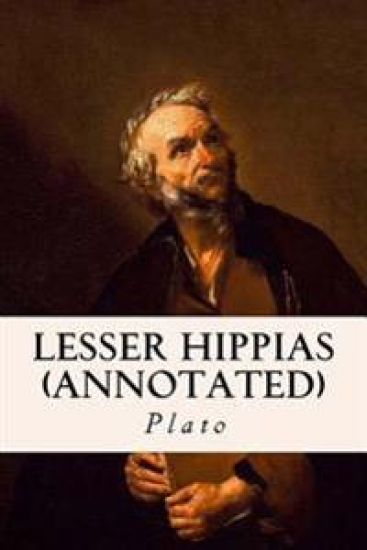
Lesser Hippias (annotated) – hinnat ja saatavuus
Kirjafiili on kirjojen hintavertailu. Löydä halvin hinta 27 kirjakaupasta. Hintavertailu koskee ISBN-tunnusta 9781518702594 (nidottu).


Kirjan kuvaus
Hippias Minor, or On Lying, is thought to be one of Plato's early works. Socrates matches wits with an arrogant polymath, who is also a smug literary critic. Hippias believes that Homer can be taken at face value, and he also thinks that… Näytä koko kuvaus Piilota kuvaus
Hippias Minor, or On Lying, is thought to be one of Plato's early works. Socrates matches wits with an arrogant polymath, who is also a smug literary critic. Hippias believes that Homer can be taken at face value, and he also thinks that Achilles may be believed when he says he hates liars, whereas Odysseus' resourceful behavior stems from his ability to lie well (365b). Socrates argues that Achilles is a cunning liar who throws people off the scent of his own deceptions and that cunning liars are actually the "best" liars. Consequently, Odysseus was equally false and true and so was Achilles (369b). Socrates proposes, possibly for the sheer dialectical fun of it, that it is better to do evil voluntarily than involuntarily. His case rests largely on the analogy with athletic skills, such as running and wrestling. He says that a runner or wrestler who deliberately sandbags is better than the one who plods along because he can do no better. In Hippias Minor, Socrates argues with Hippias about which kind of liar is the best, the man who deliberately contrives a lie, or the man who lies unwittingly, from not paying attention to what he is saying, or changing his mind. Socrates argues that the voluntary lie is better than the involuntary lie. The debate is rooted in a literary question about whom Homer intended to portray as the better man, Achilles or Odysseus. Socrates says he has heard Eudicus' father, Apemantus, declare that there is a parallel analogy between the artistic quality of the Iliad and the moral quality of its main character, Achilles, and the quality of the Odyssey and the quality of its main character, Odysseus. The men do not pursue this thesis, that the moral status of the characters in a work of literature has some bearing on its artistry. Socrates does resurrect the idea in the Republic, however, when he argues that Homer's classics would be better books if Achilles and the other warriors were presented as always righteous. Socrates says that they ought to be rewritten to this effect. The sophist Hippias is visiting Athens from his home city of Elis on the occasion of the Olympic festival. An artisan, poet, rhetor, astronomer and arithmetician, Hippias has also appointed himself an expert on Homer. He has been favoring the crowds with displays of his literary opinions. Hippias' most recent display of oratory concerned who is the better man, Achilles or Odysseus. Socrates says that he could not follow his argument, but did not want to interrupt. Now that the three men are separated from the crowd, Socrates, encouraged by Eudicus, quizzes Hippias on the particulars of his opinion. Socrates asks Hippias if Homer has not portrayed Achilles as a wily man. Hippias counters that Achilles is the most straightforward of men, simple and true, and cites a passage where Achilles declares his hatred for men who think one thing and say another, or who do not do what they say they will do. Socrates does not object to Hippias' literalism, and seems to abandon the literary question, saying that Homer is dead, and the thing cannot be resolved (365d). He tells Hippias that because he agrees with Homer that a simple and true man is better than a wily and cunning one, he will let him speak for Homer. Socrates gets Hippias to agree that the more a man knows about a subject, the better position he will be in to lie about it. He argues that the man who knows the subjects about which he tells lies, whether arithmetic, geometry, or astronomy, is twice as powerful as the man who does not know his subjects. Socrates never indicates what a man might stand to gain from lying about such matters, but brings the conversation back around to Achilles, and what kind of man Homer intended to portray.
Kirjan tiedot
Vertaa kirjan ”Lesser Hippias (annotated)” hintoja
Vertaa tuotteen hintaa ja arvioitua kokonaishintaa toimitettuna. Kaikki hinnat koskevat ISBN-tunnusta 9781518702594.
Hintoja ei päivitetty automaattisesti. Voit hakea ajantasaiset hinnat painamalla Hae hinnat.

Booky

Suomalainen

Kansallinen Kirjakauppa

Prisma

Finlandia Kirja

Fantasiapelit

Vinhan kirjakauppa

CDON

Kustantamo S&S

Kennys.ie

Kristillinenkirjakauppa.fi

Sacrum

Adlibris

BookOutlet.fi

Kirja.fi

Rosebud
Tälle kirjalle ei ole tällä hetkellä vahvistettua hintaa. Tarkista tilanne myöhemmin uudelleen.
Hintoja ei ole vielä päivitetty.
Hälytys tallennettu!
Ilmoitamme, kun hinta laskee.
Saat sähköpostin, kun hinta laskee asettamaasi rajaan tai sen alle.
Lesser Hippias (annotated) – hintahistoria
Seuraamme kirjan Lesser Hippias (annotated) hintakehitystä kirjakaupoissa. Taulukosta näet viime kuukausien alimmat hinnat.
Alin hinta kauppoittain
Kunkin kaupan alin hinta viimeisten 90 päivän aikana.
Hintahistoriaa ei ole vielä kerätty tälle kirjalle.
Hinnat ilman toimituskuluja.