
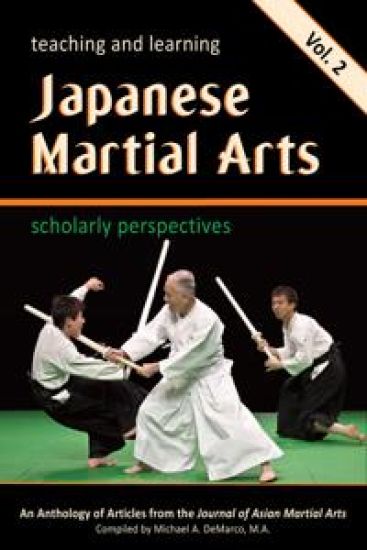
Teaching and Learning Japanese Martial Arts – hinnat ja saatavuus
Scholarly Perspectives Vol. 2
Kirjafiili on kirjojen hintavertailu. Löydä halvin hinta 27 kirjakaupasta. Hintavertailu koskee ISBN-tunnusta 9781544823096 (nidottu).
Kirjan kuvaus
This two-volume anthology brings together the best scholarly works published in the Journal of Asian Martial Arts on the topic of teaching and learning Japanese martial arts. In this 2nd volume, you'll find eight chapters that dive deep… Näytä koko kuvaus Piilota kuvaus
This two-volume anthology brings together the best scholarly works published in the Journal of Asian Martial Arts on the topic of teaching and learning Japanese martial arts. In this 2nd volume, you'll find eight chapters that dive deep into Japanese martial traditions, combining aspects of history and culture that explain how teaching methods developed and evolved. Chapter one asks: What defines and gives meaning to the practice of karate? The Dr. Wingate looks to the ideology of karate as presented in the writings of founder Ginchin Funakoshi and traditional Japanese martial arts as "ways" of self-cultivation. This ideology is often greatly different from the ideology held by modern practitioners. This chapter explores the differences. Next, Dr. Donohue comments on the ideological complex surrounding training in the Japanese martial traditions. These systems, while remaining relatively uniform through time, have, in fact, been subject to considerable philosophical interpretation and emphasis. Why many practice martial artists has little to do with the essential nature of these arts. Dr. Grossman presents a thesis in his chapter that we can arrive at a deeper understanding of any martial arts-using aikido as an example-if we consider it to be a symbolic form of communication, as well as a martial art, and utilize the science of semiotics to translate the "message" encoded in the "body language" of aikido techniques. A photographic technical section illustrates this process. The next chapter by Sakuyama Yoshinaga discusses the potential growth for learning in children. How can adults provide the best learning environment? The author believes that inspiration comes through subtle emotions of the human heart, influencing others. The theory is found in ancient samurai traditions and applied by the author in teaching Shorinji Kempo. Chapter five by Dr. Dykhuizen point out how Asian martial arts are being practiced in cultures other than those within which they originated. Specific information concerning how practitioners from different cultures understand them becomes increasingly useful to martial artists and martial arts scholars. This chapter summarizes findings of an investigation among aikido practitioners. The Japanese Imperial family is said to have been given three symbols of authority by the gods: a mirror, a jewel, and a sword. Dr. Donohue uses this symbolic structure to discuss varying perspectives on the Japanese martial arts. Each aid in our understanding and appreciation of the multifaceted dimensions of the martial arts. In his chapter, Dr. Edinborough examines how Japanese martial arts, specifically the approach developed by Inaba Minoru, can be functionally understood as a form of art. Through referring to the aesthetic theories, the article examines budo as a means of organizing experience, recognizable alongside painting, dance, theater, and literature. The final chapter by Marvin Labbate looks close at the training hall. Dressed in a uniform, students line up in a ready position, come to attention, sit, meditate, and bow. This ritualized pattern is performed at the beginning, during, and at the end of each class, but what does it mean? In this chapter, each element of the ritualized pattern will be discussed to provide a clear understanding of its original intent. If you are interested in Japanese martial traditions, you will find much in these eight chapters that clarify why the arts are taught according to a longstanding tradition-and also why there have been evolutionary changes in the instructional methods. There is sound logic for the old traditions, as well as for the changes. The scholarly research presented in this anthology will improve a teacher's way of instructing and help a student understand what to expect out of his or her studies.
Kirjan tiedot
Vertaa kirjan ”Teaching and Learning Japanese Martial Arts” hintoja
Vertaa tuotteen hintaa ja arvioitua kokonaishintaa toimitettuna. Kaikki hinnat koskevat ISBN-tunnusta 9781544823096.
Hintoja ei päivitetty automaattisesti. Voit hakea ajantasaiset hinnat painamalla Hae hinnat.

Booky

Suomalainen

Kansallinen Kirjakauppa

Prisma

Finlandia Kirja

Fantasiapelit

Vinhan kirjakauppa

CDON

Kustantamo S&S

Kennys.ie

Kristillinenkirjakauppa.fi

Sacrum

Adlibris

BookOutlet.fi

Kirja.fi

Rosebud
Tälle kirjalle ei ole tällä hetkellä vahvistettua hintaa. Tarkista tilanne myöhemmin uudelleen.
Hintoja ei ole vielä päivitetty.
Hälytys tallennettu!
Ilmoitamme, kun hinta laskee.
Saat sähköpostin, kun hinta laskee asettamaasi rajaan tai sen alle.
Teaching and Learning Japanese Martial Arts – hintahistoria
Seuraamme kirjan Teaching and Learning Japanese Martial Arts hintakehitystä kirjakaupoissa. Taulukosta näet viime kuukausien alimmat hinnat.
Alin hinta kauppoittain
Kunkin kaupan alin hinta viimeisten 90 päivän aikana.
Hintahistoriaa ei ole vielä kerätty tälle kirjalle.
Hinnat ilman toimituskuluja.