
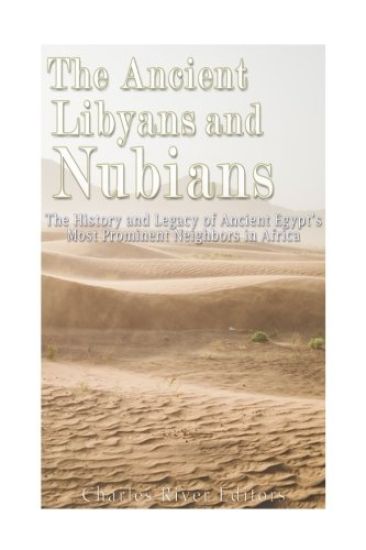
The Ancient Libyans and Nubians: The History and Legacy of Ancient Egypt's Most Prominent Neighbors in Africa – hinnat ja saatavuus
Kirjafiili on kirjojen hintavertailu. Löydä halvin hinta 27 kirjakaupasta. Hintavertailu koskee ISBN-tunnusta 9781979657488 (nidottu).
Kirjan kuvaus
*Includes pictures *Includes ancient accounts *Includes online resources and a bibliography for further reading During the several centuries that ancient Egypt stood as one of the greatest, if not the greatest, civilizations of the ancient… Näytä koko kuvaus Piilota kuvaus
*Includes pictures *Includes ancient accounts *Includes online resources and a bibliography for further reading During the several centuries that ancient Egypt stood as one of the greatest, if not the greatest, civilizations of the ancient world, conflicts with its neighbors often played a central role in hieroglyphic texts and art from temples and tombs. The three primary enemies of the Egyptians were the Libyans who occupied the Western Desert and its oases, the so-called Asiatics who lived in the Levant, and finally the Nubians to Egypt's south. Among the three peoples, the Nubians were the most "Egyptianized" and at times were integral to the development of Egyptian history. Truly, the Nubians were the greatest of all sub-Saharan peoples in pre-modern times and deserve to be studied in their own right, apart from ancient Egyptian history. Unfortunately, it is often difficult for scholars to separate aspects of ancient Nubian culture that were truly unique and "Nubian" from those elements that were Egyptian, as the Nubians borrowed heavily in terms of culture from their northern neighbor. One historian noted, "As expected, strong Nubian features and dark coloring are seen in their sculpture and relief work. This dynasty ranks as among the greatest, whose fame far outlived its actual tenure on the throne. Especially interesting, it was a member of this dynasty that decreed that no Nehsy (riverine Nubian of the principality of Kush), except such as came for trade or diplomatic reasons, should pass by the Egyptian fortress and cops at the southern end of the Second Nile Cataract. Why would this royal family of Nubian ancestry ban other Nubians from coming into Egyptian territory? Because the Egyptian rulers of Nubian ancestry had become Egyptians culturally; as pharaohs, they exhibited typical Egyptian attitudes and adopted typical Egyptian policies." Robert S. Bianchi went even further: "It is an extremely difficult task to attempt to describe the Nubians during the course of Egypt's New Kingdom, because their presence appears to have virtually evaporated from the archaeological record. The result has been described as a wholesale Nubian assimilation into Egyptian society. This assimilation was so complete that it masked all Nubian ethnic identities insofar as archaeological remains are concerned beneath the impenetrable veneer of Egypt's material culture." The Canaanites and Nubians received the most attention as Egypt's enemies and occasional trading partners, but it was the Libyans-the final third of Egypt's traditional enemies-who influenced later Egyptian culture most. Unlike the Nubians and Canaanites, the Libyans were nearly always at war with the Egyptians. The reasons for the near constant warfare between the Libyans and Egyptians are difficult to discern, but more than likely stem from the fact that Libya was poor in resources, so the Egyptians had little reason to trade with the Libyans. On the other hand, the Libyans coveted Egypt's material wealth. The result was numerous putative campaigns by the Egyptians into Libya and raids by the Libyans into Egypt. The wars between the Libyans and Egyptians reached a fevered pitch during the New Kingdom when the Libyans organized anti-Egyptian coalitions, and even formed an alliance with the mysterious Sea Peoples. By the Late New Kingdom, Egypt was an armed camp, yet it was ultimately unable to stem the tide of Libyan migration. The Libyans used their numbers to their advantage, eventually conquering Egypt and establishing two dynasties. Their ancestors created another two. The relationship between the Libyans and Egyptians was truly complicated, and an in-depth survey of Libyan history from the Neolithic Period until the middle of the 6th century BCE demonstrates just how important the Libyans were in the ancient world.
Kirjan tiedot
Vertaa kirjan ”The Ancient Libyans and Nubians: The History and Legacy of Ancient Egypt's Most Prominent Neighbors in Africa” hintoja
Vertaa tuotteen hintaa ja arvioitua kokonaishintaa toimitettuna. Kaikki hinnat koskevat ISBN-tunnusta 9781979657488.
Hintoja ei päivitetty automaattisesti. Voit hakea ajantasaiset hinnat painamalla Hae hinnat.

Booky

Suomalainen

Kansallinen Kirjakauppa

Prisma

Finlandia Kirja

Fantasiapelit

Vinhan kirjakauppa

CDON

Kustantamo S&S

Kennys.ie

Kristillinenkirjakauppa.fi

Sacrum

Adlibris

BookOutlet.fi

Kirja.fi

Rosebud
Tälle kirjalle ei ole tällä hetkellä vahvistettua hintaa. Tarkista tilanne myöhemmin uudelleen.
Hintoja ei ole vielä päivitetty.
Hälytys tallennettu!
Ilmoitamme, kun hinta laskee.
Saat sähköpostin, kun hinta laskee asettamaasi rajaan tai sen alle.
The Ancient Libyans and Nubians: The History and Legacy of Ancient Egypt's Most Prominent Neighbors in Africa – hintahistoria
Seuraamme kirjan The Ancient Libyans and Nubians: The History and Legacy of Ancient Egypt's Most Prominent Neighbors in Africa hintakehitystä kirjakaupoissa. Taulukosta näet viime kuukausien alimmat hinnat.
Alin hinta kauppoittain
Kunkin kaupan alin hinta viimeisten 90 päivän aikana.
Hintahistoriaa ei ole vielä kerätty tälle kirjalle.
Hinnat ilman toimituskuluja.