
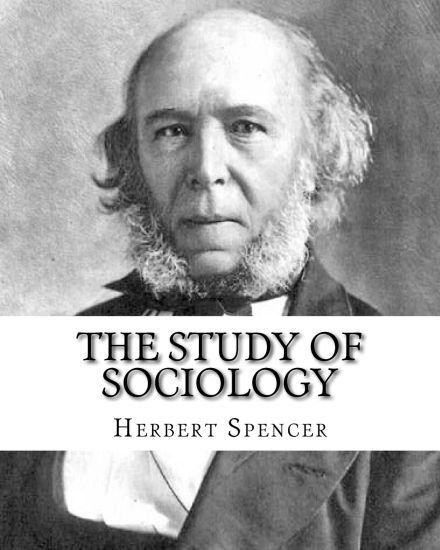
The Study of Sociology, By: Herbert Spencer: Herbert Spencer (27 April 1820 - 8 December 1903) was an English philosopher, biologist, anthropologi – hinnat ja saatavuus
Kirjafiili on kirjojen hintavertailu. Löydä halvin hinta 27 kirjakaupasta. Hintavertailu koskee ISBN-tunnusta 9781720732440 (nidottu).
Kirjan kuvaus
Herbert Spencer (27 April 1820 - 8 December 1903) was an English philosopher, biologist, anthropologist, sociologist, and prominent classical liberal political theorist of the Victorian era. Spencer developed an all-embracing conception of… Näytä koko kuvaus Piilota kuvaus
Herbert Spencer (27 April 1820 - 8 December 1903) was an English philosopher, biologist, anthropologist, sociologist, and prominent classical liberal political theorist of the Victorian era. Spencer developed an all-embracing conception of evolution as the progressive development of the physical world, biological organisms, the human mind, and human culture and societies. As a polymath, he contributed to a wide range of subjects, including ethics, religion, anthropology, economics, political theory, philosophy, literature, astronomy, biology, sociology, and psychology. During his lifetime he achieved tremendous authority, mainly in English-speaking academia. "The only other English philosopher to have achieved anything like such widespread popularity was Bertrand Russell, and that was in the 20th century." Spencer was "the single most famous European intellectual in the closing decades of the nineteenth century" but his influence declined sharply after 1900: "Who now reads Spencer?" asked Talcott Parsons in 1937. 4] Spencer is best known for the expression "survival of the fittest", which he coined in Principles of Biology (1864), after reading Charles Darwin's On the Origin of Species. This term strongly suggests natural selection, yet as Spencer extended evolution into realms of sociology and ethics, he also made use of Lamarckism. Spencer was born in Derby, England, on 27 April 1820, the son of William George Spencer (generally called George). Spencer's father was a religious dissenter who drifted from Methodism to Quakerism, and who seems to have transmitted to his son an opposition to all forms of authority. He ran a school founded on the progressive teaching methods of Johann Heinrich Pestalozzi and also served as Secretary of the Derby Philosophical Society, a scientific society which had been founded in 1783 by Erasmus Darwin, the grandfather of Charles Darwin. Spencer was educated in empirical science by his father, while the members of the Derby Philosophical Society introduced him to pre-Darwinian concepts of biological evolution, particularly those of Erasmus Darwin and Jean-Baptiste Lamarck. His uncle, the Reverend Thomas Spencer vicar of Hinton Charterhouse near Bath, completed Spencer's limited formal education by teaching him some mathematics and physics, and enough Latin to enable him to translate some easy texts. Thomas Spencer also imprinted on his nephew his own firm free-trade and anti-statist political views. Otherwise, Spencer was an autodidact who acquired most of his knowledge from narrowly focused readings and conversations with his friends and acquaintances. Both as an adolescent and as a young man, Spencer found it difficult to settle to any intellectual or professional discipline. He worked as a civil engineer during the railway boom of the late 1830s, while also devoting much of his time to writing for provincial journals that were nonconformist in their religion and radical in their politics. From 1848 to 1853 he served as sub-editor on the free-trade journal The Economist, during which time he published his first book, Social Statics (1851), which predicted that humanity would eventually become completely adapted to the requirements of living in society with the consequential withering away of the state. Its publisher, John Chapman, introduced Spencer to his salon which was attended by many of the leading radical and progressive thinkers of the capital, including John Stuart Mill, Harriet Martineau, George Henry Lewes and Mary Ann Evans (George Eliot), with whom he was briefly romantically linked. Spencer himself introduced the biologist Thomas Henry Huxley, who would later win fame as 'Darwin's Bulldog' and who remained his lifelong friend. However it was the friendship of Evans and Lewes that acquainted him with John Stuart Mill's A System of Logic and with Auguste Comte's positivism and which set him on the road to his life's work. He strongly disagreed with Comte....
Kirjan tiedot
Vertaa kirjan ”The Study of Sociology, By: Herbert Spencer: Herbert Spencer (27 April 1820 - 8 December 1903) was an English philosopher, biologist, anthropologi” hintoja
Vertaa tuotteen hintaa ja arvioitua kokonaishintaa toimitettuna. Kaikki hinnat koskevat ISBN-tunnusta 9781720732440.
Hintoja ei päivitetty automaattisesti. Voit hakea ajantasaiset hinnat painamalla Hae hinnat.

Booky

Suomalainen

Kansallinen Kirjakauppa

Prisma

Finlandia Kirja

Fantasiapelit

Vinhan kirjakauppa

CDON

Kustantamo S&S

Kennys.ie

Kristillinenkirjakauppa.fi

Sacrum

Adlibris

BookOutlet.fi

Kirja.fi

Rosebud
Tälle kirjalle ei ole tällä hetkellä vahvistettua hintaa. Tarkista tilanne myöhemmin uudelleen.
Hintoja ei ole vielä päivitetty.
Hälytys tallennettu!
Ilmoitamme, kun hinta laskee.
Saat sähköpostin, kun hinta laskee asettamaasi rajaan tai sen alle.
The Study of Sociology, By: Herbert Spencer: Herbert Spencer (27 April 1820 - 8 December 1903) was an English philosopher, biologist, anthropologi – hintahistoria
Seuraamme kirjan The Study of Sociology, By: Herbert Spencer: Herbert Spencer (27 April 1820 - 8 December 1903) was an English philosopher, biologist, anthropologi hintakehitystä kirjakaupoissa. Taulukosta näet viime kuukausien alimmat hinnat.
Alin hinta kauppoittain
Kunkin kaupan alin hinta viimeisten 90 päivän aikana.
Hintahistoriaa ei ole vielä kerätty tälle kirjalle.
Hinnat ilman toimituskuluja.