
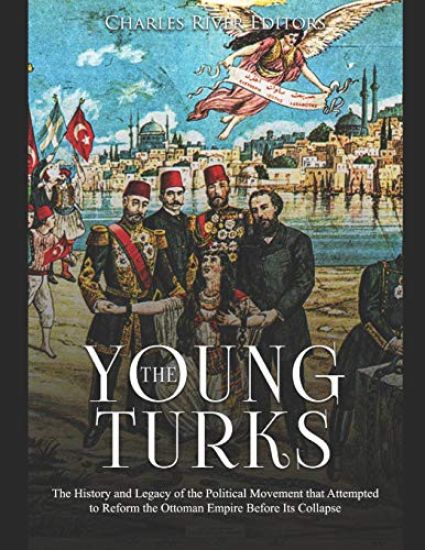
The Young Turks: The History and Legacy of the Political Movement that Attempted to Reform the Ottoman Empire Before Its Collapse – hinnat ja saatavuus
Kirjafiili on kirjojen hintavertailu. Löydä halvin hinta 27 kirjakaupasta. Hintavertailu koskee ISBN-tunnusta 9781702351287 (nidottu).
Muut painokset ja formaatit

Kirjan kuvaus
*Includes pictures*Includes a bibliography for further readingIn August 2017, Turkey's President Recip Tayyip Erdogan gave a directive to the Foreign Ministry to go into ravaged Syria and rescue an 87-year-old Turkish man stranded in… Näytä koko kuvaus Piilota kuvaus
*Includes pictures*Includes a bibliography for further readingIn August 2017, Turkey's President Recip Tayyip Erdogan gave a directive to the Foreign Ministry to go into ravaged Syria and rescue an 87-year-old Turkish man stranded in Damascus by the civil war. The elderly gentleman lived his life simply and quietly. He disliked drawing attention to himself, and he was grieving for his wife who had just died. The man called himself Dundar Abdulkerim Osmanoglu, but many affixed the title Sehzade ("Prince") to his name, for he was Head of the imperial House of Osman and heir to the defunct throne of the Ottoman Empire. His ancestors had created an Empire that had lasted for over 600 years and caused the greatest rulers of both the Muslim East and the Christian West to tremble. Osmanoglu was the great grandson of Sultan Abdul Hamid II (1841-1918), who was notable for introducing constitutional government to the Ottoman Empire. He had been brought reluctantly to this act by a revolution guided by a group of political activists known as the Young Turks. They believed they could save the dying Ottoman state by instituting reforms that would transform the empire into a secular constitutional state on par with the Great Powers of Europe. They also believed that the path to such a change lay with Turkish nationalism rather than imperialism. Abdu Hamid did not share that vision, so he was eventually deposed. Erdogan is the political heir of the Young Turks. Turkey developed into a secular and seemingly Western state, a member of the NATO alliance and an aspirant for membership in the European Union, but Erdogan seems to be reaching back to the imperial past, and he appeals more to the authoritarianism of Abdul Hamid II than the liberalism of the Young Turks. Similarly, Erdogan's Justice and Development Party opposes the secularism that has dominated Turkish national life for almost 100 years. Dundar Ali has never expressed any desire to return to the throne of his ancestors - in fact, he did not wish to leave Damascus, where he had been born and where he worked. It is ironic then, that a great-grandson of the revolution has reached out to the great-grandson of the enemy of the revolution and embraced his legacy as his own. Dundar Ali now lives in Istanbul, the former imperial capital once known internationally as Constantinople. Interest in the former imperial family and the legacy of the Ottoman Empire is increasing within Turkey, encouraged by Erdogan, and there now seems to be a rivalry growing between secularists and Ottomanists, not unlike that which arose between the Young Turks and the Ottomanists in the 19th century. The empire's inclusiveness, which marked it as a direct successor of the Byzantine Empire, was most certainly challenged by an aging leadership, and the Ottoman Empire's inability to create a shared identity, a weak central state, and growing inner dissensions were some of the main factors explaining its long demise. Such a failure also explains the need for the creation of a new form of identity, which was ultimately provided by Mustafa Kemal, the founding father of modern Turkey, a firm critic of the Young Turks. As this all suggests, the story of the Young Turks and the last years of the Ottoman Sultanate is a complex and interesting one. It is the history of a state struggling to survive against seemingly impossible odds, featuring a long battle for the minds and souls of the inhabitants of a declining empire between nationalism and liberal imperialism. It is a struggle that has produced not only modern Turkey but several states in the Balkans and the Middle East as they exist today. The Young Turks were triumphant, but in many ways it was a Pyrrhic victory, because this triumph led to the further disintegration of the Ottoman Empire and its final collapse when they disastrously plunged the empire into the First World War.
Kirjan tiedot
Vertaa kirjan ”The Young Turks: The History and Legacy of the Political Movement that Attempted to Reform the Ottoman Empire Before Its Collapse” hintoja
Vertaa tuotteen hintaa ja arvioitua kokonaishintaa toimitettuna. Kaikki hinnat koskevat ISBN-tunnusta 9781702351287.
Hintoja ei päivitetty automaattisesti. Voit hakea ajantasaiset hinnat painamalla Hae hinnat.

Booky

Suomalainen

Kansallinen Kirjakauppa

Prisma

Finlandia Kirja

Fantasiapelit

Vinhan kirjakauppa

CDON

Kustantamo S&S

Kennys.ie

Kristillinenkirjakauppa.fi

Sacrum

Adlibris

BookOutlet.fi

Kirja.fi

Rosebud
Tälle kirjalle ei ole tällä hetkellä vahvistettua hintaa. Tarkista tilanne myöhemmin uudelleen.
Hintoja ei ole vielä päivitetty.
Hälytys tallennettu!
Ilmoitamme, kun hinta laskee.
Saat sähköpostin, kun hinta laskee asettamaasi rajaan tai sen alle.
The Young Turks: The History and Legacy of the Political Movement that Attempted to Reform the Ottoman Empire Before Its Collapse – hintahistoria
Seuraamme kirjan The Young Turks: The History and Legacy of the Political Movement that Attempted to Reform the Ottoman Empire Before Its Collapse hintakehitystä kirjakaupoissa. Taulukosta näet viime kuukausien alimmat hinnat.
Alin hinta kauppoittain
Kunkin kaupan alin hinta viimeisten 90 päivän aikana.
Hintahistoriaa ei ole vielä kerätty tälle kirjalle.
Hinnat ilman toimituskuluja.