
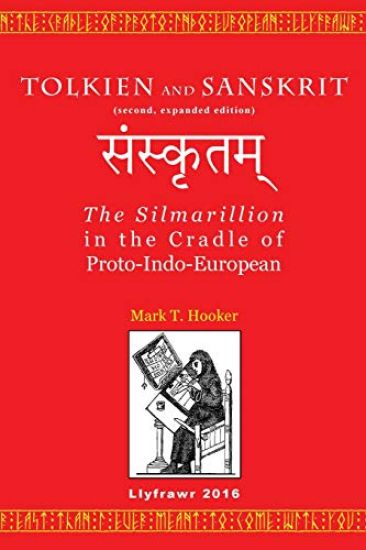
Tolkien and Sanskrit (second, expanded edition): The Silmarillion in the Cradle of Proto-Indo-European – hinnat ja saatavuus
The Silmarillion in the Cradle of Proto-indo-european
Kirjafiili on kirjojen hintavertailu. Löydä halvin hinta 27 kirjakaupasta. Hintavertailu koskee ISBN-tunnusta 9781540435484 (nidottu).
Kirjan kuvaus
This study is based on the observation that Tolkien calqued the names of the Sapta Sindhavah (Seven Rivers) from the Rig Veda as the Seven Rivers of Ossiriand. In other words, Tolkien created seven Elvish river names that mean the same… Näytä koko kuvaus Piilota kuvaus
This study is based on the observation that Tolkien calqued the names of the Sapta Sindhavah (Seven Rivers) from the Rig Veda as the Seven Rivers of Ossiriand. In other words, Tolkien created seven Elvish river names that mean the same thing as the river names of the Sapta Sindhavah. Much has been said of Tolkien's use of Welsh, Old English, Gothic, Icelandic, Russian, Greek, and Latin. Little, however, has been said about Tolkien's use of Sanskrit (Refined Speech), the great-great-...grandfather of all the languages above. Sanskrit was spoken in the second millennium B. C. in the valley of the River Indus, the river that put the "Indo" in the name Proto-Indo-European, a linguistic term for the *reconstructed common ancestor of the European languages. All indications to the contrary (C&G ii, 461), there is little doubt about Tolkien's knowledge of Sanskrit from the point of view of a linguist. It is de rigueur for any serious philologist interested in etymologies like Tolkien. Tolkien was on the Language side of the English School at Oxford, where he took Comparative Philology as a special subject for Honour Moderations. (G&G ii, 758)In a certain sense, Tolkien's The Silmarillion can be considered a veiled member of the genre of Raj Literature. The names of The Silmarillion say that in the same way that the names in Tolkien's poem "The Mewlips" are masks that hide the fact that it is a poem about World War I. As the present study shows, the names of The Silmarillion say that the locus of Tolkien's "Mythology for England" (C&G ii, 244-248) is the India of the British Raj. A literary analysis of Tolkien's place in Raj Literature is, however, much more speculative than the linguistic analysis that makes up the core of this study, which stands on solid philological ground. The literary analysis will, therefore, be left to another time and place. While the basis of Tolkien's calque of the names of the Seven Rivers as Ossiriand is Vedic in concept, the superstructure that Tolkien builds upon this foundation is non-Vedic. Some elements of the superstructure are more readily attributable to historical sources, like the history of the India Campaign of Alexander the Great, and the history of the British Raj in India, both of which were a part of the school curriculum when Tolkien was growing up. While the analysis of some of the words names in this study would not be believable in stand-alone articles, in the context of the coherent structure of words and names presented here, they are worthy of serious consideration. The discovery presented here has the potential to more clearly define the linguistic and philosophical cradle of Tolkien's 'Mythology for England, ' which was always The Silmarillion, and never The Lord of the Rings. It is Proto-Indo-European in the same way that the English language stems from Proto-Indo-European. That does not, however, mean that there is no gap between Proto-Indo-European language and culture, and the language and culture of The Shire. The analysis that follows is not a rehash of the discredited ideas of The Shores of Middle-earth (1981). It is instead, a completely new, linguistic approach to Tolkien's Silmarillion nomenclature. Correction: On page 156, the name of the King of Anga is given as Kama. It should read: Karna, which is the correct spelling of the name of this King, who is one of the main protagonists of the Hindu epic Mahabharata. Your attention is invited to: The Tolkienotheca (Llyfrawr, 2019), Part I of which is an "Addendum to Tolkien and Sanskrit."
Kirjan tiedot
Vertaa kirjan ”Tolkien and Sanskrit (second, expanded edition): The Silmarillion in the Cradle of Proto-Indo-European” hintoja
Vertaa tuotteen hintaa ja arvioitua kokonaishintaa toimitettuna. Kaikki hinnat koskevat ISBN-tunnusta 9781540435484.
Hintoja ei päivitetty automaattisesti. Voit hakea ajantasaiset hinnat painamalla Hae hinnat.

Booky

Suomalainen

Kansallinen Kirjakauppa

Prisma

Finlandia Kirja

Fantasiapelit

Vinhan kirjakauppa

CDON

Kustantamo S&S

Kennys.ie

Kristillinenkirjakauppa.fi

Sacrum

Adlibris

BookOutlet.fi

Kirja.fi

Rosebud
Tälle kirjalle ei ole tällä hetkellä vahvistettua hintaa. Tarkista tilanne myöhemmin uudelleen.
Hintoja ei ole vielä päivitetty.
Hälytys tallennettu!
Ilmoitamme, kun hinta laskee.
Saat sähköpostin, kun hinta laskee asettamaasi rajaan tai sen alle.
Tolkien and Sanskrit (second, expanded edition): The Silmarillion in the Cradle of Proto-Indo-European – hintahistoria
Seuraamme kirjan Tolkien and Sanskrit (second, expanded edition): The Silmarillion in the Cradle of Proto-Indo-European hintakehitystä kirjakaupoissa. Taulukosta näet viime kuukausien alimmat hinnat.
Alin hinta kauppoittain
Kunkin kaupan alin hinta viimeisten 90 päivän aikana.
Hintahistoriaa ei ole vielä kerätty tälle kirjalle.
Hinnat ilman toimituskuluja.