
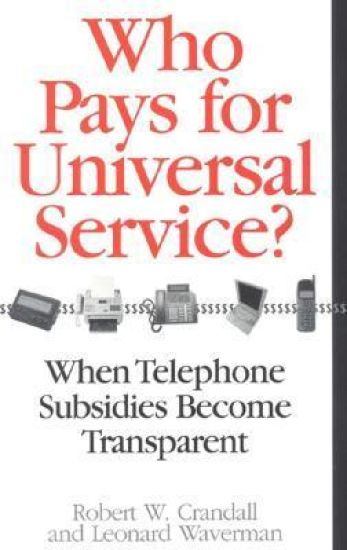
Who Pays for Universal Service? – hinnat ja saatavuus
When Telephone Subsidies Become Transparent
Kirjafiili on kirjojen hintavertailu. Löydä halvin hinta 27 kirjakaupasta. Hintavertailu koskee ISBN-tunnusta 9780815716112 (nidottu).
Kirjan kuvaus
"In virtually every country, the price of residential access to the telephone network is kept low and cross-subsidized by business services, long distance calling, and various other telephone services. This pricing practice is widely… Näytä koko kuvaus Piilota kuvaus
"In virtually every country, the price of residential access to the telephone network is kept low and cross-subsidized by business services, long distance calling, and various other telephone services. This pricing practice is widely defended as necessary to promote ""universal service,"" but Crandall and Waverman show that it has little effect on telephone subscriptions while it has major harmful effects on the value of all telephone service. The higher prices for long distance calls reduce calling, shift the burden of paying for the network to those whose social networks are widely dispersed. Therefore, many poor and rural households--the intended beneficiaries of the pricing strategy--are forced to pay far more for telephone service than they would if prices reflected the cost of service. Despite these burdens, Congress has extended the subsidies to advanced services for schools, libraries, and rural health facilities. Crandall and Waverman show that other regulated utilities are not burdened with similarly inefficient cross-subsidy schemes, yet universality of water, natural gas, and electricity service is achieved. As local telephone service competition develops in the wake of the 1996 Telecommunications Act, the universal-service subsidy system will have to change. Subsidies will have to be paid from taxes on telecom services and paid directly to carriers or subscribers. Crandall and Waverman show that an intrastate tax designed to pay for each state's subsidized subscriptions is far less costly to the economy than an interstate tax. Robert W. Crandall is a senior fellow in Economic Studies at the Brookings Institution. Leonard Waverman is a visiting professor at the London Business School, on leave from the University of Toronto. They are coauthors of Talk Is Cheap: The Promise of Regulatory Reform in North American Telecommunications (Brookings, 1995). "
Kirjan tiedot
Vertaa kirjan ”Who Pays for Universal Service?” hintoja
Vertaa tuotteen hintaa ja arvioitua kokonaishintaa toimitettuna. Kaikki hinnat koskevat ISBN-tunnusta 9780815716112.
Hintoja ei päivitetty automaattisesti. Voit hakea ajantasaiset hinnat painamalla Hae hinnat.

Booky

Suomalainen

Kansallinen Kirjakauppa

Prisma

Finlandia Kirja

Fantasiapelit

Vinhan kirjakauppa

CDON

Kustantamo S&S

Kennys.ie

Kristillinenkirjakauppa.fi
Sacrum

Adlibris

BookOutlet.fi

Kirja.fi

Rosebud
Tälle kirjalle ei ole tällä hetkellä vahvistettua hintaa. Tarkista tilanne myöhemmin uudelleen.
Hintoja ei ole vielä päivitetty.
Hälytys tallennettu!
Ilmoitamme, kun hinta laskee.
Saat sähköpostin, kun hinta laskee asettamaasi rajaan tai sen alle.
Who Pays for Universal Service? – hintahistoria
Seuraamme kirjan Who Pays for Universal Service? hintakehitystä kirjakaupoissa. Taulukosta näet viime kuukausien alimmat hinnat.
Alin hinta kauppoittain
Kunkin kaupan alin hinta viimeisten 90 päivän aikana.
Hintahistoriaa ei ole vielä kerätty tälle kirjalle.
Hinnat ilman toimituskuluja.