Kirjojen hintavertailu – 12 859 828 kirjaa ja 27 kauppaa

Kirjailija

A. C. Graham

Kirjat ja teokset yhdessä paikassa: 3 kirjaa, julkaisuja vuosilta 2003–2018, suosituimpiin kuuluu Poems Of The Late T'ang. Vertaile teosten hintoja ja tarkista saatavuus suomalaisista kirjakaupoista.

Nimi esiintyy myös muodoissa: A.C. Graham

3 kirjaa

Kirjojen julkaisuvuodet: 2003–2018.

Li Shangyin

Li Shangyin

A.C. Graham; Chloe Garcia Roberts; Lucas Klein

The New York Review of Books, Inc
2018
nidottu
A one-of-a-kind collection of work by little-known Late Tang poetic master Li Shangyin. Li Shangyin is one of the foremost poets of the late Tang, but until now he has rarely been translated into English, perhaps because the esotericism and sensuality of his work set him apart from the austere masters of the Chinese literary canon. Li favored allusiveness over directness, and his poems unfurl through mysterious images before coalescing into an emotional whole. Combining hedonistic aestheticism with stark fatalism, Li's poetry is an intoxicating mixture of pleasure and grief, desire and loss, everywhere imbued with a singular nostalgia for the present moment. This pioneering, bilingual edition presents Chloe Garcia Roberts's translations of a wide selection of Li's verse in the company of other versions by the prominent sinologist A. C. Graham and the scholar-poet Lucas Klein.
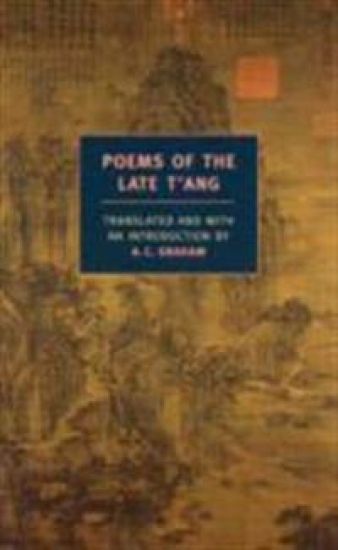
Poems Of The Late T'ang

Poems Of The Late T'ang

A. C. Graham

NYRB Classics
2008
nidottu

Halvin toimitettuna 25,60 €

Classical Chinese poetry reached its pinnacle during the T'ang Dynasty (618-907 A. D.), and the poets of the late T'ang-a period of growing political turmoil and violence-are especially notable for combining strking formal inovation with raw emotional intensity. A. C. Graham's slim but indispensable anthology of late T'ang poetry begins with Tu Fu, commonly recognized as the greatest Chinese poet of all, whose final poems and sequences lament the pains of exile in images of crystalline strangeness. It continues with the work of six other masters, including the "cold poet" Meng Chiao, who wrote of retreat from civilization to the remoteness of the high mountains; the troubled and haunting Li Ho, who, as Graham writes, cultivated a "wholly personal imagery of ghosts, blood, dying animals, weeping statues, whirlwinds, the will-o'-the-wisp"; and the shimmeringly strange poems of illicit love and Taoist initiation of the enigmatic Li Shang-yin. Offering the largest selection of these poets' work available in English in a translation that is a classic in its own right, Poems of the Late T'ang also includes Graham's searching essay "The Translation of Chinese Poetry" as well as helpful notes on each of the poets and on many of the individual poems.
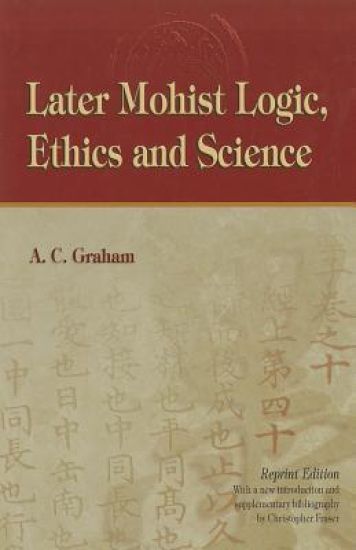
Later Mohist Logic, Ethics, and Science

Later Mohist Logic, Ethics, and Science

A. C. Graham

The Chinese University Press
2003
sidottu
The Canons and other later writings of the school of Mo-tzu, dating from about 300 B. C., contain nearly all that survives of the logic of ancient China, and its optics and mechanics, the only organized set of geometrical definitions, and the only fully rationalized system of ethics. They represent the high point of abstract rationality in traditional Chinese civilization, and are crucial documents for any inquiry into its achievements and limitations in logic and science. Unfortunately their formidable textual difficulties have hitherto made it impossible to use them with any confidence, and English translations of Mo-tzu, have omitted them. Western sinologists have generally ignored this rich material with the result that they have been forced to draw their conclusions about Chinese logic from the almost negligible remains of the Sophists. The present work begins with a general account of the school of Mo-tzu, its social basis as a movement of craftsmen, its isolated place in the Chinese tradition, and the nature of its later contributions to logic, ethics and science. The relation of Mohist thinking to the structure of the Chinese language is also discussed. The textual problems of the later writings, the grammar and style, the technical terminology, the significance of stock examples, and the overall organization of the documents, are then explored in detail. With the investigation of these preliminary questions, the possibilities of interpretation are confined within controllable limits. The edited and annotated Chinese text follows, with an English translation and commentary, a glossary, and a photographic reproduction of the unemended text from the Taoist Patrology.