Kirjojen hintavertailu – 12 903 724 kirjaa ja 27 kauppaa

Kirjailija

A. C. Grayling

Kirjat ja teokset yhdessä paikassa: 52 kirjaa, julkaisuja vuosilta 2001–2026, suosituimpiin kuuluu Russell. Vertaile teosten hintoja ja tarkista saatavuus suomalaisista kirjakaupoista.

Nimi esiintyy myös muodoissa: A.C. Grayling, A C Grayling

52 kirjaa

Kirjojen julkaisuvuodet: 2001–2026.

Truth, Meaning and Realism

Truth, Meaning and Realism

A. C. Grayling

Continuum International Publishing Group Ltd.
2008
nidottu

Halvin toimitettuna 44,00 €

A. C. Grayling focuses on a series of central philosophical concerns in this excellent collection of essays, with each one contributing to the contemporary debates on these matters. A. C. Grayling is one of Britain's leading thinkers, highly regarded as a public philosopher of distinction as well as in academic circles for his scholarly work on Descartes, Berkeley, Russell and Wittgenstein, his writings on the problem of scepticism, his widely used Introduction to Philosophical Logic and (as editor) his two volume "Philosophy" and (as chief editor) the "Continuum Encyclopaedia of British Philosophy". This book serves as an excellent guide to Grayling's main philosophical concerns and shows the intellectual underpinning of much of his more popular work. This volume of selected essays includes his work in the philosophy of language and philosophical logic, with particular focus on truth, judgment and the realism-anti-realism debate. Each essay is intended as a further contribution to previous topics covered and aims to bring them up-to-date. As such, this collection does not aspire to be the last word on a theory, but rather to advance a perspective and add relevant suggestions to understanding them further.
The Reason of Things

The Reason of Things

A.C. Grayling

Weidenfeld Nicolson
2007
pokkari
The follow-up to THE MEANING OF THINGS which continues A. C. Grayling's philosophical journey through lifeThe most important question we can ask ourselves is: what kind of life is the best? This is the same as asking: How does one give meaning to one's life? How can one justify one's existence and make it worthwhile? How does one make experience valuable, and keep growing and learning in the process - and through this learning acquire a degree of understanding of oneself and the world? A civilised society is one which never ceases debating with itself about what human life should best be. Some would, with justice, say that if we want ours to be such a society we must all contribute to that discussion. This book is, with appropriate diffidence, such a contribution. It consists of a collection of Grayling's regular 'Last Word' columns in the Guardian. This time topics include Suicide, Deceit, Luxury, Profit, Marriage, Meat-eating, Liberty, Slavery, Protest, Guns and War.
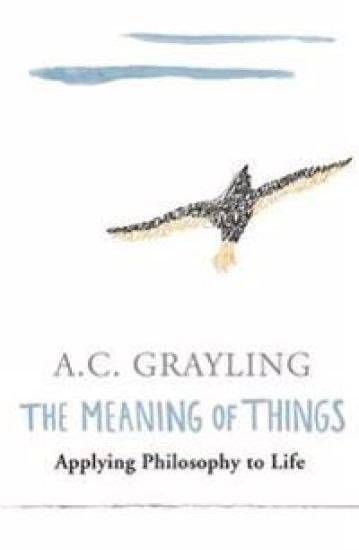
The Meaning of Things

The Meaning of Things

A.C. Grayling

Weidenfeld Nicolson
2007
pokkari

Halvin toimitettuna 18,90 €

A refreshing distillation of insights into the human condition, by one of the best-known and most popular philosophers in the UK. Thinking about life, what it means and what it holds in store does not have to be a despondent experience, but rather can be enlightening and uplifting. A life truly worth living is one that is informed and considered so a degree of philosophical insight into the inevitabilities of the human condition is inherently important and such an approach will help us to deal with real personal dilemmas. This book is an accessible, lively and thought-provoking series of linked commentaries, based on A. C. Grayling's 'The Last Word' column in the GUARDIAN. Its aim is not to persuade readers to accept one particular philosophical point of view or theory, but to help us consider the wonderful range of insights which can be drawn from an immeasurably rich history of philosophical thought. Concepts covered include courage, love, betrayal, ambition, cruelty, wisdom, passion, beauty and death. This will be a wonderfully stimulating read and act as an invaluable guide as to what is truly important in living life, whether facing success, failure, justice, wrong, love, loss or any of the other profound experience life throws out.
Grace

Grace

Mick Gordon; A. C. Grayling

Oberon Books Ltd
2007
nidottu
The astonishing adaptation, by Malcolm McKay, of Max Arthur's bestselling and acclaimed book, "Forgotten Voices", is based on the spoken testimony of veterans of the First World War, collected by the Sound Archive of the Imperial War Museum in 1970. Five ordinary survivors - four men and one woman - movingly reveal their memories, which make up a complete narrative of an awesome war. "Forgotten Voices" will run at the Assembly Theatre, Edinburgh throughout August, before transferring to the Riverside, London.
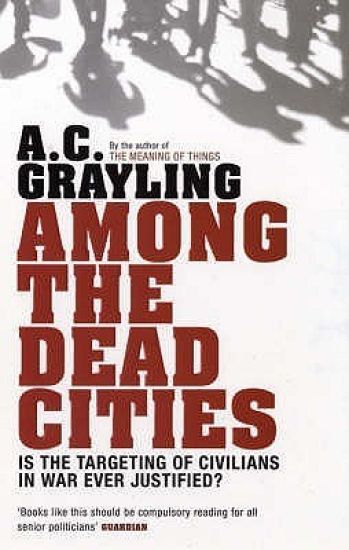
Among the Dead Cities

Among the Dead Cities

A. C. Grayling

Bloomsbury Publishing PLC
2007
nidottu
Britain and the USA carried out a massive bombing offensive against the cities of Germany and Japan in the course of the Second World War, which ended with the destruction of Hamburg, Dresden, Tokyo, Hiroshima and Nagasaki. Was the bombing of civilian targets justified by the necessities of war? Or was it, in fact, a crime against humanity? How should we, the descendants of the Allies who won the victory in that war, reply to the moral challenge of the descendants of those whose cities were targeted? A. C. Grayling looks at the stands people took, both for and against, and crucially asks what the lessons are that we can learn for today about how people should behave in a world of tension and moral confusion, of terrorism and fragile democracies. "Among the Dead Cities" is both a lucid and revealing work of modern history and an investigation of conscience into one of the last remaining controversies of that time.
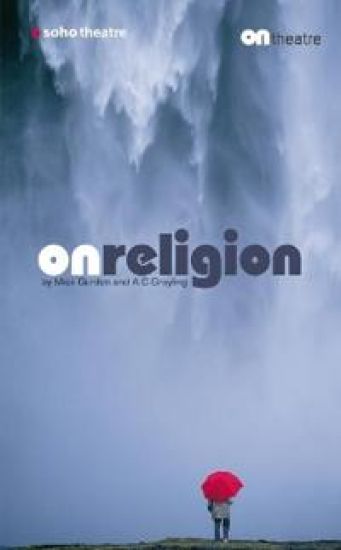
On Religion

On Religion

A. C. Grayling

Oberon Books Ltd
2006
nidottu
This book provides an exploration of the most controversial subject of the moment. 'Moralities to please invisible gods. Promises of heavens and hells to come. Passionate beliefs in the metaphysics of martyrdom. Well it's absurd. All of it. All of it. It's absurd, it's dangerous and it's wrong. A betrayal of human knowledge. A betrayal of human capacity. And yet, and yet and yet...here stand I, broken and cracked, reduced to this, this raging, raging, raging. This raging at an empty sky.' In this time of fundamentalists and fundamentalisms, "On Religion" is a considered contemplation on the complex issues of faith and religion. Following on from the huge success of "On Ego", Soho Theatre brings back Mick Gordon, in collaboration with acclaimed philosopher AC Grayling, to present an intensely stimulating and moving new play. "On Religion" opens at the Soho Theatre in November 2006.
The Heart of Things

The Heart of Things

A.C. Grayling

Weidenfeld Nicolson
2006
pokkari
The new bestseller from one of Britain's most pre-eminent philosophers and arguably the best known, A. C. GraylingEveryone wishes to live a life that is satisfying and fulfilling, in which there is achievement and pleasure, and which has the respect of people one, in turn, respects. And one of the fundamentals to living such a life is to reflect on the choices we make. In this new collection, A. C. Grayling invites the reader into a conversation with ideas. From personal questions about happiness and quality of life to wider public concerns such as war and democracy, these essays provide a springboard to thought and to exploring what is best about the human heart and mind.
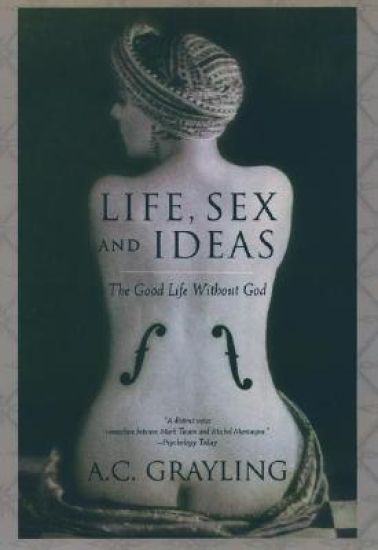
Life, Sex and Ideas: The Good Life Without God

Life, Sex and Ideas: The Good Life Without God

A. C. Grayling

Oxford University Press
2004
nidottu
"A distinctive voice somewhere between Mark Twain and Michel Montaigne" is how Psychology Today described A. C. Grayling. In Life, Sex, and Ideas: The Good Life Without God, readers have the pleasure of hearing this distinctive voice address some of the most serious topics in philosophy--and in our daily lives--including reflections on guns, anger, conflict, war; monsters, madness, decay; liberty, justice, utopia; suicide, loss, and remembrance. A civilized society, says Grayling, is one which never ceases having a discussion with itself about what human life should best be. In this book, Grayling adds to this discussion a series of short informal essays about ethics, ideas, and culture. A recurring theme is religion, of which he writes "there is no greater social evil." He argues, for instance, that liberal education is better than religion for inculcating moral values. "Education in literature, history, and appreciation of the arts," he says, "opens the possibility for us to live more reflectively and knowledgeably, especially about the nature and variety of human experience. That in turn increases our capacity for understanding others better, so that we can treat them with respect and sympathy, however different their outlook on life." Thought provoking rather than definitive, these essays don't tell readers what to think, but only note what has been thought about how it is best to live. A person who does not think about life, the author reminds us, is like a stranger mapless in a foreign land. These brief and suggestive essays offer us the outlines of a map, with avenues of thought that are a pleasure to wander down.
Meditations for the Humanist: Ethics for a Secular Age

Meditations for the Humanist: Ethics for a Secular Age

A. C. Grayling

Oxford University Press
2003
nidottu
"Magnanimity is in short supply," writes A. C. Grayling is this wonderfully incisive book, "but it is the main ingredient in everything that makes the world a better place" And indeed Meditations for the Humanist: Ethics for a Secular Age is itself a generous, insightful, wide-ranging, magnanimous inquiry into the philosophical and ethical questions that bear most strongly on the human condition. Containing nearly fifty linked commentaries on topics ranging from love, lying, perseverance, revenge, racism, religion, history, loyalty, health, and leisure, Meditations for the Humanist does not offer definitive statements but rather prompts to reflection. These brief essays serve as springboards to the kind of thoughtful examination without which, as Socrates famously claimed, life is not worth living. As Graying notes in his introduction, "It is not necessary to arrive at polished theories on all these subjects, but it is necessary to give them at least a modicum of thought if one's life is to have some degree of shape and direction." The book is divided into three sections-Virtues and Attributes, Foes and Fallacies, and Amenities and Goods-and within these sections essays are grouped into related clusters. But each piece can be read alone and each is characterized by brevity, wit, and a liveliness of mind that recalls the best of Montaigne and Samuel Johnson. Grayling's own perspective on these subjects is broadened and deepened by liberal quotations from Sophocles and Shakespeare to Byron, Twain, Proust, Simone de Beauvoir, Martin Luther King, Jr., and many others. For those wishing to explore ethical issues outside the framework of organized religious belief, Meditations for the Humanist offers an inviting map to the country of philosophical reflection.
Life, Sex, and Ideas: The Good Life Without God

Life, Sex, and Ideas: The Good Life Without God

A. C. Grayling

Oxford University Press
2003
sidottu
"A distinctive voice somewhere between Mark Twain and Michel Montaigne" is how Psychology Today described A. C. Grayling. In Life, Sex, and Ideas: The Good Life Without God, readers have the pleasure of hearing this distinctive voice address some of the most serious topics in philosophy--and in our daily lives--including reflections on guns, anger, conflict, war; monsters, madness, decay; liberty, justice, utopia; suicide, loss, and remembrance. A civilized society, says Grayling, is one which never ceases having a discussion with itself about what human life should best be. In this book, Grayling adds to this discussion a series of short informal essays about ethics, ideas, and culture. A recurring theme is religion, of which he writes "there is no greater social evil." He argues, for instance, that liberal education is better than religion for inculcating moral values. "Education in literature, history, and appreciation of the arts," he says, "opens the possibility for us to live more reflectively and knowledgeably, especially about the nature and variety of human experience. That in turn increases our capacity for understanding others better, so that we can treat them with respect and sympathy, however different their outlook on life." Thought provoking rather than definitive, these essays don't tell readers what to think, but only note what has been thought about how it is best to live. A person who does not think about life, the author reminds us, is like a stranger mapless in a foreign land. These brief and suggestive essays offer us the outlines of a map, with avenues of thought that are a pleasure to wander down.
Wittgenstein

Wittgenstein

A. C. Grayling

Oxford University Press
2001
nidottu

Halvin toimitettuna 18,90 €

Ludwig Wittgenstein (1889-1951) was an extraordinarily original philospher, whose influence on twentieth-century thinking goes well beyond philosophy itself. In this book, which aims to make Wittgenstein's thought accessible to the general non-specialist reader, A. C. Grayling explains the nature and impact of Wittgenstein's views. He describes both his early and later philosophy, the differences and connections between them, and gives a fresh assessment of Wittgenstein's continuing influence on contemporary thought. ABOUT THE SERIES: The Very Short Introductions series from Oxford University Press contains hundreds of titles in almost every subject area. These pocket-sized books are the perfect way to get ahead in a new subject quickly. Our expert authors combine facts, analysis, perspective, new ideas, and enthusiasm to make interesting and challenging topics highly readable.