Kirjojen hintavertailu – 12 859 829 kirjaa ja 27 kauppaa

Kirjailija

A. Saravanan

Kirjat ja teokset yhdessä paikassa: 64 kirjaa, julkaisuja vuosilta 2013–2026, suosituimpiin kuuluu La Croissance Inclusive Et l'Innovation. Vertaile teosten hintoja ja tarkista saatavuus suomalaisista kirjakaupoista.

Nimi esiintyy myös muodoissa: A Saravanan

64 kirjaa

Kirjojen julkaisuvuodet: 2013–2026.

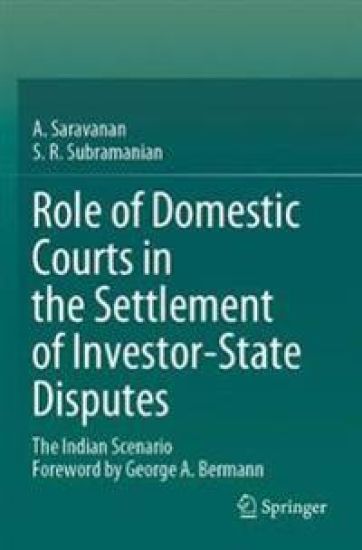
Role of Domestic Courts in the Settlement of Investor-State Disputes

Role of Domestic Courts in the Settlement of Investor-State Disputes

A. Saravanan; S.R. Subramanian

SPRINGER VERLAG, SINGAPORE
2021
nidottu
This book addresses the interactions between the domestic courts and the international investment arbitral tribunals, one of the most pressing issues confronting both domestic legal systems and the international legal system. It deals with the core issues inherent in the above interactions, especially with regard to countries outside the ICSID system. It contrasts this narrative with the position under classical international investment law, where national courts are assigned a very specific and minimalistic role in the process of investment disputes settlement. For this purpose, the book chooses India, which follows the non-ICSID model, as the major point of focus and considers both domestic judicial decisions and investment arbitral decisions for critical analysis. The ICSID Convention grants limited powers to domestic courts to issue provisional measures and to enforce ICSID awards. As the central theme of the book lies at the intersection of domestic law and international law, the work is indispensable for any scholar working in the areas of general international law, international investment law, international economic law, law and economics, international dispute settlement, or international law in domestic courts, as well as domestic judges and international arbitrators. Further, as the subject matter has great implications for both domestic and global governance, it will benefit civil servants, opinion leaders, policy planners and subject experts in economics, the political economy and regional studies, to name a few. Excerpt from the Foreword:“One of the great merits of this book is that... It looks at bilateral investment treaties themselves to probe more deeply into the role of national courts in investment arbitration... This masterful book fills a major void as a resource in Indian international arbitration law. But is also the prototype of what any serious inquiry into the judicial role in investor-State arbitration in any jurisdiction should look like…”- George A. Bermann, Walter Gellhorn Professor of Law and Jean Monnet Professor of European Union Law, Columbia Law School, USA
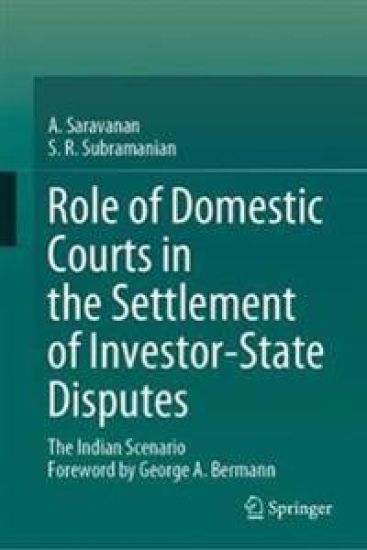
Role of Domestic Courts in the Settlement of Investor-State Disputes

Role of Domestic Courts in the Settlement of Investor-State Disputes

A. Saravanan; S.R. Subramanian

Springer Verlag, Singapore
2020
sidottu
This book addresses the interactions between the domestic courts and the international investment arbitral tribunals, one of the most pressing issues confronting both domestic legal systems and the international legal system. It deals with the core issues inherent in the above interactions, especially with regard to countries outside the ICSID system. It contrasts this narrative with the position under classical international investment law, where national courts are assigned a very specific and minimalistic role in the process of investment disputes settlement. For this purpose, the book chooses India, which follows the non-ICSID model, as the major point of focus and considers both domestic judicial decisions and investment arbitral decisions for critical analysis. The ICSID Convention grants limited powers to domestic courts to issue provisional measures and to enforce ICSID awards. As the central theme of the book lies at the intersection of domestic law and international law, the work is indispensable for any scholar working in the areas of general international law, international investment law, international economic law, law and economics, international dispute settlement, or international law in domestic courts, as well as domestic judges and international arbitrators. Further, as the subject matter has great implications for both domestic and global governance, it will benefit civil servants, opinion leaders, policy planners and subject experts in economics, the political economy and regional studies, to name a few. Excerpt from the Foreword:“One of the great merits of this book is that... It looks at bilateral investment treaties themselves to probe more deeply into the role of national courts in investment arbitration... This masterful book fills a major void as a resource in Indian international arbitration law. But is also the prototype of what any serious inquiry into the judicial role in investor-State arbitration in any jurisdiction should look like…”- George A. Bermann, Walter Gellhorn Professor of Law and Jean Monnet Professor of European Union Law, Columbia Law School, USA

Scientific Utilization of Treated Distillery Effluent on Sugarcane

Scientific Utilization of Treated Distillery Effluent on Sugarcane

S Previna; A Saravanan; K Sivagamy

Scholars' Press
2013
pokkari
Sugarcane producing countries running sugar industries and apart from the sugar and alcohol, these factories generate many by-products and waste materials like solid waste (press mud), molasses and bagasse. The effluent in distillery industry plays a prime role in bridging the gap between the depletion and repletion by its inherent potential of high organic carbon and nutrient contents. Although the distillery effluent utilization in agriculture has augmented the crop yields, its unscientific and unsystematic use causes degradation of land and the environment. To harmless its full manurial potential, there is a recommendation of one time land application and distillery effluent through irrigation water as a source of plant nutrients for sugarcane crop and also to sustain the soil health. Thus, wherever there is uncontrolled discharge of distillery effluent, the environment is aesthetically unpleasant. Scientific utilization of distillery effluent in agriculture would save costs on fertilizers and facilitate reduction in pollution load on the environment and also improve the overall soil health.