Kirjojen hintavertailu – 12 903 724 kirjaa ja 27 kauppaa
Kirjailija
Aaron James
Kirjat ja teokset yhdessä paikassa: 10 kirjaa, julkaisuja vuosilta 2013–2024, suosituimpiin kuuluu Differential Diagnoses in Surgical Pathology: Soft Tissue and Bone. Vertaile teosten hintoja ja tarkista saatavuus suomalaisista kirjakaupoista.
New in the Differential Diagnosis in Surgical Pathology series, this abundantly illustrated title helps you systematically solve tough diagnostic challenges in soft tissue and bone pathology. It uses select images of clinical and pathological findings, together with succinct, expert instructions and diagnostic pearls, to guide you through the decision-making process by distinguishing between commonly confused lesions of soft tissue and bone. By presenting material according to the way pathologists actually work, this user-friendly volume helps you quickly differentiate entities that have overlapping morphologic features. Presents over 130 differential diagnoses in soft tissue and bone pathology, including the most common entities as well as selected rare diseases. Provides concise, bulleted summaries of clinical and pathological findings and relevant pictorial examples on the corresponding pages. Expertly guides you in using hematoxylin and eosin-stained sections as a tool to better evaluate small samples, precisely guiding ancillary testing, and using radiologic clues for diagnosis of bone lesions. Features over 1,300 high-quality, full-color images of similar-looking lesions side by side for easy comparison with respect to clinicopathologic features and ancillary tests. Includes sections on soft tissue (Spindle Cell, Adipose Tissue, Myxoid, Epithelioid, Vasoformative, Pleomorphic, and Round Cell) along with those in bone (Osteoblastic, Cartilage, Fibroosseous, Fibrous, Giant cell, Round Cell, Vascular, Cystic, Pleomorphic, Notochordal Tumors, and Synovial). Ideal for practicing pathologists, pathologists in training, residents, and medical students. Enrich Your Ebook Reading ExperienceRead directly on your preferred device(s),such as computer, tablet, or smartphone. Easily convert to audiobook,powering your content with natural language text-to-speech.

From bestselling author Aaron James and Alexandria Ocasio-Cortez's economic advisor Bob Hockett comes a probing exploration of what the dollar really is (even some economists misunderstand or ignore it) and how its power can be harnessed to create the shared prosperity that has always been the great promise of American democracy. After fifty years of stagnating wages and the ever-growing gap between the rich and the rest of us, many Americans believe that their government and their society have broken faith with them. Hockett and James aim to repair and renew our fraying social contract by showing how money itself can restore shared prosperity and protect democracy against the rising tide of authoritarianism. To address these problems, MONEY FROM NOTHING lays out a new vision of money and public finance, without the wonky policy arguments that make even the educated reader's eyes glaze over. Most importantly, the bold plan laid out here--which includes the Federal Reserve putting real money directly into the bank account of each and every citizen--avoids the pitfalls of unwanted taxes, added regulation, and increased inflation.
Leif Wenar’s 2016 book Blood Oil: Tyrants, Violence, and the Rules that Run the World argues that much of the conflict, suffering, and injustice in the world is driven by an archaic rule in global trade that forces consumers to fund oppression and corruption. This oil curse is a major threat to global peace and stability. Wenar sets out Clean Trade policies to lift the oil curse through national legislation that affirms democratic principles. In Beyond Blood Oil, Wenar summarizes and extends his views, setting the stage for five essays from first-class critics from the fields of political theory, philosophy, and energy politics. Wenar replies vigorously and frankly to the critics, making the volume the scene of a highly energetic debate that will benefit all scholars, students, and global citizens interested in global justice, international security, oil politics, fair trade, climate change, and progressive reforms.
Jean-Paul Sartre once declared waterskiing to be "the ideal limit of aquatic sports." Aaron James, who is both an avid surfer and a professor of philosophy, vigorously disagrees. In these pages, he presents his surfer's worldview as a foil to Sartre's, along the way elucidating such philosophical categories as freedom, being, phenomenology, morality, epistemology, and even the emerging values of what he terms "leisure capitalism." In developing his unique surfer's philosophy, he draws from surf culture and lingo--and engages with philosophers from Aristotle to Wittgenstein. In the process, he speaks to those of us in search of personal and social meaning--particularly in our current anxious moment--by way of real, authentic philosophy. In or out of the water.
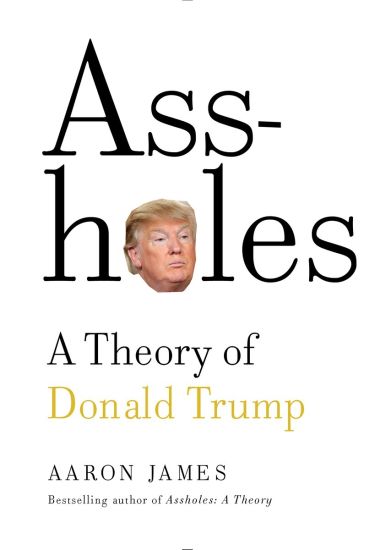
That Donald Trump is an asshole is a fact widely agreed upon even by his supporters, who actually like that about him. But his startling political rise makes the question of just what sort of asshole he is, and how his assholedom may help to explain his success, one not just of philosophical interest but of almost existential urgency. Enter the philosopher Aaron James, author of the foundational text in the burgeoning field of Asshole Studies: the bestselling Assholes: A Theory. In this brisk and trenchant inquiry into the phenomenon that is Donald Trump, James places the man firmly in the typology of the asshole (takes every advantage, entrenched sense of entitlement, immune to criticism); considers whether, in the Hobbesian world we seem to inhabit, he might not somehow be a force for good i.e., the Stronger Asshole; and offers a suggestion for how the bonds of our social contract, spectacularly broken by Trump s (and Ted Cruz s) disdain for democratic civility, might in time be repaired. You will never think about Donald Trump the same way after reading this book. And, like it or not, think about him we must.
What does it mean for someone to be an asshole? The answer is not obvious, despite the fact that we are often stuck dealing with people for whom there is no better name. We try to avoid them, but assholes are everywhereat work, at home, on the road, in the public sphereand we struggle to comprehend why exactly someone should be acting like that. Asshole management begins with asshole understanding. Finally giving us the concepts to discern why assholes disturb us so, philosopher Aaron James presents a provocative theory of the asshole to explain why such people exist, especially in an age of raging narcissism and unbridled capitalism. We get a better sense of when the asshole is best resisted and best ignoreda better sense of what is, and what is not, worth fighting for.
'A wonderful book. If you come across it, you must read it.' - John CleeseWhat does it mean for someone to be an a**hole? The answer is not obvious, despite the fact that we are often personally stuck dealing with people for whom there is no better name. Try as we might to avoid them, a**holes are found everywhere at work, at home, on the road, and in the public sphere. Encountering one causes great difficulty and personal strain, especially because we often cannot understand why exactly someone should be acting like that. A**hole management begins with a**hole understanding. In the spirit of the bestselling On Bullshit, James gives us the concepts to think or say why a**holes disturb us so, and explains why such people seem part of the human social condition, especially in an age of raging narcissism and unbridled capitalism. These concepts are also practically useful, as understanding the a**hole we are stuck with helps us think constructively about how to handle problems they present. We get a better sense of when the a**hole is best resisted, and when he is best ignored a better sense of what is, and what is not, worth fighting for.
If the global economy seems unfair, how should we understand what a fair global economy would be? What ideas of fairness, if any, apply, and what significance do they have for policy and law? Working within the social contract tradition, this book argues that fairness is best seen as a kind of equity in practice. The global economy as we know it is organized by an international social practice in which countries mutually rely upon common markets. This practice generates shared responsibilities of "structural equity," independently of humanitarian, human rights, or other justice concerns, for how benefits and burdens are distributed across different societies and their social classes. Equity in the practice of trade requires not only compensation of people harmed by their exposure to global economic forces, but also equal division of the "gains of trade," across and within societies, unless still greater gains flow to developing countries. Fairness therefore calls for strong social insurance schemes, international capital controls, policy flexibility for developing countries, and more-all as the "fair price" of free trade.