
Kirjojen hintavertailu – 12 903 724 kirjaa ja 27 kauppaa

Kirjailija

Aaron Shapiro

Kirjat ja teokset yhdessä paikassa: 6 kirjaa, julkaisuja vuosilta 2011–2020, suosituimpiin kuuluu Users Not Customers. Vertaile teosten hintoja ja tarkista saatavuus suomalaisista kirjakaupoista.

6 kirjaa

Kirjojen julkaisuvuodet: 2011–2020.

Design, Control, Predict

Design, Control, Predict

Aaron Shapiro

University of Minnesota Press
2020
nidottu
An in-depth look at life in the “smart” city Technology has fundamentally transformed urban life. But today’s “smart” cities look little like what experts had predicted. Aaron Shapiro shows us the true face of the revolution in urban technology, taking the reader on a tour of today’s smart city. Along the way, he develops a new lens for interpreting urban technologies-logistical governance-to critique an urban future based on extraction and rationalization. Through ethnographic research, journalistic interviews, and his own hands-on experience, Shapiro helps us peer through cracks in the smart city’s facade. He investigates the true price New Yorkers pay for “free,” ad-funded WiFi, finding that it ultimately serves the ends of commercial media. He also builds on his experience as a bike courier for a food delivery startup to examine how promises of “flexible employment” in the gig economy in fact pave the way for strict managerial control. And he turns his eye toward hot-button debates around police violence and new patrol technologies, asking whether algorithms are really the answer to reforming our cities’ ongoing crises of criminal justice. Through these gripping accounts of the new technological urbanism, Design, Control, Predict makes vital contributions to conversations around data privacy and algorithmic governance. Shapiro brings much-needed empirical research to a field that has often relied on “10,000-foot views.” Timely, important, and expertly researched, Design, Control, Predict doesn’t just help us comprehend urbanism today-it advances strategies for critiquing and resisting a dystopian future that can seem inevitable.

Design, Control, Predict

Design, Control, Predict

Aaron Shapiro

University of Minnesota Press
2020
sidottu
An in-depth look at life in the “smart” city Technology has fundamentally transformed urban life. But today’s “smart” cities look little like what experts had predicted. Aaron Shapiro shows us the true face of the revolution in urban technology, taking the reader on a tour of today’s smart city. Along the way, he develops a new lens for interpreting urban technologies-logistical governance-to critique an urban future based on extraction and rationalization. Through ethnographic research, journalistic interviews, and his own hands-on experience, Shapiro helps us peer through cracks in the smart city’s facade. He investigates the true price New Yorkers pay for “free,” ad-funded WiFi, finding that it ultimately serves the ends of commercial media. He also builds on his experience as a bike courier for a food delivery startup to examine how promises of “flexible employment” in the gig economy in fact pave the way for strict managerial control. And he turns his eye toward hot-button debates around police violence and new patrol technologies, asking whether algorithms are really the answer to reforming our cities’ ongoing crises of criminal justice. Through these gripping accounts of the new technological urbanism, Design, Control, Predict makes vital contributions to conversations around data privacy and algorithmic governance. Shapiro brings much-needed empirical research to a field that has often relied on “10,000-foot views.” Timely, important, and expertly researched, Design, Control, Predict doesn’t just help us comprehend urbanism today-it advances strategies for critiquing and resisting a dystopian future that can seem inevitable.
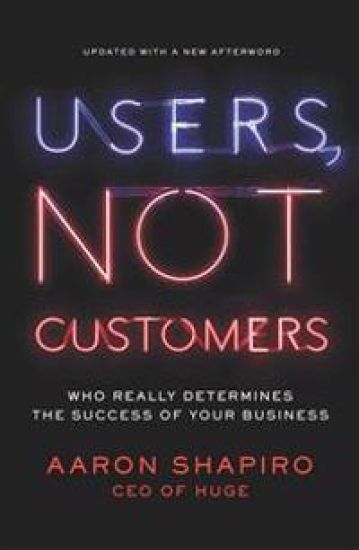
Users, Not Customers: Who Really Determines the Success of Your Business
If you still think "the customer is king," you're falling behind. Today's most powerful growth engine is users--people who interact with a company through digital media and technology even if they have never spent a dime. Become indispensable to users and the profits will follow. As CEO of the digital marketing agency HUGE, Aaron Shapiro goes inside blue-chip companies to advise them on how to thrive in this new business reality. He led an extensive study of the Fortune 1000 and found that the most successful companies focus on users first. Look at Facebook and Google. They built their businesses before they even figured out what they were selling, let alone who their customers were. Shapiro argues that every business needs to stop obsessing about customers and start creating powerful user experiences. For instance: Mint.com made the easiest and most effective interface for controlling your personal finances, and once there, you can follow ads that let you improve your financial performance even more. And Net_ ix took down Blockbuster by treating its subscribers as users, not customers. It continually changed and improved its technology to create the best possible experience instead of maximizing rental fees and late fees.
The Lure of the North Woods

The Lure of the North Woods

Aaron Shapiro

University of Minnesota Press
2013
nidottu
In the late nineteenth century, the North Woods offered people little in the way of a pleasant escape. Rather, it was a hub of production supplying industrial America with vast quantities of lumber and mineral ore. This book tells the story of how northern Minnesota, northern Wisconsin, and Michigan’s Upper Peninsula became a tourist paradise, turning a scarred countryside into the playground we know today. Stripped of much of its timber and ore by the early 1900s, the North Woods experienced deindustrialization earlier than the Rust Belt cities that consumed its resources. In The Lure of the North Woods, Aaron Shapiro describes how residents and visitors reshaped the region from a landscape of exploitation to a vacationland. The rejuvenating North Woods profited in new ways by drawing on emerging connections between the urban and the rural, including improved transportation, promotion, recreational land use, and conservation initiatives. Shapiro demonstrates how this transformation helps explain the interwar origins of modern American environmentalism, when both the consumption of nature for pleasure and the work of the Civilian Conservation Corps in the North Woods and elsewhere led many Americans to cultivate a fresh perspective on the outdoors. At a time when travel and recreation are considered major economic forces, The Lure of the North Woods reveals how leisure-and tourism in particular-has shaped modern America.
Writing—The Sacred Art

Writing—The Sacred Art

Rami Shapiro; Aaron Shapiro

Skylight Paths Publishing
2012
sidottu
Push your writing through the trite and the boring to something fresh, something transformative. "Writing as spiritual practice has nothing to do with readers per se. You aren't writing to be read; you are writing to be freed. Writing as spiritual practice is conspiratorial rather than inspirational. It conspires to strip away everything you use to maintain the illusion of certainty, security and self-identity. Where spiritual writing seeks to bind you all the more tightly to the self you imagine yourself to be, writing as spiritual practice intends to free you from it." —from Rami’s Preface This isn’t about how to write spiritual books. It isn’t about the romance of writing. It doesn’t cover the ins and outs of publishing and building a brand. Instead, this fresh and unapologetic guide to writing as a spiritual practice approaches writing as a way to turn the spiral of body, heart, mind, soul and spirit that leads to spiritual awakening. Lead by renowned spirituality teacher Rami Shapiro and award-winning writer and writing coach Aaron Shapiro—and featuring over fifty unique, practical exercises—it takes you beyond assigning inspirational words to the page. It shows you how to use your writing to unlock the joy of life and the infinite perspectives and possibilities that living provides.
Users Not Customers

Users Not Customers

Aaron Shapiro

Portfolio Penguin
2011
pokkari
Boardroom conversations are adapting to a new and brutal reality; there is no such thing as an offline business. And if you don't embrace digital, you'll be out of business altogether. Blockbuster, AOL, Yahoo and Borders were all unstoppable, but they didn't see the new economic order coming. Google, Facebook, Groupon and Twitter barely existed at the turn of the millennium, but are now rocketing ahead. Aaron Shapiro is CEO of HUGE, the leading digital agency which builds and operates websites that handle 150 million users a month and bring in $1.2 billion annually for their clients. That's the GDP of a small country. He thinks constantly about the most pressing issue in business today: how can businesses can use digital to thrive? Shapiro has studied what the businesses succeeding today have in common, and in Users, Not Customers, he teaches us to recognise that it's not just customers who interact with the digital version of our organisations. The businesses who are now roaring ahead put the interests and the digital experience of all of their users - employees, business partners, media and anyone else who interacts with you through digital channels - ahead of everything else, including their paying customers. In a world were we are all users you have a choice: you can be sure that people are using your digital ecosystem, or you can be irrelevant.