Kirjojen hintavertailu – 12 903 725 kirjaa ja 27 kauppaa

Kirjailija

Aaron Wildavsky

Kirjat ja teokset yhdessä paikassa: 25 kirjaa, julkaisuja vuosilta 1981–2023, suosituimpiin kuuluu Presidential Elections. Vertaile teosten hintoja ja tarkista saatavuus suomalaisista kirjakaupoista.

25 kirjaa

Kirjojen julkaisuvuodet: 1981–2023.

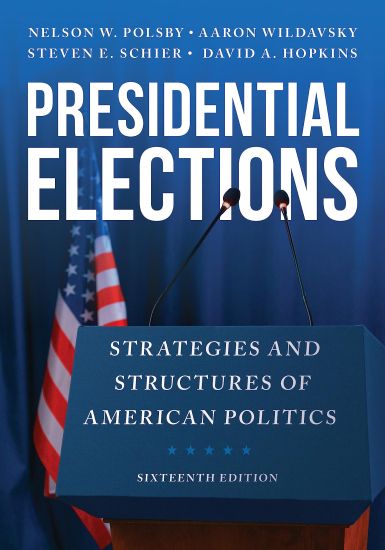
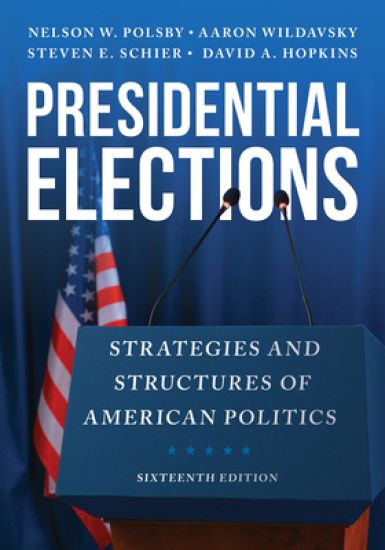
Presidential Elections

Presidential Elections

Nelson W. Polsby; Aaron Wildavsky; Steven E. Schier; David A. Hopkins

BLOOMSBURY PUBLISHING PLC
2023
sidottu
Polsby and Wildavsky’s classic text, now updated by Stephen Schier and David Hopkins, argues that the institutional rules of the presidential nomination and election processes, in combination with the behavior of the mass electorate, structure the strategic choices faced by politicians in powerful and foreseeable ways. We can make sense of the decisions made by different political actors—incumbents, challengers, Democrats, Republicans, consultants, party officials, activists, delegates, journalists, and voters—by understanding the ways in which their world is organized by incentives, regulations, events, resources, customs, and opportunities. Thoroughly revised and updated, this Sixteenth Edition provides everything students need to know about presidential elections going into the 2024 cycle.
Presidential Elections

Presidential Elections

Nelson W. Polsby; Aaron Wildavsky; Steven E. Schier; David A. Hopkins

BLOOMSBURY PUBLISHING PLC
2023
nidottu
Polsby and Wildavsky’s classic text, now updated by Stephen Schier and David Hopkins, argues that the institutional rules of the presidential nomination and election processes, in combination with the behavior of the mass electorate, structure the strategic choices faced by politicians in powerful and foreseeable ways. We can make sense of the decisions made by different political actors—incumbents, challengers, Democrats, Republicans, consultants, party officials, activists, delegates, journalists, and voters—by understanding the ways in which their world is organized by incentives, regulations, events, resources, customs, and opportunities. Thoroughly revised and updated, this Sixteenth Edition provides everything students need to know about presidential elections going into the 2024 cycle.
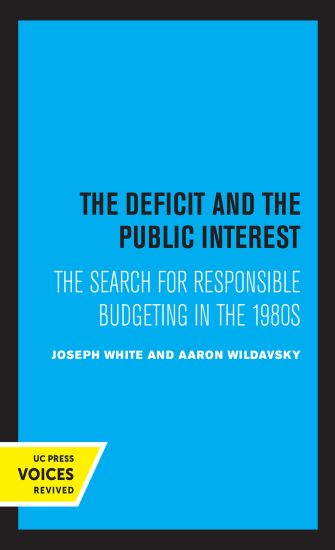
The Deficit and the Public Interest

The Deficit and the Public Interest

Joseph White; Aaron Wildavsky

University of California Press
2021
sidottu
Political time is counted not in years, but in issues—the Depression defined the political era of the 1930s just as the Cold War did the 1950s and civil rights the 1960s. In the 1980s, the federal budget loomed as the dominant issue by which all others were considered and has become a concern that catalyzes debate in our nation's capital. In this definitive work, Joseph White and Aaron Wildavsky describe and analyze the struggles over taxing and spending from Carter's last year through the Reagan administration. The battle of the budget is largely about defining the role of the government and its relationship to the people. It involves congressional horse-trading, partisan posturing, and technical tricks that affect billions of dollars. It is also a story of politicians operating within constraints set by both public opinion and political interpretation of economic reality. Though budgeting has always been important, its impact on the national agenda has grown dramatically. Based on documentary sources and extensive interviews with participants, The Deficit and the Public Interest explains how budgeting works so the reader can see what is at stake in seemingly arcane disputes. It also explains the relationship of the budget to the media as well as to party and policy activists and explores the ways in which the deficit represents a crisis of confidence in our institutions, preeminently Congress and the presidency. Along the way, it provides a uniquely comprehensive account of the entire budget problem, exploring Gramm-Rudman, tax reform, and the continuing political gridlock. The authors demonstrate that institutions have performed better than their members and critics believe, and they contend that extreme solutions to the deficit would likely be much worse than the original problems. Redefining the problem as one of reducing interest costs so the deficit becomes manageable, they proffer political advice on how to make this approach politically acceptable, both at home and abroad. This title is part of UC Press's Voices Revived program, which commemorates University of California Press’s mission to seek out and cultivate the brightest minds and give them voice, reach, and impact. Drawing on a backlist dating to 1893, Voices Revived makes high-quality, peer-reviewed scholarship accessible once again using print-on-demand technology. This title was originally published in 1989.
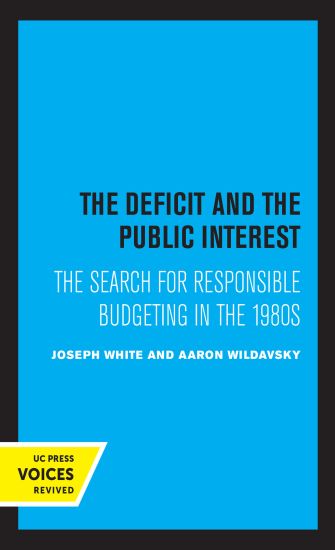
The Deficit and the Public Interest

The Deficit and the Public Interest

Joseph White; Aaron Wildavsky

University of California Press
2021
pokkari
Political time is counted not in years, but in issues—the Depression defined the political era of the 1930s just as the Cold War did the 1950s and civil rights the 1960s. In the 1980s, the federal budget loomed as the dominant issue by which all others were considered and has become a concern that catalyzes debate in our nation's capital. In this definitive work, Joseph White and Aaron Wildavsky describe and analyze the struggles over taxing and spending from Carter's last year through the Reagan administration. The battle of the budget is largely about defining the role of the government and its relationship to the people. It involves congressional horse-trading, partisan posturing, and technical tricks that affect billions of dollars. It is also a story of politicians operating within constraints set by both public opinion and political interpretation of economic reality. Though budgeting has always been important, its impact on the national agenda has grown dramatically. Based on documentary sources and extensive interviews with participants, The Deficit and the Public Interest explains how budgeting works so the reader can see what is at stake in seemingly arcane disputes. It also explains the relationship of the budget to the media as well as to party and policy activists and explores the ways in which the deficit represents a crisis of confidence in our institutions, preeminently Congress and the presidency. Along the way, it provides a uniquely comprehensive account of the entire budget problem, exploring Gramm-Rudman, tax reform, and the continuing political gridlock. The authors demonstrate that institutions have performed better than their members and critics believe, and they contend that extreme solutions to the deficit would likely be much worse than the original problems. Redefining the problem as one of reducing interest costs so the deficit becomes manageable, they proffer political advice on how to make this approach politically acceptable, both at home and abroad. This title is part of UC Press's Voices Revived program, which commemorates University of California Press’s mission to seek out and cultivate the brightest minds and give them voice, reach, and impact. Drawing on a backlist dating to 1893, Voices Revived makes high-quality, peer-reviewed scholarship accessible once again using print-on-demand technology. This title was originally published in 1989.
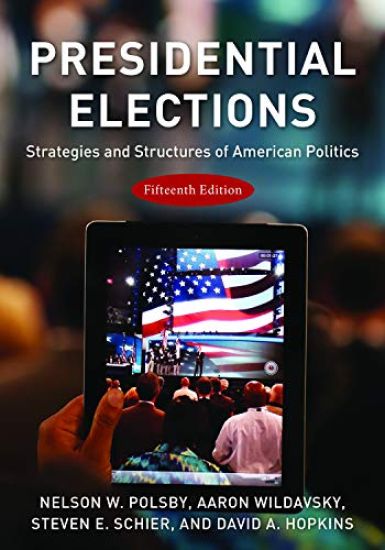
Presidential Elections

Presidential Elections

Nelson W. Polsby; Aaron Wildavsky; Steven E. Schier; David A. Hopkins

Rowman Littlefield
2019
nidottu
Polsby and Wildavsky’s classic text argues that the institutional rules of the presidential nomination and election processes, in combination with the behavior of the mass electorate, structure the strategic choices faced by politicians in powerful and foreseeable ways. We can make sense of the decisions made by differently situated political actors—incumbents, challengers, Democrats, Republicans, consultants, party official, activists, delegates, journalists, and voters—by understanding the ways in which their world is organized by incentives, regulations, events, resources, customs, and opportunities.
Cultural Theory

Cultural Theory

Michael Thompson; Richard J Ellis; Aaron Wildavsky; Mary Wildavsky

Routledge
2019
sidottu
Why do people want what they want? Why does one person see the world as a place to control, while another feels controlled by the world? A useful theory of culture, the authors contend, should start with these questions, and the answers, given different historical conditions, should apply equally well to people of all times, places, and walks of li
Searching for Safety

Searching for Safety

Aaron Wildavsky

Routledge
2018
sidottu
Protecting ourselves against the risks associated with modern technologies has emerged as a major public concern throughout the industrialized world. Searching for Safety is unique in its exposition of a theory that explains how and why risk taking makes life safer and exposes the high risk of avoiding change. The book covers a wide range, including how the human body, as well as plants, animals, and insects, cope with danger. Wildavsky asks whether piling on safety measures actually improves safety. While he agrees that society should sometimes try to prevent large-scale harm, he explains why a strategy of resilience—learning from error how to bounce back in better shape—is usually better. His intention is to shift the debate about risk from passive prevention of harm to an active search for safety. This book will be of special interest to those concerned with risk involving technology, health, safety, environmental protection, regulation, and more.
The Revolt Against the Masses

The Revolt Against the Masses

Aaron Wildavsky

Routledge
2018
sidottu
The author of this stunning set of essays on politics and public policy makes crystal clear the meaning of the title. "The revolutionaries of contemporary America do not seek to redistribute privilege from those who have it to those who do not. These radicals wish to arrange a transfer of power from those elites who now exercise it to another elite, namely themselves, who do not. This aspiring elite is of the same race (white), the same class (upper middle and upper), and the same educational background (the best colleges and universities) as those they wish to displace." Wildavsky's bracing work takes a close look at these elites, who probably make up little more than one percent of the population. He sees their common denominator as hostility toward the masses, anti-American attitudes, derision of authority, and a belief in participatory rather than representative politics. The author carries through these themes in a variety of essays on black-white racial relations, social work orientations and black militancy, the politics of budgetary reform, elite and mass trends in the political party system, and the substitution of bureaucratic for democratic modes of advancing the policy process. This work is, in short, vintage Wildavsky: tough minded, spirited, and plain-spoken political analysis. In his new Introduction, Irving Louis Horowitz examines what has changed and what continues to be salient in Wildavsky's line of analysis. Essentially, the report card on The Revolt Against the Masses is that the situation described in these essays has changed somewhat in style but hardly at all in substance. The nuclear shield replaces the ABM treaty, and Afghanistan replaces Vietnam as centers of political gravity-but the same coalition of forces across party and economy still dominate the American political process. The justifiably famous essay on "The Two Presidencies" shows how persistent is the gap between the conflict over domestic priorities and the consensus on foreign policy-and why. This is, in short, a classic text that continues to merit careful study by all those interested in political life. Aaron Wildavsky was, until his death in 1993, professor of political science and public policy at the University of California in Berkeley. He was also director of its Survey Research Center. He served as director of the Russell-Sage Foundation, was a president of the American Political Science Association, and held a number of visiting professorships during his lifetime. Most recently, Transaction has posthumously published Wildavsky's complete essays and papers in five volumes. Irving Louis Horowitz is Hannah Arendt distinguished university professor emeritus at Rutgers, The State University, and longtime friend and associate of Aaron Wildavsky.
Culture and Social Theory

Culture and Social Theory

Aaron Wildavsky

Routledge
2018
nidottu
Aaron Wildavsky, along with Mary Douglas, identified what they called grid-group theory. Wildavsky began calling this "cultural theory," and applied it to an astounding array of subjects. The essays in this volume exemplify the theory's potential contributions to three seemingly disparate, but related, areas: the social construction of meaning, normative/analytic political philosophy, and a theory of rational choices. This book is the first in a series of Aaron Wildavsky's collected writings being published posthumously by Transaction. Wildavsky selected, sequenced, and grouped all but three of the essays included in Culture and Social Theory prior to his death. Some are presented here for the first time. Wildavsky's cultural theory provides ways to organize and interpret the world. In the first section, he shows how social scientists, particularly economists and sociologists, apply the theory. Wildavsky argues that concepts such as externalities, public goods, altruism, and even risk and rape are tools of rival, ubiquitous cultures engaged in perpetual struggle with one another. The second section deals with cultural theory as a way to interpret the works of normative and analytic political philosophers, including Thomas Hobbes and John Stuart Mill, on competing human objectives. Wildavsky argues that particular types of interaction among a society's cultures are necessary for effective realization of basic concepts such as democracy. In the third section, Wildavsky applies cultural theory in conjunction with instrumental rationality, the former as a theory of preference formation, the latter as a device for realizing preferences efficiently. High-priority objectives, and thus the character of norms and rational action, shift across cultures. The world and its various elements comprise a complex, frequently changing, and thus ambiguous reality, nowhere more so than in the dynamic contours of the United States. For cultural theory, individualistic, hierarchical, and egalitarian interpretations of the world are the only ones capable of forming and sustaining institutions and related patterns of social relations that will support human social groups. Wildavsky's central objective is to strip away the camouflage and to reveal varying domains of social life as fields of cultural competition. Culture and Social Theory will be a necessary addition to the libraries of political scientists, economists, and policymakers, not to mention all those who admire Aaron Wildavsky and his work.

Cultural Analysis

Cultural Analysis

Aaron Wildavsky

Routledge
2017
nidottu
As a result of a lifetime of incomparably wide-ranging investigations, Aaron Wildavsky concluded that politics in the United States and elsewhere was a patterned activity, exhibiting recurring regularities. Political values, beliefs, and institutions were neither endlessly varied, nor haphazardly organized. They tended to exhibit a limited range of variation, and were organized in discoverable, predictable ways. In Cultural Analysis, the fourth collection of his essays posthumously published by Transaction, Wildavsky argues that American politics, public law, and public administration are the contested terrain of rival, inescapable political cultures. Analysts of American politics distinguish liberals from conservatives and Democrats from Republicans, but do not explain how these categories of political allegiance develop, maintain themselves, or change. Wildavsky offers a cultural-functional explanation for ideological and partisan coherence and realignment. Wildavsky also felt that these dualisms did not adequately capture the ideological and partisan variation he observed on the political landscape. Like others, he detected another recurring strain of political allegiance: that of classical liberalism or libertarianism. People of this political stripe valued freedom more than equality (the primary political value of contemporary liberals), and also more than order, the primary political value of conservatives. The value of Wildavsky's reconceptualization of the ideological and social foundations of political conflict, compromise, and coalition is assessed here by Wildavsky's former colleagues and students at the University of California, Berkeley: Dennis Coyle, Richard Ellis, Robert Kagan, Austin Ranney, and Brendon Swedlow.
Craftways

Craftways

Aaron Wildavsky

Routledge
2017
sidottu
The one subject that serious students want most to know about, other than their specialty, is how academic life is lived and how scholarly work is carried out. Their curiosity is equally shared by those interested in how to improve the quality and quantity of their work. With few exceptions, the time honored word-of-mouth approach is all there has been until now; how one works is rarely a subject seriously discussed in print. Craftways is intended to address these concerns and needs. Aaron Wildavsky has long been admired as one of the most productive political scientists of his generation. Repeated expressions of interest in his scholarly craft led him to gather together his essays on how he works. Included are chapters on how to read social science -"not always everyone's favorite pastime" - how to work with others on collaborative projects, and how to improve one's academic writing. The question of time, the most limited resource available to most scholars, is addressed in an amusing chapter, "The Organization of Time in Scholarly Activities Carried Out Under American Conditions in Resource-Rich Universities." He includes a section on interviewing, focusing not only on the process, but on the spirit of scholarly enterprise that should animate it. The last part of the book is purely personal, emphasizing the familial and background variables that have made Wildavsky who he is and play a large part in how he goes about his work. This wise volume, by a master of his craft, should be of broad interest to students and faculty in the social sciences.
Budgeting and Governing

Budgeting and Governing

Aaron Wildavsky

Routledge
2017
sidottu
Aaron Wildavsky's greatest concern, as expressed in his writings, is how people manage to live together. This concern may at first appear to have little to do with the study of budgeting, but for Wildavsky budgeting made living together possible. Indeed, as he argues here, if you cannot budget, you cannot govern. Budgeting and Governing gathers in one place a mass of material that otherwise would be lost in a wilderness of journals and edited volumes. With few exceptions, Wildavsky chose the articles in this collection. They are organized largely chronologically so that the reader can trace the progression of his thought which moved from studies of the American federal government, through comparative work, and on to placing budgeting within a broader theory of political culture. Wildavsky wrote about budgeting because in his words, "when a process involves power, authority, culture, consensus, and conflict, it captures a great deal of national political life." Wildavsky was interested in budgeting because of what it could tell us about the classic questions of- politics: who gets what, how, and why? His earlier analyses focus narrowly on budgeting personnel and agency actors in answering these questions, while in his later work the contending actors become sub-cultural types. To Wildavsky politics was about finding terms for living together in spite of ideological differences. Budgetary incrementalism helped to manage this otherwise unmanageable task. He thought synoptic budgeting and all related reforms would increase disagreement and raise the stakes, and so were unwise. Analysis had to serve politics, not try to displace it.
The Art and Craft of Policy Analysis

The Art and Craft of Policy Analysis

Aaron Wildavsky

Springer International Publishing AG
2017
nidottu
The Art and Craft of Policy Analysis is a classic work of the Public Policy discipline. Wildavsky’s emphasis on the values involved in public policies, as well as the need to build political understandings about the nature of policy, are as important for 21st century policymaking as they were in 1979. B. Guy Peters’ critical introduction provides the reader with context for the book, its main themes and contemporary relevance, and offers a guide to understanding a complex but crucial text.
Searching for Safety

Searching for Safety

Aaron Wildavsky

Bowling Green State University
2017
nidottu
Protecting ourselves against the risks associated with modern technologies has emerged as a major public concern throughout the industrialized world. Searching for Safety is unique in its exposition of a theory that explains how and why risk taking makes life safer and exposes the high risk of avoiding change. The book covers a wide range, including how the human body, as well as plants, animals, and insects, cope with danger. Wildavsky asks whether piling on safety measures actually improves safety. While he agrees that society should sometimes try to prevent large-scale harm, he explains why a strategy of resilience--learning from error how to bounce back in better shape--is usually better. His intention is to shift the debate about risk from passive prevention of harm to an active search for safety. This book will be of special interest to those concerned with risk involving technology, health, safety, environmental protection, regulation, and more.
Budgeting and Governing

Budgeting and Governing

Aaron Wildavsky

AldineTransaction
2006
nidottu
Aaron Wildavsky's greatest concern, as expressed in his writings, is how people manage to live together. This concern may at first appear to have little to do with the study of budgeting, but for Wildavsky budgeting made living together possible. Indeed, as he argues here, if you cannot budget, you cannot govern. Budgeting and Governing gathers in one place a mass of material that otherwise would be lost in a wilderness of journals and edited volumes. With few exceptions, Wildavsky chose the articles in this collection. They are organized largely chronologically so that the reader can trace the progression of his thought which moved from studies of the American federal government, through comparative work, and on to placing budgeting within a broader theory of political culture. Wildavsky wrote about budgeting because in his words, "when a process involves power, authority, culture, consensus, and conflict, it captures a great deal of national political life." Wildavsky was interested in budgeting because of what it could tell us about the classic questions of- politics: who gets what, how, and why? His earlier analyses focus narrowly on budgeting personnel and agency actors in answering these questions, while in his later work the contending actors become sub-cultural types. To Wildavsky politics was about finding terms for living together in spite of ideological differences. Budgetary incrementalism helped to manage this otherwise unmanageable task. He thought synoptic budgeting and all related reforms would increase disagreement and raise the stakes, and so were unwise. Analysis had to serve politics, not try to displace it.
Cultural Analysis

Cultural Analysis

Aaron Wildavsky

Transaction Publishers
2006
sidottu
As a result of a lifetime of incomparably wide-ranging investigations, Aaron Wildavsky concluded that politics in the United States and elsewhere was a patterned activity, exhibiting recurring regularities. Political values, beliefs, and institutions were neither endlessly varied, nor haphazardly organized. They tended to exhibit a limited range of variation, and were organized in discoverable, predictable ways. In Cultural Analysis, the fourth collection of his essays posthumously published by Transaction, Wildavsky argues that American politics, public law, and public administration are the contested terrain of rival, inescapable political cultures. Analysts of American politics distinguish liberals from conservatives and Democrats from Republicans, but do not explain how these categories of political allegiance develop, maintain themselves, or change. Wildavsky offers a cultural-functional explanation for ideological and partisan coherence and realignment. Wildavsky also felt that these dualisms did not adequately capture the ideological and partisan variation he observed on the political landscape. Like others, he detected another recurring strain of political allegiance: that of classical liberalism or libertarianism. People of this political stripe valued freedom more than equality (the primary political value of contemporary liberals), and also more than order, the primary political value of conservatives. The value of Wildavsky's reconceptualization of the ideological and social foundations of political conflict, compromise, and coalition is assessed here by Wildavsky's former colleagues and students at the University of California, Berkeley: Dennis Coyle, Richard Ellis, Robert Kagan, Austin Ranney, and Brendon Swedlow.
The Revolt Against the Masses

The Revolt Against the Masses

Aaron Wildavsky

Transaction Publishers
2002
nidottu
The author of this stunning set of essays on politics and public policy makes crystal clear the meaning of the title. "The revolutionaries of contemporary America do not seek to redistribute privilege from those who have it to those who do not. These radicals wish to arrange a transfer of power from those elites who now exercise it to another elite, namely themselves, who do not. This aspiring elite is of the same race (white), the same class (upper middle and upper), and the same educational background (the best colleges and universities) as those they wish to displace." Wildavsky's bracing work takes a close look at these elites, who probably make up little more than one percent of the population. He sees their common denominator as hostility toward the masses, anti-American attitudes, derision of authority, and a belief in participatory rather than representative politics. The author carries through these themes in a variety of essays on black-white racial relations, social work orientations and black militancy, the politics of budgetary reform, elite and mass trends in the political party system, and the substitution of bureaucratic for democratic modes of advancing the policy process. This work is, in short, vintage Wildavsky: tough minded, spirited, and plain-spoken political analysis. In his new Introduction, Irving Louis Horowitz examines what has changed and what continues to be salient in Wildavsky's line of analysis. Essentially, the report card on The Revolt Against the Masses is that the situation described in these essays has changed somewhat in style but hardly at all in substance. The nuclear shield replaces the ABM treaty, and Afghanistan replaces Vietnam as centers of political gravity-but the same coalition of forces across party and economy still dominate the American political process. The justifiably famous essay on "The Two Presidencies" shows how persistent is the gap between the conflict over domestic priorities and the consensus on foreign policy-and why. This is, in short, a classic text that continues to merit careful study by all those interested in political life. Aaron Wildavsky was, until his death in 1993, professor of political science and public policy at the University of California in Berkeley. He was also director of its Survey Research Center. He served as director of the Russell-Sage Foundation, was a president of the American Political Science Association, and held a number of visiting professorships during his lifetime. Most recently, Transaction has posthumously published Wildavsky's complete essays and papers in five volumes. Irving Louis Horowitz is Hannah Arendt distinguished university professor emeritus at Rutgers, The State University, and longtime friend and associate of Aaron Wildavsky.
But Is It True?

But Is It True?

Aaron Wildavsky

Harvard University Press
1997
nidottu
We've eaten Alar with our apples and PCBs with our fish, drunk arsenic with our water, breathed asbestos in our schools. Someone sounded the alarm, someone else said we were safe, and both had science on their side. Whom are we to trust? How are we to know? Amid this chaos of questions and conflicting information, Aaron Wildavsky arrives with just what the beleaguered citizen needs: a clear, fair, and factual look at how the rival claims of environmentalists and industrialists work, what they mean, and where to start sorting them out. Working with his students at a risk analysis center, Wildavsky examined all the evidence behind the charges and countercharges in several controversial cases involving environmental health and public safety. Here he lays out these cases in terms an average citizen can understand, weighs the merits of the claims of various parties, and offers reasoned judgments on the government's response. From Love Canal to Times Beach, from DDT to Agent Orange, acid rain, and global warming, from saccharin to asbestos, nuclear waste, and radon, Wildavsky shows how we can achieve an informed understanding of the contentious environmental issues that confront us daily. The book supports the conclusion Wildavsky reached himself, both as a citizen committed to the welfare of the earth and its inhabitants, and as a social scientist concerned with how public policy is made: though it is bad to be harmed, it is worse to be harmed in the name of health.
Culture and Social Theory

Culture and Social Theory

Aaron Wildavsky

Transaction Publishers
1996
sidottu
Aaron Wildavsky, along with Mary Douglas, identified what they called grid-group theory. Wildavsky began calling this "cultural theory," and applied it to an astounding array of subjects. The essays in this volume exemplify the theory's potential contributions to three seemingly disparate, but related, areas: the social construction of meaning, normative/analytic political philosophy, and a theory of rational choices. This book is the first in a series of Aaron Wildavsky's collected writings being published posthumously by Transaction. Wildavsky selected, sequenced, and grouped all but three of the essays included in Culture and Social Theory prior to his death. Some are presented here for the first time. Wildavsky's cultural theory provides ways to organize and interpret the world. In the first section, he shows how social scientists, particularly economists and sociologists, apply the theory. Wildavsky argues that concepts such as externalities, public goods, altruism, and even risk and rape are tools of rival, ubiquitous cultures engaged in perpetual struggle with one another. The second section deals with cultural theory as a way to interpret the works of normative and analytic political philosophers, including Thomas Hobbes and John Stuart Mill, on competing human objectives. Wildavsky argues that particular types of interaction among a society's cultures are necessary for effective realization of basic concepts such as democracy. In the third section, Wildavsky applies cultural theory in conjunction with instrumental rationality, the former as a theory of preference formation, the latter as a device for realizing preferences efficiently. High-priority objectives, and thus the character of norms and rational action, shift across cultures. The world and its various elements comprise a complex, frequently changing, and thus ambiguous reality, nowhere more so than in the dynamic contours of the United States. For cultural theory, individualistic, hierarchical, and egalitarian interpretations of the world are the only ones capable of forming and sustaining institutions and related patterns of social relations that will support human social groups. Wildavsky's central objective is to strip away the camouflage and to reveal varying domains of social life as fields of cultural competition. Culture and Social Theory will be a necessary addition to the libraries of political scientists, economists, and policymakers, not to mention all those who admire Aaron Wildavsky and his work.
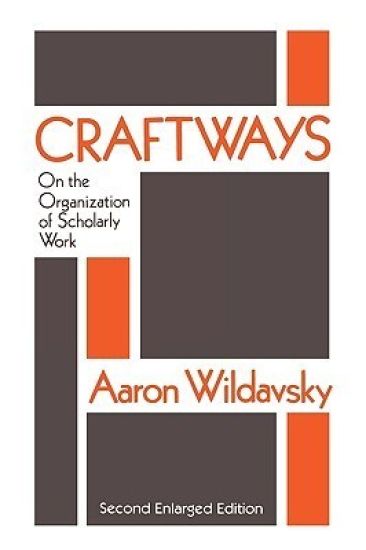
Craftways

Craftways

Aaron Wildavsky

Transaction Publishers
1993
nidottu
The one subject that serious students want most to know about, other than their specialty, is how academic life is lived and how scholarly work is carried out. Their curiosity is equally shared by those interested in how to improve the quality and quantity of their work. With few exceptions, the time honored word-of-mouth approach is all there has been until now; how one works is rarely a subject seriously discussed in print. Craftways is intended to address these concerns and needs. Aaron Wildavsky has long been admired as one of the most productive political scientists of his generation. Repeated expressions of interest in his scholarly craft led him to gather together his essays on how he works. Included are chapters on how to read social science -"not always everyone's favorite pastime" - how to work with others on collaborative projects, and how to improve one's academic writing. The question of time, the most limited resource available to most scholars, is addressed in an amusing chapter, "The Organization of Time in Scholarly Activities Carried Out Under American Conditions in Resource-Rich Universities." He includes a section on interviewing, focusing not only on the process, but on the spirit of scholarly enterprise that should animate it. The last part of the book is purely personal, emphasizing the familial and background variables that have made Wildavsky who he is and play a large part in how he goes about his work. This wise volume, by a master of his craft, should be of broad interest to students and faculty in the social sciences.