

Kirjailija
Abu Hamid Muhammad Al-Ghazali
Kirjat ja teokset yhdessä paikassa: 8 kirjaa, julkaisuja vuosilta 1998–2026, suosituimpiin kuuluu The Alchemy of Happiness (Volume One). Vertaile teosten hintoja ja tarkista saatavuus suomalaisista kirjakaupoista.
8 kirjaa
Kirjojen julkaisuvuodet: 1998–2026.

The Bane of Tongue (Kitab afat al-lisan) is Book 24 of the Imam al-Ghazali’s magnum opus, I?ya? ?ulum al-din, The Revival of the Religious Sciences. Within the architecture of this monumental work, Afat al-lisan is the fourth book of the third quarter, The Ways to Perdition (Rub al-muhlikat), in which al-Ghazali sums up in ten books (or chapters) all the human shortcomings and vices traditionally believed to lead a person into a state of loss in this world and the Next, and which in certain respects overlap with the Judeo-Christian notion of the seven deadly sins. In Book 24, al-Ghazali divides the banes (afat) or defects of the tongue, from the least to the most offensive, into twenty short chapters, each of which comprises a psychological/spiritual analysis of how and why the particular defect might exist in a person's soul, examples of how it manifests itself in behavior, and practical suggestions for eliminating it from one's personality. The misuse of the gift of speech and language is certainly not something new, as this work, composed nearly 950 years ago, amply shows, but in this age of internet-based communication, it has taken on a new and more destructive dimension.

Being the twenty-sixth book of The Revival of the Religious Sciences (Ihya' 'ulum al-din), The Book of the Censure of This World (Kitab Dhamm al-dunya) seeks to persuade its reader of the folly of worldly pleasures and possessions. To do so, al-Ghazali begins with a collection of Islamic primary-source texts that speak to the dangers of this world from a variety of angles. He then adds to this collection fourteen metaphors for this world that illustrate its perfidious nature. In a third subsection, al-Ghazali provides an original rationale for renouncing worldly enjoyments, and he furnishes his reader with a blueprint for determining what constitutes 'this world' in its most dangerous sense. In a fourth and final subsection, al-Ghazali applies a sociological theory to enumerate the essential human vocations and identify the mechanisms through which these lead people away from God.

Al-Ghazali's "Moderation in Belief"
Abu Hamid Muhammad Al-Ghazali
University of Chicago Press
2017
nidottu
Centuries after his death, al-Ghazali remains one of the most influential figures of the Islamic intellectual tradition. Although he is best known for his Incoherence of the Philosophers, Moderation in Belief is his most profound work of philosophical theology. In it, he offers what scholars consider to be the best defense of the Ash'arite school of Islamic theology that gained acceptance within orthodox Sunni theology in the twelfth century, though he also diverges from Ash'arism with his more rationalist approach to the Quran. Together with The Incoherence of the Philosophers, Moderation in Belief informs many subsequent theological debates, and its influence extends beyond the Islamic tradition, informing broader questions within Western philosophical and theological thought. The first complete English-language edition of Moderation in Belief, this new annotated translation by Aladdin M. Yaqub draws on the most esteemed critical editions of the Arabic texts and offers detailed commentary that analyzes and reconstructs the arguments found in the work's four treatises. Explanations of the historical and intellectual background of the texts also enable readers with a limited knowledge of classical Arabic to fully explore al-Ghazali and this foundational text for the first time. With the recent resurgence of interest in Islamic philosophy and the conflict between philosophy and religion, this new translation will be a welcome addition to the scholarship.

The Jerusalem Epistle: A Tract on the Fundamentals of Muslim Doctrine
Safaruk Z. Chowdhury; Abu Hamid Muhammad Al-Ghazali
Createspace Independent Publishing Platform
2016
nidottu

The Incoherence of the Philosophers, 2nd Edition
Abu Hamid Muhammad Al-Ghazali
Brigham Young University Press
2002
sidottu
Halvin toimitettuna 43,90 €
Although Abu Hamid Muhammad al-Ghazali lived a relatively short life (1058-1111), he established himself as one of the most important thinkers in the history of Islam. The Incoherence of the Philosophers, written after more than a decade of travel and ascetic contemplation, contends that while such Muslim philosophers as Avicenna boasted of unassailable arguments on matters of theology and metaphysics, they could not deliver on their claims; moreover, many of their assertions represented disguised heresy and unbelief. Despite its attempted refutation by the twelfth-century philosopher Ibn Rushd, al-Ghazali's work remains widely read and influential.

Faith in Divine Unity and Trust in Divine Providence
Abu Hamid Muhammad al-Ghazali; David B. Burrell
Fons Vitae,US
2001
nidottu
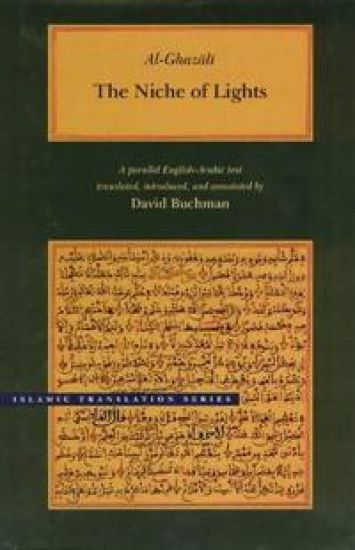
Abu Hamid Muhammad al-Ghazali's philosophical explorations covered nearly the entire spectrum of twelfth-century beliefs. Beginning his career as a skeptic, he ended it as a scholar of mysticism and orthodoxy. The Niche of Lights, written near the end of his illustrious career, advances the philosophically important idea that reason can serve as a connection between the devout and God. Al-Ghazali argues that abstracting God from the world, as he believed theologians did, was not sufficient for understanding. Exploring the boundary between philosophy and theology, The Niche of Lights seeks to understand the role of reality in the perception of the spiritual.