Kirjojen hintavertailu – 12 903 725 kirjaa ja 27 kauppaa

Kirjailija

Adam Frank

Kirjat ja teokset yhdessä paikassa: 15 kirjaa, julkaisuja vuosilta 2009–2025, suosituimpiin kuuluu Astronomy. Vertaile teosten hintoja ja tarkista saatavuus suomalaisista kirjakaupoista.

15 kirjaa

Kirjojen julkaisuvuodet: 2009–2025.

El Punto Ciego: Por Qué La Ciencia No Puede Ignorar La Experiencia Humana

El Punto Ciego: Por Qué La Ciencia No Puede Ignorar La Experiencia Humana

Adam Frank; Marcelo Gleiser; Evan Thompson

Editorial Kairos
2025
nidottu
In The Blind Spot, astrophysicist Adam Frank, theoretical physicist Marcelo Gleiser, and philosopher Evan Thompson argue for a revolutionary vision of the scientific world, one that includes humanity's lived experience as an inescapable part of our search for objective truth. Since the Enlightenment, science has been turned to knowing who we are, where we came from, and where we are going, but we have been stuck thinking that we can know the universe from outside our position in it. When we try to understand reality only through external physical things, imagined from this external position, we lose sight of the need for experience. This is the blind spot that, according to the authors, lies behind our scientific enigmas about time and the origin of the universe, quantum physics, life, artificial intelligence, mind, consciousness, and the Earth as a planetary system. The authors propose an alternative vision: scientific knowledge as a self-correcting narrative made from the world and our experience of it.
The Blind Spot

The Blind Spot

Adam Frank; Marcelo Gleiser

MIT PRESS LTD
2025
nidottu

Halvin toimitettuna 27,00 €

A compelling argument for including the human perspective within science, and for how human experience makes science possible. 'This is by far the best book I've read this year.' Michael Pollan, Professor of the Practice of Non-fiction, Harvard University; #1 New York Times bestselling author. It s tempting to think that science gives us a God s-eye view of reality. But we neglect the place of human experience at our peril. In The Blind Spot, astrophysicist Adam Frank, theoretical physicist Marcelo Gleiser, and philosopher Evan Thompson call for a revolutionary scientific worldview, where science includes rather than ignores or tries not to see humanity s lived experience as an inescapable part of our search for objective truth. The authors present science not as discovering an absolute reality but rather as a highly refined, constantly evolving form of human experience. They urge practitioners to reframe how science works for the sake of our future in the face of the planetary climate crisis and increasing science denialism. Since the dawn of the Enlightenment, humanity has looked to science to tell us who we are, where we come from, and where we re going, but we ve gotten stuck thinking we can know the universe from outside our position in it. When we try to understand reality only through external physical things imagined from this outside position, we lose sight of the necessity of experience. This is the Blind Spot, which the authors show lies behind our scientific conundrums about time and the origin of the universe, quantum physics, life, AI and the mind, consciousness, and Earth as a planetary system. The authors propose an alternative vision: scientific knowledge is a self-correcting narrative made from the world and our experience of it evolving together. To finally 'see' the Blind Spot is to awaken from a delusion of absolute knowledge and to see how reality and experience intertwine. The Blind Spot goes where no science book goes, urging us to create a new scientific culture that views ourselves both as an expression of nature and as a source of nature s self-understanding, so that humanity can flourish in the new millennium.
The Blind Spot

The Blind Spot

Adam Frank; Marcelo Gleiser

MIT PRESS LTD
2024
sidottu

Halvin toimitettuna 32,00 €

A compelling argument for including the human perspective within science, and for how human experience makes science possible.“This is by far the best book I've read this year.” —Michael Pollan, Professor of the Practice of Non-fiction, Harvard University; #1 New York Times bestselling author“(A) stimulating manifesto for changing the way we look at things.” —Wall Street JournalIt’s tempting to think that science gives us a God’s-eye view of reality. But we neglect the place of human experience at our peril. In The Blind Spot, astrophysicist Adam Frank, theoretical physicist Marcelo Gleiser, and philosopher Evan Thompson call for a revolutionary scientific worldview, where science includes—rather than ignores or tries not to see—humanity’s lived experience as an inescapable part of our search for objective truth. The authors present science not as discovering an absolute reality but rather as a highly refined, constantly evolving form of human experience. They urge practitioners to reframe how science works for the sake of our future in the face of the planetary climate crisis and increasing science denialism. Since the dawn of the Enlightenment, humanity has looked to science to tell us who we are, where we come from, and where we’re going, but we’ve gotten stuck thinking we can know the universe from outside our position in it. When we try to understand reality only through external physical things imagined from this outside position, we lose sight of the necessity of experience. This is the Blind Spot, which the authors show lies behind our scientific conundrums about time and the origin of the universe, quantum physics, life, AI and the mind, consciousness, and Earth as a planetary system. The authors propose an alternative vision: scientific knowledge is a self-correcting narrative made from the world and our experience of it evolving together. To finally “see” the Blind Spot is to awaken from a delusion of absolute knowledge and to see how reality and experience intertwine. The Blind Spot goes where no science book goes, urging us to create a new scientific culture that views ourselves both as an expression of nature and as a source of nature’s self-understanding, so that humanity can flourish in the new millennium.
The Little Book of Aliens

The Little Book of Aliens

Adam Frank

Harper
2023
sidottu

Halvin toimitettuna 26,00 €

"With wit and brio, Frank separates current nonsense about aliens from the serious and fascinating search for extraterrestrial life." --Carlo Rovelli, New York Times bestselling author of Seven Brief Lessons on PhysicsFrom astrophysicist Adam Frank, a little book on the biggest questions in our search for extraterrestrial life, questions we stand ready to answer. Everyone is curious about life in the Universe, UFOs and whether ET is out there. Over the course of his thirty-year career as an astrophysicist, Adam Frank has consistently been asked about the possibility of intelligent life in the universe. Are aliens real? Where are they? Why haven't we found them? What happens if we do? We've long been led to believe that astronomers spend every night searching the sky for extraterrestrials, but the truth is we have barely started looking. Not until now have we even known where to look or how. In The Little Book of Aliens, Frank, a leading researcher in the field, takes us on a journey to all that we know about the possibility of life outside planet Earth and shows us the cutting-edge science that has brought us to this unique moment in human history: the one where we go find out for ourselves. In this small book with big stakes, Frank gives us a rundown of everything we need to know, from the scientific origins of the search for intelligent life, the Fermi Paradox, the Kardashev Scale, the James Webb Telescope, as well as UFOs and their conspiracy theories. Drawing from his own work and that of other scientists studying the possibility of alien life, he brings together the latest scientific thinking, data, ideas, and discoveries to equip us with the critical facts as we stand at what may be the last moment in human history where we still believe we are all alone. This book is about everything we do--and do not--know about life, intelligent or otherwise beyond Earth. In language that is engaging, entertaining and fun, The Little Book of Aliens provides a comprehensive first look at how close we are to finding out if others actually exist--and if they do, what they might be like. Humankind is on the precipice of finding its neighbors. What comes next? No person is better suited to answer that question--and lead the search--than Adam Frank.
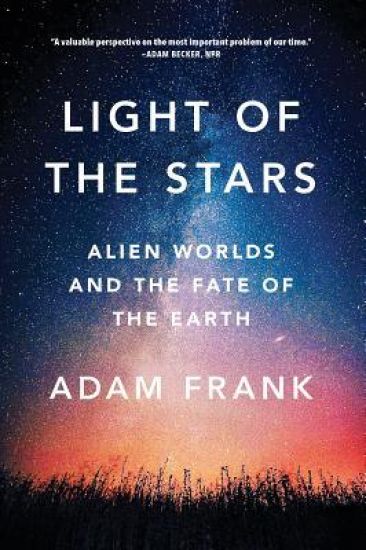
Light of the Stars

Light of the Stars

Adam Frank

WW Norton Co
2019
nidottu

Halvin toimitettuna 24,80 €

Light of the Stars tells a radically new story about what we are: one world in a universe awash in planets. Building on his widely discussed scientific papers and The New York Times op-eds, astrophysicist Adam Frank shows that not only is it likely that alien civilisations have existed many times before but that many of them have driven their own worlds into dangerous eras of change. He explains how dust storms on Mars, the greenhouse effect on Venus, Gaia Theory, the threat of nuclear winter, and efforts to prove or disprove the plurality of worlds from Aristotle to Copernicus to Carl Sagan have contributed to our understanding of our place in the universe and the growing challenge of climate change. And he explores what may be the largest question of all: if there has been life on other worlds, what its presence can tell us about our own fate.
Light of the Stars

Light of the Stars

Adam Frank

WW Norton Co
2018
sidottu
Light of the Stars tells a radically new story about what we are: one world in a universe awash in planets. Building on his widely discussed scientific papers and The New York Times op-eds, astrophysicist Adam Frank shows that not only is it likely that alien civilisations have existed many times before but that many of them have driven their own worlds into dangerous eras of change. He explains how dust storms on Mars, the greenhouse effect on Venus, Gaia Theory, the threat of nuclear winter, and efforts to prove or disprove the plurality of worlds from Aristotle to Copernicus to Carl Sagan have contributed to our understanding of our place in the universe and the growing challenge of climate change. And he explores what may be the largest question of all: if there has been life on other worlds, what its presence can tell us about our own fate.
Transferential Poetics, from Poe to Warhol

Transferential Poetics, from Poe to Warhol

Adam Frank

Fordham University Press
2014
pokkari
Transferential Poetics presents a method for bringing theories of affect to the study of poetics. Informed by the thinking of Silvan Tomkins, Melanie Klein, and Wilfred Bion, it offers new interpretations of the poetics of four major American artists: Edgar Allan Poe, Henry James, Gertrude Stein, and Andy Warhol. The author emphasizes the close, reflexive attention each of these artists pays to the transfer of feeling between text and reader, or composition and audience— their transferential poetics. The book's historical route from Poe to Warhol culminates in television, a technology and cultural form that makes affect distinctly available to perception. The peculiar theatricality of these four artists, Frank argues, can best be understood as a reciprocal framing relation between the bodily means of communicating affect (by face and voice) and technologies of graphic reproduction.
Transferential Poetics, from Poe to Warhol

Transferential Poetics, from Poe to Warhol

Adam Frank

Fordham University Press
2014
sidottu
Transferential Poetics presents a method for bringing theories of affect to the study of poetics. Informed by the thinking of Silvan Tomkins, Melanie Klein, and Wilfred Bion, it offers new interpretations of the poetics of four major American artists: Edgar Allan Poe, Henry James, Gertrude Stein, and Andy Warhol. The author emphasizes the close, reflexive attention each of these artists pays to the transfer of feeling between text and reader, or composition and audience— their transferential poetics. The book's historical route from Poe to Warhol culminates in television, a technology and cultural form that makes affect distinctly available to perception. The peculiar theatricality of these four artists, Frank argues, can best be understood as a reciprocal framing relation between the bodily means of communicating affect (by face and voice) and technologies of graphic reproduction.
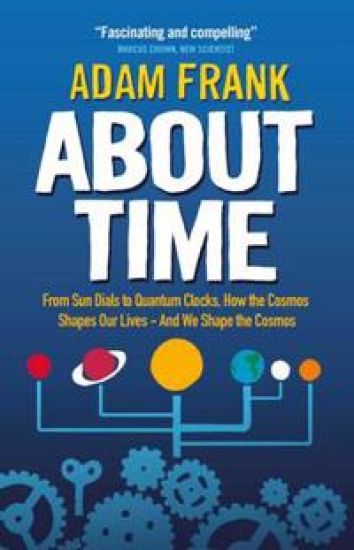
About Time

About Time

Adam Frank

Oneworld Publications
2013
pokkari
From Stonehenge to beyond the Big Bang, an exhilarating scientific exploration of how we make time Time is the grandest conception of the universe that we humans have been able to imagine – and its most intimate, the very frame of human life. In About Time, astrophysicist and award-winning writer Adam Frank tells the scientific story of this wonderful and tyrannical invention. A Palaeolithic farmer moved through the sun-fuelled day and star-steered night in a radically different way than the Elizabethan merchants who set their pace to the clocks newly installed in their town squares. Since then, science has swept time into increasingly minute and standardized units – the industrial efficiency of ironworks’ punch clocks; the space-age precision of atomic fountains and GPS satellites; the fifteen-minute increments of Outlook’s digital revolution. And in the past decade, string-theory branes, multiverses, and “clockless” physics have begun to overturn our ideas about how the universe began – the Big Bang – in ways that will completely rewrite time and our experience of it. Weaving cosmology with day-to-day chronicles and a down-to-earth style, About Time is both dazzling and riveting as it confronts what comes next.
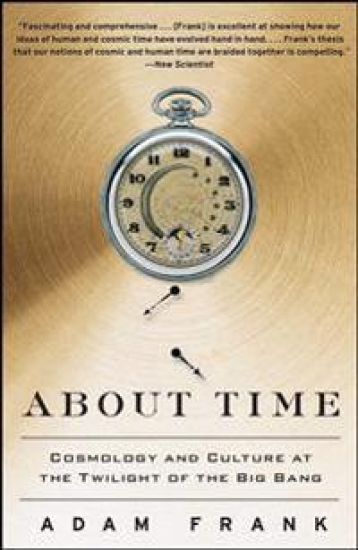
About Time: Cosmology and Culture at the Twilight of the Big Bang
Now in paperback, "a phenomenal blend of science and cultural history" (Kirkus Reviews, starred review), About Time gives readers a peek into the cutting edge of cosmology, showing how it is intimately wedded to the texture of our daily lives. Our universe's "beginning" is at an end. What does this have to do with us, here on Earth? Everything. Our lives are about to be dramatically shaken--as altered as they were by the invention of the clock, the steam engine, the railroad, the radio and the Internet. In About Time, astrophysicist Adam Frank allows us a peek into the cutting edge of cosmology, explaining how the texture of our lives changes along with our understanding of the universe's origin. Since we awoke to self-consciousness fifty thousand years ago, our lived experience of time, from hunting and gathering to the invention of cell phones and electronic calendars, has been transformed and rebuilt many times. But the latest theories in cosmology--time with no beginning, parallel universes, eternal inflation--are about to send us in a new direction. Time is both our grandest and most intimate conception of the universe. Frank tells the story of humanity's deepest question--when and how did everything begin?--alongside the story of how human beings have experienced time, looking at the way our engagement with the world has allowed us to discover the nature of the universe and how those discoveries inform our daily experience. This astounding book will change the way we think about time and how it affects our lives.
About Time

About Time

Adam Frank

Oneworld Publications
2012
nidottu
From Stonehenge to beyond the Big Bang, an exhilarating scientific exploration of how we make time Time is the grandest conception of the universe that we humans have been able to imagine – and its most intimate, the very frame of human life. In About Time, astrophysicist and award-winning writer Adam Frank tells the scientific story of this wonderful and tyrannical invention. A Palaeolithic farmer moved through the sun-fuelled day and star-steered night in a radically different way than the Elizabethan merchants who set their pace to the clocks newly installed in their town squares. Since then, science has swept time into increasingly minute and standardized units – the industrial efficiency of ironworks’ punch clocks; the space-age precision of atomic fountains and GPS satellites; the fifteen-minute increments of Outlook’s digital revolution. And in the past decade, string-theory branes, multiverses, and “clockless” physics have begun to overturn our ideas about how the universe began – the Big Bang – in ways that will completely rewrite time and our experience of it. Weaving cosmology with day-to-day chronicles and a down-to-earth style, About Time is both dazzling and riveting as it confronts what comes next.
The Constant Fire

The Constant Fire

Adam Frank

University of California Press
2009
pokkari
Eloquent, urgent, and inspiring, "The Constant Fire" tackles the acrimonious debate between science and religion, taking us beyond its stagnant parameters into the wider domain of human spiritual experience. From a Neolithic archaeological site in Ireland to modern theories of star formation, Adam Frank traverses a wide terrain, broadening our sights and allowing us to imagine an alternative perspective. Drawing from his experience as a practicing astrophysicist and from the writings of the great scholars of religion, philosophy, and mythology, Frank locates the connective tissue linking science and religion - their commonality as sacred pursuits - and finds their shared aspiration in pursuit of 'the True and the Real'. Taking us from the burning of Giordano Bruno in 1600 to Einstein and on to today's pressing issues of global warming and resource depletion, "The Constant Fire" shows us how to move beyond this stale debate into a more profound experience of the world as sacred - a world that embraces science without renouncing human spirituality.