Kirjojen hintavertailu – 12 903 724 kirjaa ja 27 kauppaa
Kirjailija
Adam Smith
Kirjat ja teokset yhdessä paikassa: 452 kirjaa, julkaisuja vuosilta 1776–2026, suosituimpiin kuuluu The Wealth of Nations (Book One) and the Manifesto of the Communist Party. a Combined Edition. Vertaile teosten hintoja ja tarkista saatavuus suomalaisista kirjakaupoista.
This edition of John M. Lothian s transcription of an almost complete set of a student s notes on Smith s lectures given at the University of Glasgow in 176263 brings back into print not only an important discovery but a valuable contribution to eighteenth-century rhetorical theory."
Introduction by Robert ReichCommentary by R. H. Campbell and A. S. Skinner Adam Smith's masterpiece, first published in 1776, is the foundation of modern economic thought and remains the single most important account of the rise of, and the principles behind, modern capitalism. Written in clear and incisive prose, "The Wealth of Nations" articulates the concepts indispensable to an understanding of contemporary society; and Robert Reich's Introduction both clarifies Smith's analyses and illuminates his overall relevance to the world in which we live. As Reich writes, "Smith's mind ranged over issues as fresh and topical today as they were in the late eighteenth century--jobs, wages, politics, government, trade, education, business, and ethics." Includes a Modern Library Reading Group Guide
To those who know Adam Smith principally by his classic treatise on economics, The Wealth of Nations, this earlier work may come as a revelation. Smith is often misrepresented in the public imagination as a cold, calculating rationalist espousing the pursuit of self-interest in the marketplace of laissez-faire capitalism, regardless of the human cost. This grossly inaccurate portrait may go back to Karl Marx, who seems not to have read Smith's work very carefully and thus criticized him as an unfeeling advocate of a system that exploited and alienated workers. The Theory of Moral Sentiments, however, clearly demonstrates that besides mundane economic pursuits, Smith was just as interested, if not more so, in the capacity of people to bestow and to esteem benevolence, and to strive for virtue even while they are pursuing their own self-interest. The root of our motivation to act benevolently toward others, says Smith, is our natural propensity to sympathize with others. By the same token, our need to have others sympathize with us fuels our desire to be esteemed by others for our benevolence and generally virtuous character. But beyond the need for social approbation, we also have a genuine desire to live according to the dictates of conscience (called by Smith the "Impartial Spectator"). This is our highest impulse and leads us continually to strive for excellence in all spheres of life quite apart from any recognition or encouragement from others. It may be prudent in our economic life to follow our self-interest to secure the basic necessities, but this is only the first stage of personal development toward the much higher goal of living a morally virtuous life. Although The Theory of Moral Sentiments is not well known today, it was widely read and highly praised by the leading intellectuals of the day including David Hume and Edmund Burke. The book went through six different editions between 1759 and 1790 and was also translated into French by the widow of Condorcet. To gain a complete picture of Adam Smith and his ideas, every reader of The Wealth of Nations should also become familiar with his classic treatment of ethics.
Smith's THE WEALTH OF NATIONS was the first comprehensive treatment of political economy. Originally delivered in the form of lectures at Glasgow, the book's publication in 1776 co-incided with America's Declaration of Independence. These volumes include Smith's assessment of the mercantile system, his advocacy of the freedom of commerce and industry, and his famous prophecy that "America will be one of the foremost nations of the world".
Le souci esthetique d'Adam Smith permet de resituer son oeuvre la plus connue (La richesse des nations), comme element d'un systeme qui prend en compte le fonctionnement particulier des lois de l'esprit dans chaque domaine: morale, esthetique, politique, jurisprudence. L'art fournit ainsi la voie d'acces la plus plaisante a la comprehension de l'economie de l'esprit et aux lois de l'imagination. Les textes de Smith font se croiser la notion d'imitation, heritee de l'esthetique de son temps, et celle de systeme qui lui est propre. La musique instrumentale est par exemple denuee de fonction imitative, mais se donne comme un systeme complet et regulier. Des oeuvres nous faisons retour vers l'esprit, en meme temps que l'experience du plaisir leve la distinction entre l'esthetique et la theorie. L'edition proposee demontre encore la variete des preoccupations de Smith; la Lettre a l'Edimburgh Review consacree a la culture francaise de son temps nous revele le lecteur de l'Encyclopedie autant que celui de Rousseau.
Introduction by Robert ReichCommentary by R. H. Campbell and A. S. Skinner Adam Smith's masterpiece, first published in 1776, is the foundation of modern economic thought and remains the single most important account of the rise of, and the principles behind, modern capitalism. Written in clear and incisive prose, "The Wealth of Nations" articulates the concepts indispensable to an understanding of contemporary society; and Robert Reich's Introduction both clarifies Smith's analyses and illuminates his overall relevance to the world in which we live. As Reich writes, "Smith's mind ranged over issues as fresh and topical today as they were in the late eighteenth century--jobs, wages, politics, government, trade, education, business, and ethics." Includes a Modern Library Reading Group Guide "From the Trade Paperback edition."
First published in 1776, the year in which the American Revolution officially began, Smith's Wealth of Nations sparked a revolution of its own. In it Smith analyzes the major elements of political economy, from market pricing and the division of labor to monetary, tax, trade, and other government policies that affect economic behavior. Throughout he offers seminal arguments for free trade, free markets, and limited government. Criticizing mercantilists who sought to use the state to increase their nations' supply of precious metals, Smith points out that a nation's welath should be measured by the well-being of its people. Prosperity in turn requires voluntary exchange of goods in a peaceful, well-ordered market. How to establish and maintain such markets? For Smith the answer lay in man's social instincts, which government may encourage by upholding social standards of decency, honesty, and virtue, but which government undermines when it unduly interferes with the intrinsically private functions of production and exchange.
First published in 1776, the year in which the American Revolution officially began, Smith's Wealth of Nations sparked a revolution of its own. In it Smith analyzes the major elements of political economy, from market pricing and the division of labor to monetary, tax, trade, and other government policies that affect economic behavior. Throughout he offers seminal arguments for free trade, free markets, and limited government. Criticizing mercantilists who sought to use the state to increase their nations' supply of precious metals, Smith points out that a nation's wealth should be measured by the well-being of its people. Prosperity in turn requires voluntary exchange of goods in a peaceful, well-ordered market. How to establish and maintain such markets? For Smith the answer lay in man's social instincts, which government may encourage by upholding social standards of decency, honesty, and virtue, but which government undermines when it unduly interferes with the intrinsically private functions of production and exchange.
This thoughtful new abridgment is enriched by the brilliant commentary which accompanies it. In it, Laurence Dickey argues that the Wealth of Nations contains--and conceals--a great deal of how Smith actually thought a commercial society works. Guided by his conviction that the so-called Adam Smith Problem--the relationship between ethics and economics in Smith's thinking--is a core element in the argument of the work itself, Dickey's commentary focuses on the devices Smith uses to ground his economics in broadly ethical and social categories. An unparalleled guide to an often difficult and perplexing work.
Political economy had been studied long before Adam Smith. But Wealth of Nations (1776) established it for the first time as a separate science. Smith based his arguments on vast historical knowledge, and developed his principles with remarkable clarity. What set this work apart was its statement of the doctrine of natural liberty. Smith believed that "man's self-interest is God's providence" - that if government abstained from interfering with free competition, the invisible hand of capitalism would emerge from the competing claims of individual self-interest. Industrial problems would be resolved and maximum efficiency reached. After more than two centuries, Smith's work still stands as the best statement and defense of the fundamental principles of capitalism.
Published in the same year as the American Declaration of Independence, The Wealth of Nations has had an equally great impact on the course of modern history. Adam Smith’s celebrated defence of free market economics is notable also as one of the Enlightenment’s most eloquent testaments to the sanctity of the individual in his relations to the state.
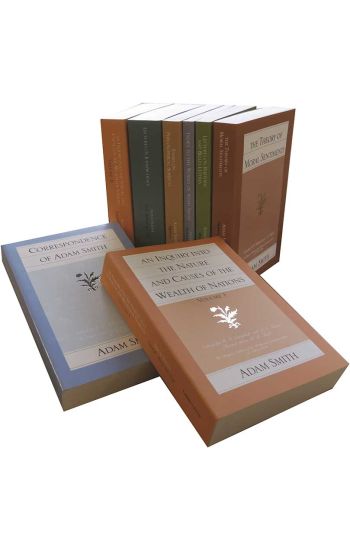
Now complete in seven titles/eight volumes, this series is the first uniform collection of Adam Smith's writings. The Glasgow edition is published in hardcover by Oxford University Press. The paperback edition is published by Liberty Fund.
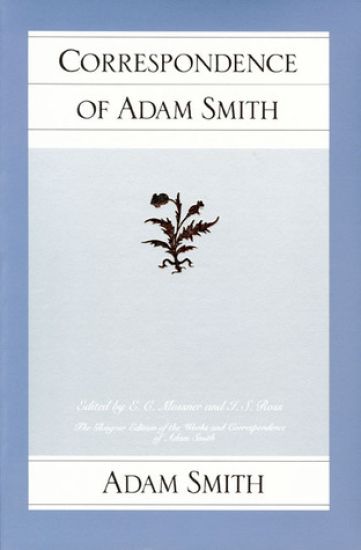
This volume offers an engaging portrait of Smith through over four hundred letters; also included are appendixes with Smith's thoughts on the "Contest with America" and a collection of letters from Jeremy Bentham.
This book is divided into "an examination of the several ways of communicating our thoughts by speech" and "an attention to the principles of those literary compositions which contribute to persuasion or entertainment". The species of communication discussed include descriptive and narrative (or historical) composition, poetry, demonstrative oratory, panegyric, didactic or scientific language, deliberative oratory, and judicial or forensic oratory. The subjects addressed in his teachings include the style and genius of some of the best of the ancient writers and poets, especially the historians and the English classics.
The Theory of Moral Sentiments, Smith's first and in his own mind most important work, outlines his view of proper conduct and the institutions and sentiments that make men virtuous. Here he develops his doctrine of the impartial spectator, whose hypothetical disinterested judgment we must use to distinguish right from wrong in any given situation. We by nature pursue our self-interest, according to Smith. This makes independence or self-command an instinctive good and neutral rules as difficult to craft as they are necessary But society is not held together merely by neutral rules; it is held together by sympathy. Smith argues that we naturally share the emotions and to a certain extent the physical sensations we witness in others. Sharing the sensations of our fellows, we seek to maximize their pleasures and minimize their pains so that we may share in their joys and enjoy their expressions of affection and approval.
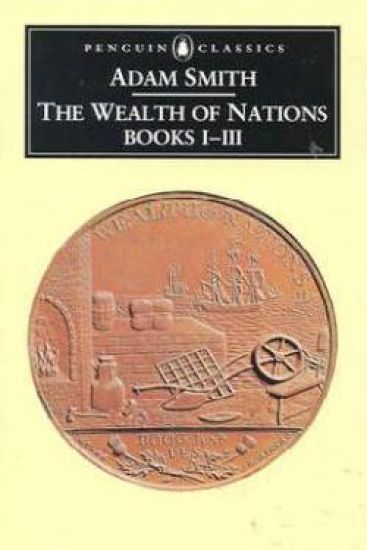
Originally delivered in the form of lectures at Glasgow, Adam Smith's The Wealth of Nations Books I-III laid the foundations of economic theory in general and 'classical' economics in particular, and this Penguin Classics edition is edited with an introduction and notes by Andrew Skinner. The publication of The Wealth of Nations in 1776 coincided with America's Declaration of Independence, and with this landmark treatise on political economy, Adam Smith paved the way for modern capitalism, arguing that a truly free market - fired by competition yet guided as if by an 'invisible hand' to ensure justice and equality - was the engine of a fair and productive society. Books I - III of The Wealth of Nations examine the 'division of labour' as the key to economic growth, by ensuring the interdependence of individuals within society. They also cover the origins of money and the importance of wages, profit, rent and stocks; but the real sophistication of his analysis derives from the fact that it encompasses a combination of ethics, philosophy and history to create a vast panorama of society. This edition contains an analytical introduction offering an in-depth discussion of Smith as an economist and social scientist, as well as a preface, further reading and explanatory notes. Adam Smith (1723-90) was born in Glasgow and educated at Glasgow and Oxford. Two years after his return to Scotland, Smith moved to Edinburgh, where he delivered lectures on Rhetoric. In 1751 Smith was appointed Professor of Logic at Glasgow, but was translated to chair of Moral Philosophy in 1752. The Theory of Moral Sentiments was published in 1759, and The Wealth of Nations in 1776, the same year as the Declaration of Independence. If you enjoyed The Wealth of Nations, you might like Karl Marx's Capital, also available in Penguin Classics.