Kirjojen hintavertailu – 12 903 725 kirjaa ja 27 kauppaa

Kirjailija

Addolorata Marasco

Kirjat ja teokset yhdessä paikassa: 7 kirjaa, julkaisuja vuosilta 2001–2019, suosituimpiin kuuluu Classical Mechanics with Mathematica®. Vertaile teosten hintoja ja tarkista saatavuus suomalaisista kirjakaupoista.

7 kirjaa

Kirjojen julkaisuvuodet: 2001–2019.

Classical Mechanics with Mathematica®

Classical Mechanics with Mathematica®

Antonio Romano; Addolorata Marasco

Springer Nature Switzerland AG
2019
nidottu
This textbook takes a broad yet thorough approach to mechanics, aimed at bridging the gap between classical analytic and modern differential geometric approaches to the subject. Developed by the authors from over 30 years of teaching experience, the presentation is designed to give students an overview of the many different models used through the history of the field—from Newton to Hamilton—while also painting a clear picture of the most modern developments. The text is organized into two parts. The first focuses on developing the mathematical framework of linear algebra and differential geometry necessary for the remainder of the book. Topics covered include tensor algebra, Euclidean and symplectic vector spaces, differential manifolds, and absolute differential calculus. The second part of the book applies these topics to kinematics, rigid body dynamics, Lagrangian and Hamiltonian dynamics, Hamilton–Jacobi theory, completely integrable systems, statistical mechanics of equilibrium, and impulsive dynamics, among others. This new edition has been completely revised and updated and now includes almost 200 exercises, as well as new chapters on celestial mechanics, one-dimensional continuous systems, and variational calculus with applications. Several Mathematica® notebooks are available to download that will further aid students in their understanding of some of the more difficult material. Unique in its scope of coverage and method of approach, Classical Mechanics with Mathematica® will be useful resource for graduate students and advanced undergraduates in applied mathematics and physics who hope to gain a deeper understanding of mechanics.
Classical Mechanics with Mathematica®

Classical Mechanics with Mathematica®

Antonio Romano; Addolorata Marasco

Birkhauser Verlag AG
2018
sidottu
This textbook takes a broad yet thorough approach to mechanics, aimed at bridging the gap between classical analytic and modern differential geometric approaches to the subject. Developed by the authors from over 30 years of teaching experience, the presentation is designed to give students an overview of the many different models used through the history of the field—from Newton to Hamilton—while also painting a clear picture of the most modern developments. The text is organized into two parts. The first focuses on developing the mathematical framework of linear algebra and differential geometry necessary for the remainder of the book. Topics covered include tensor algebra, Euclidean and symplectic vector spaces, differential manifolds, and absolute differential calculus. The second part of the book applies these topics to kinematics, rigid body dynamics, Lagrangian and Hamiltonian dynamics, Hamilton–Jacobi theory, completely integrable systems, statistical mechanics of equilibrium, and impulsive dynamics, among others. This new edition has been completely revised and updated and now includes almost 200 exercises, as well as new chapters on celestial mechanics, one-dimensional continuous systems, and variational calculus with applications. Several Mathematica® notebooks are available to download that will further aid students in their understanding of some of the more difficult material. Unique in its scope of coverage and method of approach, Classical Mechanics with Mathematica® will be useful resource for graduate students and advanced undergraduates in applied mathematics and physics who hope to gain a deeper understanding of mechanics.
Continuum Mechanics using Mathematica®

Continuum Mechanics using Mathematica®

Antonio Romano; Addolorata Marasco

Springer-Verlag New York Inc.
2017
nidottu
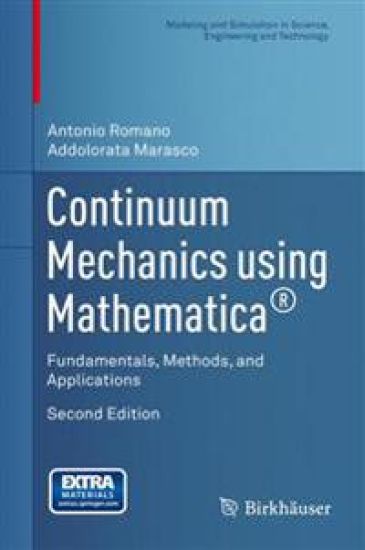
This textbook's methodological approach familiarizes readers with the mathematical tools required to correctly define and solve problems in continuum mechanics. Covering essential principles and fundamental applications, this second edition of Continuum Mechanics using Mathematica® provides a solid basis for a deeper study of more challenging and specialized problems related to nonlinear elasticity, polar continua, mixtures, piezoelectricity, ferroelectricity, magneto-fluid mechanics and state changes (see A. Romano, A. Marasco, Continuum Mechanics: Advanced Topics and Research Trends, Springer (Birkhäuser), 2010, ISBN 978-0-8176-4869-5). Key topics and features: * Concise presentation strikes a balance between fundamentals and applications * Requisite mathematical background carefully collected in two introductory chapters and one appendix * Recent developments highlighted through coverage of more significant applications to areas such as wave propagation, fluid mechanics, porous media, linear elasticity. This second edition expands the key topics and features to include: * Two new applications of fluid dynamics: meteorology and navigation * New exercises at the end of the existing chapters * The packages are rewritten for Mathematica 9 Continuum Mechanics using Mathematica®: Fundamentals, Applications and Scientific Computing is aimed at advanced undergraduates, graduate students and researchers in applied mathematics, mathematical physics and engineering. It may serve as a course textbook or self-study reference for anyone seeking a solid foundation in continuum mechanics.
Continuum Mechanics using Mathematica®

Continuum Mechanics using Mathematica®

Antonio Romano; Addolorata Marasco

Birkhauser Boston Inc
2014
sidottu
This textbook's methodological approach familiarizes readers with the mathematical tools required to correctly define and solve problems in continuum mechanics. Covering essential principles and fundamental applications, this second edition of Continuum Mechanics using Mathematica® provides a solid basis for a deeper study of more challenging and specialized problems related to nonlinear elasticity, polar continua, mixtures, piezoelectricity, ferroelectricity, magneto-fluid mechanics and state changes (see A. Romano, A. Marasco, Continuum Mechanics: Advanced Topics and Research Trends, Springer (Birkhäuser), 2010, ISBN 978-0-8176-4869-5). Key topics and features: * Concise presentation strikes a balance between fundamentals and applications * Requisite mathematical background carefully collected in two introductory chapters and one appendix * Recent developments highlighted through coverage of more significant applications to areas such as wave propagation, fluid mechanics, porous media, linear elasticity. This second edition expands the key topics and features to include: * Two new applications of fluid dynamics: meteorology and navigation * New exercises at the end of the existing chapters * The packages are rewritten for Mathematica 9 Continuum Mechanics using Mathematica®: Fundamentals, Applications and Scientific Computing is aimed at advanced undergraduates, graduate students and researchers in applied mathematics, mathematical physics and engineering. It may serve as a course textbook or self-study reference for anyone seeking a solid foundation in continuum mechanics.
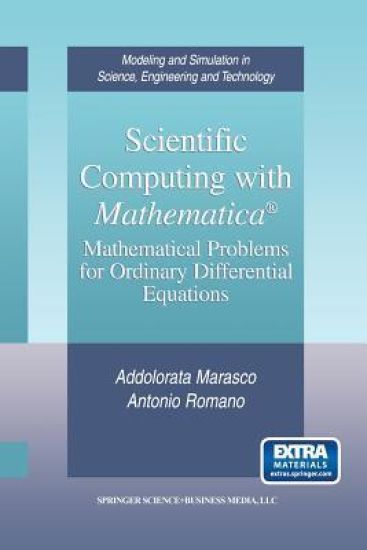
Scientific Computing with Mathematica®

Scientific Computing with Mathematica®

Addolorata Marasco; Antonio Romano

Springer-Verlag New York Inc.
2013
nidottu
Many interesting behaviors of real physical, biological, economical, and chemical systems can be described by ordinary differential equations (ODEs). Scientific Computing with Mathematica for Ordinary Differential Equations provides a general framework useful for the applications, on the conceptual aspects of the theory of ODEs, as well as a sophisticated use of Mathematica software for the solutions of problems related to ODEs. In particular, a chapter is devoted to the use ODEs and Mathematica in the Dynamics of rigid bodies. Mathematical methods and scientific computation are dealt with jointly to supply a unified presentation. The main problems of ordinary differential equations such as, phase portrait, approximate solutions, periodic orbits, stability, bifurcation, and boundary problems are covered in an integrated fashion with numerous worked examples and computer program demonstrations using Mathematica. Topics and Features:*Explains how to use the Mathematica package ODE.m to support qualitative and quantitative problem solving *End-of- chapter exercise sets incorporating the use of Mathematica programs *Detailed description and explanation of the mathematical procedures underlying the programs written in Mathematica *Appendix describing the use of ten notebooks to guide the reader through all the exercises. This book is an essential text/reference for students, graduates and practitioners in applied mathematics and engineering interested in ODE's problems in both the qualitative and quantitative description of solutions with the Mathematica program. It is also suitable as a self-
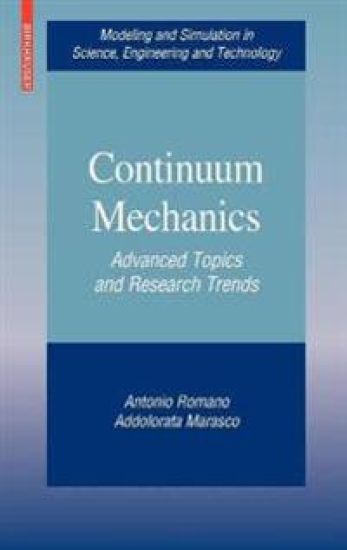
Continuum Mechanics

Continuum Mechanics

Antonio Romano; Addolorata Marasco

Birkhauser Boston Inc
2010
sidottu
R In the companion book (Continuum Mechanics Using Mathematica )to this volume, we explained the foundations of continuum mechanics and described some basic applications of ?uid dynamics and linear elasticity. However, deciding on the approach and content of this book, Continuum Mechanics: Advanced Topics and Research Trends, proved to be a more di?culttask. Afteralongperiodofre?ection,wemadethedecisiontodirect our e?orts into drafting a book that demonstrates the ?exibility and great potential of continuum physics to describe the wide range of macroscopic phenomena that we can observe. It is the opinion of the authors that this is the most stimulating way to learn continuum mechanics. However, it is also quite evident that this aim cannot be fully realized in a single book. Consequently,inthis book wechoseto presentonly thebasicsofinteresting continuum mechanics models, along with some important applications of them. We assume that the reader is familiar with all of the basic principles of continuum mechanics: the general balance laws, constitutive equations, isotropygroupsfor materials,the laws of thermodynamics, ordinarywaves, etc. All of these concepts can be found in Continuum Mechanics Using Mathematica and many other books. We believe that this book gives the reader a su?ciently wide view of the “boundless forest” of continuum mechanics, before focusing his or her attention on the beauty and complex structure of single trees within it (- deed,wecouldsaythatContinuumMechanics UsingMathematica provides only the fertile humus on which the trees of this forest take root!).
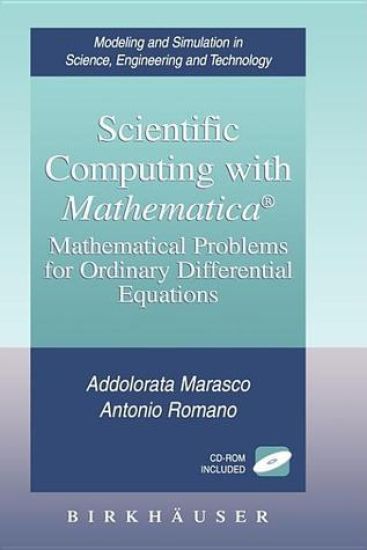
Scientific Computing with Mathematica®

Scientific Computing with Mathematica®

Addolorata Marasco; Antonio Romano

Birkhauser Boston Inc
2001
sidottu
Many interesting behaviors of real physical, biological, economical, and chemical systems can be described by ordinary differential equations (ODEs). Scientific Computing with Mathematica for Ordinary Differential Equations provides a general framework useful for the applications, on the conceptual aspects of the theory of ODEs, as well as a sophisticated use of Mathematica software for the solutions of problems related to ODEs. In particular, a chapter is devoted to the use ODEs and Mathematica in the Dynamics of rigid bodies. Mathematical methods and scientific computation are dealt with jointly to supply a unified presentation. The main problems of ordinary differential equations such as, phase portrait, approximate solutions, periodic orbits, stability, bifurcation, and boundary problems are covered in an integrated fashion with numerous worked examples and computer program demonstrations using Mathematica. Topics and Features:*Explains how to use the Mathematica package ODE.m to support qualitative and quantitative problem solving *End-of- chapter exercise sets incorporating the use of Mathematica programs *Detailed description and explanation of the mathematical procedures underlying the programs written in Mathematica *Appendix describing the use of ten notebooks to guide the reader through all the exercises. This book is an essential text/reference for students, graduates and practitioners in applied mathematics and engineering interested in ODE's problems in both the qualitative and quantitative description of solutions with the Mathematica program. It is also suitable as a self-