Kirjojen hintavertailu – 12 859 818 kirjaa ja 27 kauppaa

Kirjailija

Adi Ophir

Kirjat ja teokset yhdessä paikassa: 8 kirjaa, julkaisuja vuosilta 1991–2020, suosituimpiin kuuluu Plato's Invisible Cities. Vertaile teosten hintoja ja tarkista saatavuus suomalaisista kirjakaupoista.

8 kirjaa

Kirjojen julkaisuvuodet: 1991–2020.

Goy

Goy

Adi Ophir; Ishay Rosen-Zvi

Oxford University Press
2020
nidottu
Goy: Israel's Others and the Birth of the Gentile traces the development of the term and category of the goy from the Bible to rabbinic literature. Adi Ophir and Ishay Rosen-Zvi show that the category of the goy was born much later than scholars assume; in fact not before the first century CE. They explain that the abstract concept of the gentile first appeared in Paul's Letters. However, it was only in rabbinic literature that this category became the center of a stable and long standing structure that involved God, the Halakha, history, and salvation. The authors narrate this development through chronological analyses of the various biblical and post biblical texts (including the Dead Sea scrolls, the New Testament and early patristics, the Mishnah, and rabbinic Midrash) and synchronic analyses of several discursive structures. Looking at some of the goy's instantiations in contemporary Jewish culture in Israel and the United States, the study concludes with an examination of the extraordinary resilience of the Jew/goy division and asks how would Judaism look like without the gentile as its binary contrast.
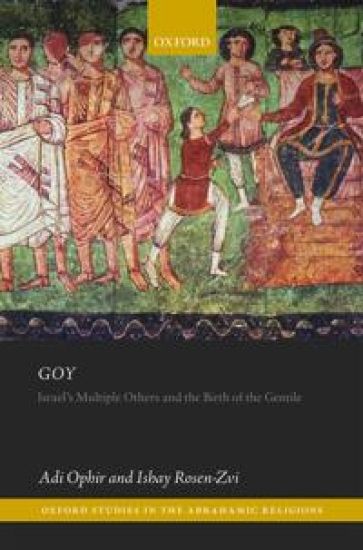
Goy

Goy

Adi Ophir; Ishay Rosen-Zvi

Oxford University Press
2018
sidottu
Goy: Israel's Others and the Birth of the Gentile traces the development of the term and category of the goy from the Bible to rabbinic literature. Adi Ophir and Ishay Rosen-Zvi show that the category of the goy was born much later than scholars assume; in fact not before the first century CE. They explain that the abstract concept of the gentile first appeared in Paul's Letters. However, it was only in rabbinic literature that this category became the center of a stable and long standing structure that involved God, the Halakha, history, and salvation. The authors narrate this development through chronological analyses of the various biblical and post biblical texts (including the Dead Sea scrolls, the New Testament and early patristics, the Mishnah, and rabbinic Midrash) and synchronic analyses of several discursive structures. Looking at some of the goy's instantiations in contemporary Jewish culture in Israel and the United States, the study concludes with an examination of the extraordinary resilience of the Jew/goy division and asks how would Judaism look like without the gentile as its binary contrast.

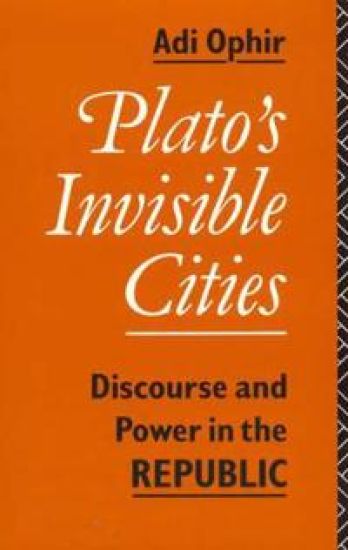
Plato's Invisible Cities

Plato's Invisible Cities

Adi Ophir

Routledge
2014
nidottu
This book offers an original and detailed reading of Plato's Republic, one of the most influential philosophical works in the emergence of Western philosophy. The author discusses the Republic in terms of discursive events and political acts. Plato's act is placed in the context of a politico-discursive crisis in Athens at the end of the fifth and the beginning of the fourth century B. C that gave rise to the dialogue's primary question, that of justice. The originality of Dr. Ophir lies in the way he reconstructs the Republic's different spatial settings - utopian, mythical, dramatic and discursive - using them as the main thread of his interpretation. Against the background of Plato's critique of the organisation of civic-space in the Greek polis, the author relates the spatial settings in the Plato text to each other. This provides a basis for a re-examination of the relationship between philosophy and politics, which Plato's work advocates, and which it actually enacted.
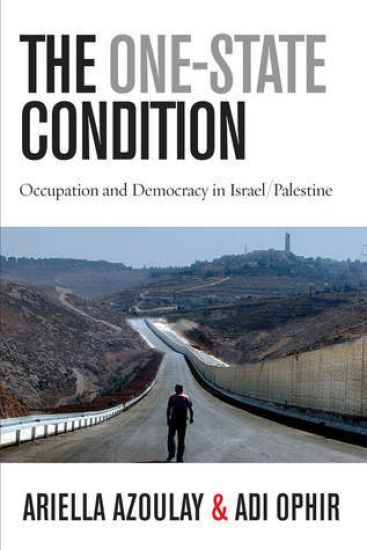
The One-State Condition

The One-State Condition

Ariella Azoulay; Adi Ophir

Stanford University Press
2012
pokkari
Since the start of the occupation of Palestinian territories in 1967, Israel's domination of the Palestinians has deprived an entire population of any political status or protection. But even decades on, most people speak of this rule—both in everyday political discussion and in legal and academic debates—as temporary, as a state of affairs incidental and external to the Israeli regime. In The One-State Condition, Ariella Azoulay and Adi Ophir directly challenge this belief. Looking closely at the history and contemporary formation of the ruling apparatus—the technologies and operations of the Israeli army, the General Security Services, and the legal system imposed in the Occupied Territories—Azoulay and Ophir outline the one-state condition of Israel/Palestine: the grounding principle of Israeli governance is the perpetuation of differential rule over populations of differing status. Israeli citizenship is shaped through the active denial of Palestinian citizenship and civil rights. Though many Israelis, on both political right and left, agree that the occupation constitutes a problem for Israeli democracy, few ultimately admit that Israel is no democracy or question the very structure of the Israeli regime itself. Too frequently ignored are the lasting effects of the deceptive denial of the events of 1948 and 1967, and the ways in which the resulting occupation has reinforced the sweeping militarization and recent racialization of Israeli society. Azoulay and Ophir show that acknowledgment of the one-state condition is not only a prerequisite for considering a one- or two-state solution; it is a prerequisite for advancing new ideas to move beyond the trap of this false dilemma.
The One-State Condition

The One-State Condition

Ariella Azoulay; Adi Ophir

Stanford University Press
2012
sidottu
Since the start of the occupation of Palestinian territories in 1967, Israel's domination of the Palestinians has deprived an entire population of any political status or protection. But even decades on, most people speak of this rule—both in everyday political discussion and in legal and academic debates—as temporary, as a state of affairs incidental and external to the Israeli regime. In The One-State Condition, Ariella Azoulay and Adi Ophir directly challenge this belief. Looking closely at the history and contemporary formation of the ruling apparatus—the technologies and operations of the Israeli army, the General Security Services, and the legal system imposed in the Occupied Territories—Azoulay and Ophir outline the one-state condition of Israel/Palestine: the grounding principle of Israeli governance is the perpetuation of differential rule over populations of differing status. Israeli citizenship is shaped through the active denial of Palestinian citizenship and civil rights. Though many Israelis, on both political right and left, agree that the occupation constitutes a problem for Israeli democracy, few ultimately admit that Israel is no democracy or question the very structure of the Israeli regime itself. Too frequently ignored are the lasting effects of the deceptive denial of the events of 1948 and 1967, and the ways in which the resulting occupation has reinforced the sweeping militarization and recent racialization of Israeli society. Azoulay and Ophir show that acknowledgment of the one-state condition is not only a prerequisite for considering a one- or two-state solution; it is a prerequisite for advancing new ideas to move beyond the trap of this false dilemma.
The Order of Evils

The Order of Evils

Adi Ophir

Zone Books
2005
sidottu
A new moral theory from an Israeli philosopher and activist emphasizing the existential and political nature of evil. What remains of moral judgment when truth itself is mistrusted, when the validity of every belief system depends on its context, when power and knowledge are inextricably entangled? Is a viable moral theory still possible in the wake of the postmodern criticism of modern philosophyThe Order of Evils responds directly to these questions and dilemmas with one simple and brilliant change of focus. Rather than concentrating on the age-old themes of justice and freedom, Adi Ophir offers a moral theory that emphasizes the existential and political nature of evil. Ophir's main contention is that evil is neither a diabolical element residing in the hearts of men nor a meaningless absence of the good. Rather, it is the socially structured order of "superfluous evils." Evils, like pain, suffering, loss, and humiliation, are superfluous when they could have been-but were not-prevented. Through close analysis of seminal works by modern and postmodern philosophers-from Rousseau, Kant, Marx, Sartre, and Arendt to Foucault, Levinas, Derrida, and Lyotard-Ophir forges a new perspective for thinking about what it means to be a moral being: to be moral, he argues, is to care for others, and to be committed to preventing, at all costs, their suffering and distress. A theoretically sophisticated work, The Order of Evils also bears the traces of Ophir's own political and personal experiences as an Israeli philosopher and activist. Two major events in recent Jewish history have profoundly influenced his thinking: the Holocaust and the prolonged Israeli domination of Palestinians in the Occupied Territories. Ophir does not compare the two events. Instead, he introduces a typology of disasters that allows them to be located within the wide spectrum of humanly generated calamities whose specificity and general patterns emerge clearly and distinctly as what they are and are not.
Plato's Invisible Cities

Plato's Invisible Cities

Adi Ophir

Barnes Noble Books-Imports, Div of Rowman Littlefield Pubs., Inc
1991
sidottu
Selected by CHOICE as an Outstanding Academic Book for 1992. This book provides a detailed analysis of one of the most influential philosophical works in the emergence of Western philosophy. Its originality lies in the author's discussion of the political significance of the Republic and of the relationship between philosophy and politics which it advocates. In eloquent, clear language it also examines the different spatial settings of the dialogueódrama, myth, utopia and discourseóand throws new light on the symmetrical structure of the text. The author discusses the Republic in terms of discursive events and political acts. Plato's act is placed in the context of a politico-discursive crisis in Athens at the end of the fifth and the beginning of the fourth century B. C. that gave rise to the dialogue's primary question, that of justice.
Plato's Invisible Cities

Plato's Invisible Cities

Adi Ophir

Routledge
1991
sidottu
This book offers an original and detailed reading of Plato's Republic, one of the most influential philosophical works in the emergence of Western philosophy. The author discusses the Republic in terms of discursive events and political acts. Plato's act is placed in the context of a politico-discursive crisis in Athens at the end of the fifth and the beginning of the fourth century B. C that gave rise to the dialogue's primary question, that of justice. The originality of Dr. Ophir lies in the way he reconstructs the Republic's different spatial settings - utopian, mythical, dramatic and discursive - using them as the main thread of his interpretation. Against the background of Plato's critique of the organisation of civic-space in the Greek polis, the author relates the spatial settings in the Plato text to each other. This provides a basis for a re-examination of the relationship between philosophy and politics, which Plato's work advocates, and which it actually enacted.