Kirjojen hintavertailu – 12 859 818 kirjaa ja 27 kauppaa

Kirjailija

Adrian Armstrong

Kirjat ja teokset yhdessä paikassa: 7 kirjaa, julkaisuja vuosilta 2000–2019, suosituimpiin kuuluu The Multilingual Muse. Vertaile teosten hintoja ja tarkista saatavuus suomalaisista kirjakaupoista.

7 kirjaa

Kirjojen julkaisuvuodet: 2000–2019.

My Observations on People and How We Interact and By Gosh Are We Complicated
Welcome to the 2nd volume of my Observation series. Here, I will be writing about my observations of people and how we interact and are molded. I will be documenting how I view racial issues and how I think people view each other. This will not be for the sensitive but will be for those who are looking for a different perspective. I hope you enjoy. Please enjoy. I have 20 mouths to feed. Also, look out for my first volume on Relationships and be on the watch for futher observations on Religion, Politics and Mental Health. You may now proceed to blow your mind but not too early or else you won't be able to finish the book. Duh.
The Multilingual Muse

The Multilingual Muse

Adrian Armstrong

Legenda
2017
sidottu
In the late Middle Ages, the Low Countries -- ruled by the Dukes of Burgundy and their Hapsburg successors -- boasted a dynamic literary culture in both French and Dutch. Speakers of these languages interacted in more ways than might be expected. Writers shared topics and techniques; works were translated; printers who spoke one language published material in the other. The Multilingual Muse brings together an unprecedented community of scholars, both historians and literary specialists, to chart these interactions. It reveals that poetry, far from resisting linguistic and cultural translation as is widely supposed, was a deeply transcultural enterprise in the region. Adrian Armstrong is Centenary Professor of French at Queen Mary University of London. Elsa Strietman is a Fellow Emerita of Murray Edwards College, Cambridge and was Senior Lecturer in Dutch, University of Cambridge.
Ethics and Justice for the Environment

Ethics and Justice for the Environment

Adrian Armstrong

Routledge
2014
nidottu
Examining the concepts of ‘ethics’ and ‘justice’ as they apply to the environment, this book starts from the observation that environmental ethics and environmental justice appear to have few points of contact. It attempts to find a common ground between these two strands and so to develop a unified statement of justice for the environment that includes the insights of both approaches. Adrian Armstrong argues that the standard account of justice is too anthropocentric, and attempts to provide an alternative account of justice, based on Nussbaum’s capabilities approach, in which the needs of animals, ecosystems and the earth are identified and given moral consideration. Although the two movements do not come together at the theoretical level, this book shows that they do so at the grass roots activist level, and provides a review of the extent to which the environmental justice movement - primarily an American phenomenon - can be used to inform environmental ethical approaches suitable for use in resolving current issues. Beyond identifying justice, practical considerations require rules for the resolutions of conflicts of interest, particularly between human and environmental needs. Thus Ethics and Justice for the Environment explores the value of the approach by considering three areas of applicability: climate change and energy use; human relations with animals, and direct protest action.
Ethics and Justice for the Environment

Ethics and Justice for the Environment

Adrian Armstrong

Routledge
2012
sidottu
Examining the issues of ethics and justice as they apply to the environment, this book starts from the observation that the parallel expositions of environmental ethics and environmental justice appear to have few points of contact. Environmental justice is highly politicized and concerned with human access to the environment and the unequal exposure to environmental pollution. It grew out of the US civil rights movement, the liberal tradition of rights, and Rawls’ description of justice as fairness. It is thus almost exclusively anthropocentric, and does not address the question of justice for the environment. By contrast environmental ethical studies are a wide ranging collection of approaches that are concerned with caring for the earth, and the justifications for it, but rarely consider the issue of justice. Although the two movements do not come together at the theoretical level, they do so at the grass roots activist level. An essential component of this study is thus to consider both the issues of grass roots action, and the application of the methods to actual case studies. This book finds a common ground between these two strands and so to develop a unified statement of justice for the environment that includes the insights of both approaches, particularly based on the 'capability ideas of justice' developed by Martha Nussbaum.
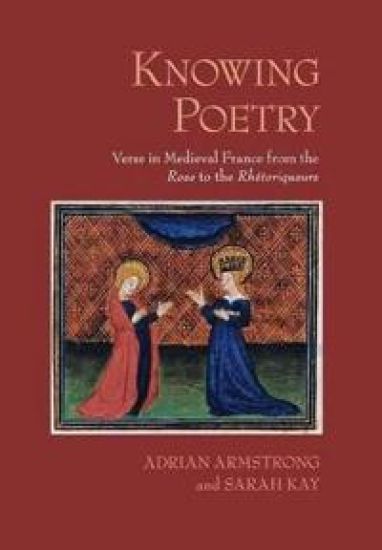
Knowing Poetry

Knowing Poetry

Adrian Armstrong; Sarah Kay

Cornell University Press
2011
sidottu
In the later Middle Ages, many writers claimed that prose is superior to verse as a vehicle of knowledge because it presents the truth in an unvarnished form, without the distortions of meter and rhyme. Beginning in the thirteenth century, works of verse narrative from the early Middle Ages were recast in prose, as if prose had become the literary norm. Instead of dying out, however, verse took on new vitality. In France verse texts were produced, in both French and Occitan, with the explicit intention of transmitting encyclopedic, political, philosophical, moral, historical, and other forms of knowledge. In Knowing Poetry, Adrian Armstrong and Sarah Kay explore why and how verse continued to be used to transmit and shape knowledge in France. They cover the period between Jean de Meun's Roman de la rose (c. 1270) and the major work of Jean Bouchet, the last of the grands rhétoriqueurs (c. 1530). The authors find that the advent of prose led to a new relationship between poetry and knowledge in which poetry serves as a medium for serious reflection and self-reflection on subjectivity, embodiment, and time. They propose that three major works—the Roman de la rose, the Ovide moralisé, and Boethius' Consolation of Philosophy—form a single influential matrix linking poetry and intellectual inquiry, metaphysical insights, and eroticized knowledge. The trio of thought-world-contingency, poetically represented by Philosophy, Nature, and Fortune, grounds poetic exploration of reality, poetry, and community.
Print and Power in France and England, 1500-1800

Print and Power in France and England, 1500-1800

Adrian Armstrong

Ashgate Publishing Limited
2006
sidottu
What was the relationship between power and the public sphere in early modern society? How did the printed media inform this relationship? Contributors to this volume address those questions by examining the interaction of print and power in France and England during the 'hand-press period'. Four interconnected and overlapping themes emerge from these studies, showing the essential historical and contextual considerations shaping the strategies both of power and of those who challenged it via the written word during this period. The first is reading and control, which examines the relationship between institutional power and readers, either as individuals or as a group. A second is propaganda on behalf of institutional power, and the ways in which such writings engage with the rhetorics of power and their reception. The Academy constitutes a third theme, in which contributors explore the economic and political implications of publishing in the context of intellectual elites. The last theme is clientism and faction, which examines the competing political discourses and pressures which influenced widely differing forms of publication. From these articles there emerges a global view of the relationship between print and power, which takes the debate beyond the narrowly theoretical to address fundamental questions of how print sought to challenge, or reinforce, existing power-structures, both from within and from without.
Technique and Technology

Technique and Technology

Adrian Armstrong

Clarendon Press
2000
sidottu
Literary studies cannot neglect the study of books, the physical objects through which literary texts are transmitted. Book form is especially relevant to the literature of the late fifteenth and early sixteenth centuries, which saw the crucial shift from manuscript to print in Western Europe. This book examines manuscripts and printed editions of three major French writers of this key period: Jean Molinet, Jean Lemaire de Belges and Jean Bouchet. Presentational features which influence the reading of poems, such as layout, illustration, anthologization and paratext, are analysed. The development of these features reflects a gradual change in the ways in which literary self-consciousness is manifested. In earlier texts, produced within an essentially manuscript culture, poets' creative investment in their work is exhibited primarily as formal virtuosity. As printing becomes dominant, such virtuosity tends to be rejected in favour of self-commentary and an apparently more personal discourse.