Kirjojen hintavertailu – 12 903 733 kirjaa ja 27 kauppaa

Kirjailija

Adrian R. Bell

Kirjat ja teokset yhdessä paikassa: 5 kirjaa, julkaisuja vuosilta 2004–2026, suosituimpiin kuuluu The Soldier in Later Medieval England. Vertaile teosten hintoja ja tarkista saatavuus suomalaisista kirjakaupoista.

Nimi esiintyy myös muodoissa: Adrian R Bell

5 kirjaa

Kirjojen julkaisuvuodet: 2004–2026.

The Soldier in Later Medieval England

The Soldier in Later Medieval England

Adrian R. Bell; Anne Curry; Andy King; David Simpkin

Oxford University Press
2026
nidottu
The Hundred Years War was a struggle for control over the French throne, fought as a series of conflicts between England, France, and their respective allies. The Soldier in Later Medieval England is the outcome of a project which collects the names of every soldier known to have served the English Crown from 1369 to the loss of Gascony in 1453, the event which is traditionally accepted as the end-date of the Hundred Years War. The data gathered throughout the project has allowed the authors of this volume to compare different forms of war, such as the chevauchées of the late fourteenth century and the occupation of French territories in the fifteenth century, and thus to identify longer-term trends. It also highlights the significance of the change of dynasty in England in the early 1400s. The scope of the volume begins in 1369 because of the survival from that point of the 'muster roll', a type of documentary record in which soldiers names are systematically recorded. The muster roll is a rich resource for the historian, as it allows closer study to be made of the peerage, the knights, the men-at-arms (the esquires), and especially the lower ranks of the army, such as the archers, who contributed the largest proportion of troops to English royal service. The Soldier in Later Medieval England seeks to investigate the different types of soldier, their regional and national origins, and movement between ranks. This is a wide-ranging volume, which offers invaluable insights into a much-neglected subject, and presents many opportunities for future research.
The Soldier in Later Medieval England

The Soldier in Later Medieval England

Adrian R. Bell; Anne Curry; Andy King; David Simpkin

Oxford University Press
2013
sidottu
The Hundred Years War was a struggle for control over the French throne, fought as a series of conflicts between England, France, and their respective allies. The Soldier in Later Medieval England is the outcome of a project which collects the names of every soldier known to have served the English Crown from 1369 to the loss of Gascony in 1453, the event which is traditionally accepted as the end-date of the Hundred Years War. The data gathered throughout the project has allowed the authors of this volume to compare different forms of war, such as the chevauchées of the late fourteenth century and the occupation of French territories in the fifteenth century, and thus to identify longer-term trends. It also highlights the significance of the change of dynasty in England in the early 1400s. The scope of the volume begins in 1369 because of the survival from that point of the 'muster roll', a type of documentary record in which soldiers names are systematically recorded. The muster roll is a rich resource for the historian, as it allows closer study to be made of the peerage, the knights, the men-at-arms (the esquires), and especially the lower ranks of the army, such as the archers, who contributed the largest proportion of troops to English royal service. The Soldier in Later Medieval England seeks to investigate the different types of soldier, their regional and national origins, and movement between ranks. This is a wide-ranging volume, which offers invaluable insights into a much-neglected subject, and presents many opportunities for future research.
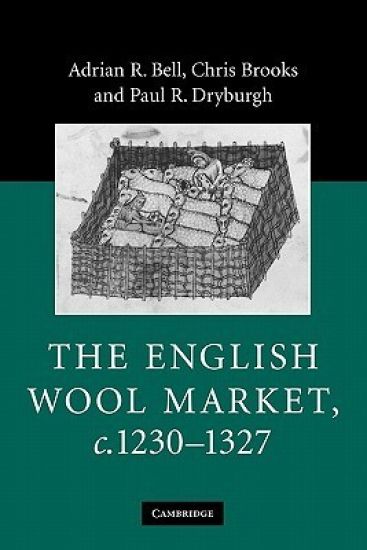
The English Wool Market, c.1230–1327

The English Wool Market, c.1230–1327

Adrian R. Bell; Chris Brooks; Paul R. Dryburgh

Cambridge University Press
2011
pokkari
The wool market was extremely important to the English medieval economy and wool dominated the English export trade from the late-thirteenth century to its decline in the late-fifteenth century. Wool was at the forefront of the establishment of England as a European political and economic power and this volume was the first study of the medieval wool market in over 20 years. It investigates in detail the scale and scope of advance contracts for the sale of wool; the majority of these agreements were formed between English monasteries and Italian merchants, and the book focuses on the data contained within them. The pricing structures and market efficiency of the agreements are examined, employing practices from modern finance. A detailed case study of the impact of entering into such agreements on medieval English monasteries is also presented, using the example of Pipewell Abbey in Northamptonshire.
The English Wool Market, c.1230–1327

The English Wool Market, c.1230–1327

Adrian R. Bell; Chris Brooks; Paul R. Dryburgh

Cambridge University Press
2007
sidottu
The wool market was extremely important to the English medieval economy and wool dominated the English export trade from the late-thirteenth century to its decline in the late-fifteenth century. Wool was at the forefront of the establishment of England as a European political and economic power and this volume was the first study of the medieval wool market in over 20 years. It investigates in detail the scale and scope of advance contracts for the sale of wool; the majority of these agreements were formed between English monasteries and Italian merchants, and the book focuses on the data contained within them. The pricing structures and market efficiency of the agreements are examined, employing practices from modern finance. A detailed case study of the impact of entering into such agreements on medieval English monasteries is also presented, using the example of Pipewell Abbey in Northamptonshire.
War and the Soldier in the Fourteenth Century

War and the Soldier in the Fourteenth Century

Adrian R Bell

The Boydell Press
2004
sidottu
Evidence for the identity and careers of soldiers (usually neglected by scholars in favour of tactics or hardware) in two campaigns of the Hundred Years War. Little is known about the soldiers who fought in the Hundred Years War, though much about tactics and weapons. Adrian Bell's book redresses the balance: he explores the 'military community' through focusing on the records of the two royal expeditions led by Richard Fitzalan, earl of Arundel, in 1387 and 1388, where the extensive surviving evidence makes it possible to identify those who served on these expeditions, and to follow their careers. These campaigns are not only interesting for the wealth and concentration of materials surviving on military organisation, but also because of the political background against which the expeditions were undertaken, which included the attack upon the favourites of the King in Parliament by the Lords Appellant and the possible temporary deposition of Richard II. Advances made in historical computing techniques have made possible for the first time such detailed analysisof the personnel of a royal army. ADRIAN R. BELL lectures in history at the University of Reading.