Kirjojen hintavertailu – 12 903 735 kirjaa ja 27 kauppaa
Kirjailija
Adrianna Kezar
Kirjat ja teokset yhdessä paikassa: 9 kirjaa, julkaisuja vuosilta 2011–2024, suosituimpiin kuuluu Creating a Campus-Wide Culture of Student Success. Vertaile teosten hintoja ja tarkista saatavuus suomalaisista kirjakaupoista.
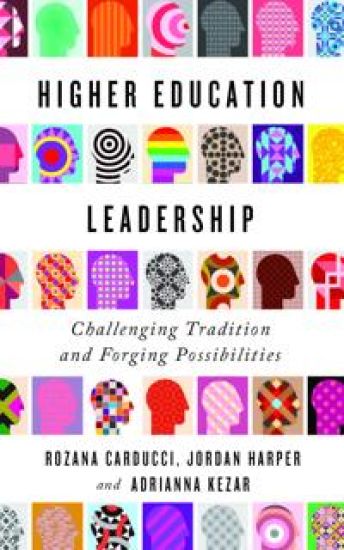
Sharing the new and evolving approaches to higher education leadership that foster liberatory systemic change. Higher Education Leadership offers a groundbreaking exploration of leadership in higher education. Rozana Carducci, Jordan Harper, and Adrianna Kezar challenge traditional paradigms and ideologies that hinder progress—advocating instead for liberatory systemic change. The authors highlight new and evolving interdisciplinary leadership approaches for resisting and dismantling oppressive systems, including neoliberalism and white supremacy, within and beyond higher education organizations. This comprehensive textbook synthesizes decades of leadership scholarship and dissects the limitations of hierarchical and individual-centered models prevalent in higher education. Through critical analysis, the authors unveil process-centered, shared-power, and equity-oriented approaches that prioritize liberation. By translating classic and revolutionary theories, they empower current and aspiring higher education leaders to reimagine their roles to create more meaningful impact. The authors bring theory to life by exploring the specific context of higher education and providing practical applications. Their survey also identifies gaps in knowledge and methodologies and provides ideas for future leadership research. They invite readers to view leadership as both a problem to be interrogated and dismantled as well as a pathway to a more liberatory future. By recognizing these dual possibilities of leadership, the authors open the door to powerful insights while also offering a cautionary tale. With enriching case studies, vignettes, and discussion questions, Higher Education Leadership serves as an essential resource for graduate classrooms and professionals seeking to critique existing leadership practices and forge new pathways that foster equity and systemic transformation. This thought-provoking textbook offers a new vision for higher education scholars and leaders committed to fostering inclusive, anti-racist, and equitable universities.

Offering a new approach to institutional practices, this book describes evidence-based strategies to create a campus culture conducive to truly supporting all students. We are at a critical crossroads in higher education, where large numbers of low-income, racially minoritized, and first-generation college students – referred to in this book as "at-promise students" – are attending college in greater numbers than ever, yet access has not translated to significantly improved retention and graduation rates. This book, therefore, proposes a realignment of existing initiatives to create campus-wide support through a new model of coordination. The ideas presented in this book are the culmination of one of the largest studies of comprehensive college support programs for at-promise students. Chapters include illustrations of the key concepts and promising practices of the Promoting At-promise Student Success (PASS) Project, as well as guiding questions that can be used to facilitate conversations on campus. In this helpful resource, the authors address how student supports are delivered in validating ways, rather than focusing solely on what supports are offered, as has typically been the way institutions address the issues that at-promise students face. This book is intended to provide guidance and support to educators who want to be a part of changing how higher education supports at-promise students toward increased equity.
When faculty climb the ranks into leadership positions, they come with years of knowledge and experience, yet they are often blindsided by the delicate interpersonal situations and political minefields they must now navigate as university administrators. What are the specific skills that faculty need to acquire when they move into administrative positions, and how can they build upon their existing abilities to excel in these roles? What skills can other mid-level leaders learn to help in their positions? Using an engaging case study approach, Leading for Tomorrow provides readers with real-world examples that will help them reflect on their own management and communication styles. It also shows newly minted administrators how they can follow best practices while still developing a style of leadership that is authentic and uniquely their own. The book’s case studies offer practical solutions for how to deal with emerging trends and persistent problems in the field of higher education, from decreasing state funding to political controversies on campus. Leading for Tomorrow gives readers the tools they need to get the best out of their team, manage conflicts, support student success, and instill a campus culture of innovation that will meet tomorrow’s challenges.
Why the Gig Academy is the dominant organizational form within the higher education economy—and its troubling implications for faculty, students, and the future of college education. Over the past two decades, higher education employment has undergone a radical transformation with faculty becoming contingent, staff being outsourced, and postdocs and graduate students becoming a larger share of the workforce. For example, the faculty has shifted from one composed mostly of tenure-track, full-time employees to one made up of contingent, part-time teachers. Non-tenure-track instructors now make up 70 percent of college faculty. Their pay for teaching eight courses averages $22,400 a year—less than the annual salary of most fast-food workers. In The Gig Academy, Adrianna Kezar, Tom DePaola, and Daniel T. Scott assess the impact of this disturbing workforce development. Providing an overarching framework that takes the concept of the gig economy and applies it to the university workforce, this book scrutinizes labor restructuring across both academic and nonacademic spheres. By synthesizing these employment trends, the book reveals the magnitude of the problem for individual workers across all institutional types and job categories while illustrating the damaging effects of these changes on student outcomes, campus community, and institutional effectiveness. A pointed critique of contemporary neoliberalism, the book also includes an analysis of the growing divide between employees and administrators. The authors conclude by examining the strengthening state of unionization among university workers. Advocating a collectivist, action-oriented vision for reversing the tide of exploitation, Kezar, DePaola, and Scott urge readers to use the book as a tool to interrogate the state of working relations on their own campuses and fight for a system that is run democratically for the benefit of all. Ultimately, The Gig Academy is a call to arms, one that encourages non-tenure-track faculty, staff, postdocs, graduate students, and administrative and tenure-track allies to unite in a common struggle against the neoliberal Gig Academy.
Joining theory and practice, How Colleges Change unmasks problematic assumptions that university leaders and change agents typically possess, and provides research-based principles for approaching change. Featuring case studies, teaching questions, change tools, and a greater focus on scaling change, this monumental new edition offers updated content and fresh insights into understanding, leading, and enacting change. Recognizing that internal and external conditions shape and frame change processes, Kezar presents an overarching practical toolkit—a framework for analyzing change, as well as a set of theoretical perspectives to apply that framework in order to custom-design a change process, no matter the organizational challenge or context. How Colleges Change is a crucial resource for aspiring and practicing campus leaders, higher education practitioners, scholars, faculty, and staff who want to become agents of change in their own institutions.
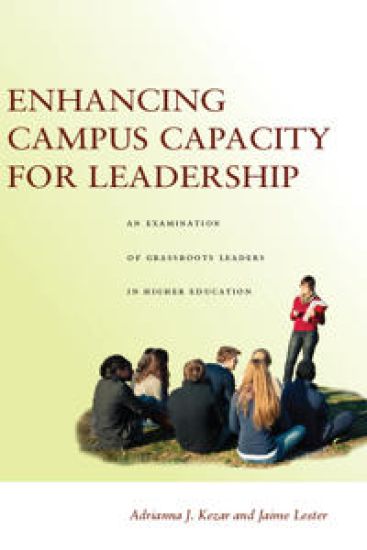
Enhancing Campus Capacity for Leadership contributes to the growing tradition of giving voice to grassroots leaders, focusing on the largely untapped potential of faculty and staff on college campuses. In an increasingly corporatized environment, grassroots leadership can provide a balance to the prestige- and revenue-seeking impulses of traditional campus leaders, create changes in the teaching and learning core, build greater equity, improve relationships among campus stakeholders, and enhance the student experience. This book documents the stories of grassroots leaders, including their motivation and background, the tactics and strategies that they use, the obstacles that they overcome, and the ways that they navigate power and join with formal authority. This investigation also highlights the fact that grassroots leaders, particularly in more marginalized groups, can face significant backlash. The authors end with a discussion of the future of leadership on college campuses, examining the possibilities for shared and collaborative forms of guidance and governance.