Kirjojen hintavertailu – 12 859 818 kirjaa ja 27 kauppaa

Kirjailija

Agnes Heller

Kirjat ja teokset yhdessä paikassa: 37 kirjaa, julkaisuja vuosilta 1984–2026, suosituimpiin kuuluu Lebendigkeit ist eine Entscheidung. Triff sie.. Vertaile teosten hintoja ja tarkista saatavuus suomalaisista kirjakaupoista.

Nimi esiintyy myös muodoissa: Ágnes Heller, Agnes Heller+, Agnes Heller†

37 kirjaa

Kirjojen julkaisuvuodet: 1984–2026.

Doomsday or Deterrence?

Doomsday or Deterrence?

Ferenc Fehér; Agnes Heller

Routledge
2016
sidottu
Doomsday or Deterrence? argues against the majority of premises and conclusions of the antinuclear argument as existed in 1986 when this study was first published. Fehér and Heller’s study claims that social changes are important to curb technology trends that lean toward the construction of nuclear weapons, as well as using the ‘West’ as its own value that needs to be defended and emphasising the importance of understanding the true feelings behind the antinuclear argument. This title will be of interest to students of politics and international relations.
Everyday Life

Everyday Life

Ágnes Heller

Routledge
2015
sidottu
This book, first published in 1984, examines the politics and philosophy of ordinary men and women, and their ordinary transactions. It analyses the interaction between the individual and the social, both for the roots of everyday behaviour and for the means to change the social fabric. Using an approach that combines Marx, Husserl, Heidegger and Aristotle, Agnes Heller defines categories such as ‘group’, ‘crowd’, ‘community’, and deals with characteristics of everyday life such as repetition, rules, norms, economics, habits, probability, imitation. She also analyses everyday knowledge, and concludes by looking at the place of personality in everyday life.
Renaissance Man

Renaissance Man

Ágnes Heller

Routledge
2015
sidottu
Considering such witnesses of the time as Shakespeare, Dante, Petrarch, Michelangelo, Machiavelli, Montaigne, More and Bacon, Agnes Heller looks at both the concept and the image of a Renaissance man. The concept was generalised and accepted by all; its characteristic features were man as a dynamic being, creating and re-creating himself throughout his life. The images of man, however, were very different, having been formed through the ideas and imagination of artists, politicians, philosophers, scientists and theologians and viewed from the different aspects of work, love, fate, death, friendship, devotion and the concepts of space and time. Renaissance Man thus stood as both as a leading protagonist of his time, one who led and formulated the substantial attitudes of his time, and as one who stood as a witness on the sidelines of the discussion. This book, first published in English in 1978, is based on the diverse but equally important sources of autobiographies, works of art and literature, and the writings of philosophers. Although she uses Florence as a starting point, Agnes Heller points out that the Renaissance was a social and cultural phenomenon common to all of Western Europe; her Renaissance Man is thus a figure to be found throughout Europe.

The Concept of the Beautiful

The Concept of the Beautiful

Agnes Heller

Lexington Books
2012
sidottu
The main purpose of this book is to explicate the problematic relationship between the heterogeneity of what is experienced as beautiful and the homogeneity of the conceptualization of that experience, or attempt at such a conceptualization in the era of modern philosophy. While the heterogeneity of what is experienced as beautiful was permitted, and indeed celebrated, in the dominant ancient conception—for example, in the Symposium and Phaedrus of Plato—the need for homogenization in the later appropriation of Plato and in the Enlightenment period relegated the beautiful to the privileged domain of artworks. In her analysis Agnes Heller provides a unique and significant emphasis on the original 'life content' of the experience of the beautiful, which becomes lost in the modern system of the arts. This book details the history of the concept of the beautiful, starting with what Agnes Heller distinguishes between the 'warm' metaphysics of beauty and the 'cold' one—inspired by Plato's Janus-faced relationship to beauty—and ending with a fragmented yet hopeful vision propagated by Friedrich Nietzsche, Walter Benjamin, and Theodor W. Adorno, among others. In between these two historical parentheses—the metaphysical Plato on one hand and the post-metaphysical Nietzsche, Benjamin, and Adorno on the other hand—lay a plenitude of figures and intellectual developments, all of which contributed to the demise of the concept of the beautiful in the Western metaphysical tradition. The most important of these figures and developments are examined in this book.
A Short History of My Philosophy

A Short History of My Philosophy

Agnes Heller

Lexington Books
2010
sidottu
A Short History of My Philosophy is an autobiographic account of Agnes Heller's intellectual and academic career. While the narration mainly traces the development of ideas, we also learn how they occurred in the context of challenging life circumstances. Agnes Heller presents the life of her ideas is four stages: the first, "years of apprenticeship," details both the pre- and post-Hungarian revolution period during which she studied under György Lukács; the second, "years of dialogue," describes the relationships of the "Budapest school" in terms of their shared work and contributions; the third, "years of building and intervention," gives insight into important works written while living in Australia, along with Agnes Heller's political engagements during this period; and finally, the fourth, "years of wandering," describes the various projects Agnes Heller has undertaken as a world-traveler at conferences since the departure of her late husband, Ferenc Fehér.
A Theory of Feelings

A Theory of Feelings

Agnes Heller

Lexington Books
2009
nidottu
A Theory of Feelings examines the problem of human feelings, widely understood, from phenomenological, analytic, and historical perspectives. It begins with an analysis of drives and affects, and pursues the nature of 'feeling' itself, in all of its variability, through a close study of the distinctive categories of emotions, emotional dispositions, orientive feelings, and the passions. As such, the starting point of the anlysis entails an examination of the characteristics of human involvement, or our ways of being in the world. Building upon this assessment of the conditions of human involvement, the philosophical history and emotional economy characteristic of modern relationships is treated, and the nature of expression, social division, suffering, and responsibility is evaluated in light of the theory of feeling presented here. The book is recommended to anyone interested in philosophy, psychology, sociology, and cognitive science.
A Theory of Feelings

A Theory of Feelings

Agnes Heller

Lexington Books
2009
sidottu
A Theory of Feelings examines the problem of human feelings, widely understood, from phenomenological, analytic, and historical perspectives. It begins with an analysis of drives and affects, and pursues the nature of "feeling" itself, in all of its variability, through a close study of the distinctive categories of emotions, emotional dispositions, orientive feelings, and the passions. As such, the starting point of the anlysis entails an examination of the characteristics of human involvement, or our ways of being in the world. Building upon this assessment of the conditions of human involvement, the philosophical history and emotional economy characteristic of modern relationships is treated, and the nature of expression, social division, suffering, and responsibility is evaluated in light of the theory of feeling presented here. The book is recommended to anyone interested in philosophy, psychology, sociology, and cognitive science.
Hannah Arendt - An Ethics of Personal Responsibility

Hannah Arendt - An Ethics of Personal Responsibility

Bethania Assy; Agnes Heller

Peter Lang AG
2007
nidottu
Arendt understands morality not in terms of maxims or moral principles, neither in their abstract nor in their relativistic acceptation. There is an original question raised by Arendt that has not been taken seriously enough. This question has powerful moral implications, for it directs us to choose our -company among men, among things, among thoughts, in the present as well as in the past-. This book is concerned with an ethics based on the visibility of our words and deeds, in which, apart our intentions, appearance is ethically relevant. In the ethics of personal responsibility stands a fundamental dimension of choice able to bridge the self and the world, consciousness and experience. This ethics takes into account three levels of responsibility: responsibility towards ourselves, or how we make our presence in the world; responsibility to judge; and responsibility to the world through the consistency of our actions."
The Immortal Comedy

The Immortal Comedy

Agnes Heller

Lexington Books
2005
sidottu
Immortal Comedy is the first book to 'think' philosophically about the comic phenomenon in general. Although author Agnes Heller had written a book that is both deeply scholarly and meditative on the subject of the comic form in film, literature, and life her writing is eminently approachable. In both its subject and style, Immortal Comedy is a seminal book. In it, Heller takes us on a journey through theories of comedy beginning with classical thought. She then detours through foundational political thinkers who refer to, for instance, laughter and power. We are also introduced to modern systematic approaches to thinking comedy, psychological approaches, and existential approaches. The discerning combination of Heller's individual taste for the pantheon of comedic work and, also, what critics may consider 'less significant' work gives this book a character apart from all others. It is the detail with which Heller makes her discussion, how and where she locates 'the comic,' and probably most significantly her discussion of comedy and our own lives that makes Immortal Comedy a principal book for the entire range of humanities scholars and enthusiasts.
The Immortal Comedy

The Immortal Comedy

Agnes Heller

Lexington Books
2005
nidottu
Immortal Comedy is the first book to "think" philosophically about the comic phenomenon in general. Although author Agnes Heller had written a book that is both deeply scholarly and meditative on the subject of the comic form in film, literature, and life her writing is eminently approachable. In both its subject and style, Immortal Comedy is a seminal book. In it, Heller takes us on a journey through theories of comedy beginning with classical thought. She then detours through foundational political thinkers who refer to, for instance, laughter and power. We are also introduced to modern systematic approaches to thinking comedy, psychological approaches, and existential approaches. The discerning combination of Heller's individual taste for the pantheon of comedic work and, also, what critics may consider "less significant" work gives this book a character apart from all others. It is the detail with which Heller makes her discussion, how and where she locates "the comic," and probably most significantly her discussion of comedy and our own lives that makes Immortal Comedy a principal book for the entire range of humanities scholars and enthusiasts.
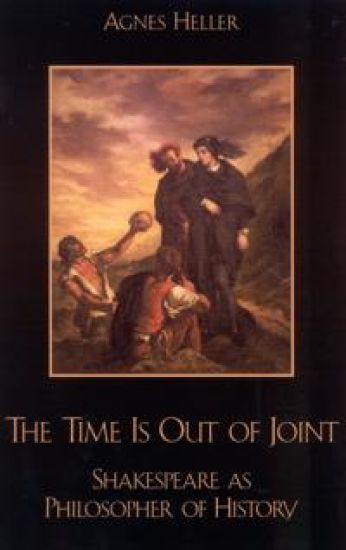
The Time Is Out of Joint

The Time Is Out of Joint

Agnes Heller

Rowman Littlefield Publishers
2002
nidottu
The Time Is Out of Joint handles the Shakespearean oeuvre from a philosophical perspective, finding that Shakespeare's historical dramas reflect on issues and reveal puzzles which were taken up by philosophy proper only in the centuries following them. Shakespeare's extraordinary handling of time and temporality, the difference between truth and fact, that of theory, and that of interpretation and revelatory truth are evaluated in terms of Shakespeare's own conjectural endeavors, and are compared with early modern, modern, and postmodern thought. Heller shows that modernity, which recognized itself in Shakespeare only from the time of Romanticism, found in Shakespeare's work a revelatory character which marked the end of both metaphysical system-building and a tragic reckoning with the inaccessibility of an absolute, timeless truth. Heller distinguishes the four stages found in constantly unique relation in Shakespeare's work (historical, personal, political, and existential) and probes their significance as time comes to fall "out of joint" and may be again set aright. Rather than initially bestowing upon Shakespeare the dubious honorary title of philosopher, Heller probes the concretely situated reflections of characters who must face a blind and irrational fate either without taking responsibility for the discordance of time, or with a responsibility which may both transform history into politics, and set right the time which is out of joint. In the ruminations and undertakings of these characters, Shakespeare's dramas present a philosophy of history, a political philosophy, and a philosophy of (im)moral personality. Heller weighs each as distinctly modern confrontations with the possibility of truth and virtue within a human historical condition no less multifarious for its momentariness.
A Theory of Modernity

A Theory of Modernity

Agnes Heller

JOHN WILEY AND SONS LTD
1999
nidottu
Written by one of the most influential figures in post-World-War-II social thought, A Theory of Modernity is a comprehensive analysis of the main dynamics of modernity, which discusses the technological, social and political elements of modernism.
A Theory of Modernity

A Theory of Modernity

Agnes Heller

Blackwell Publishers
1999
sidottu
Written by one of the most influential figures in post-World-War-II social thought, A Theory of Modernity is a comprehensive analysis of the main dynamics of modernity, which discusses the technological, social and political elements of modernism.
Grandeur and Twilight of Radical Universalism

Grandeur and Twilight of Radical Universalism

Agnes Heller

Transaction Publishers
1991
sidottu
Grandeur and Twilight of Radical Universalism provides a theoretical construction to the extraordinary events of the past several years in Europe and the Soviet Union, and China. These masterful essays attribute much of the problem of totalitarianism to its blind acceptance of a Marxist philosophy of practice. With the failure of communist practice, the collapse of the Marxian paradigm was quick to follow. At its roots this volume is a critique of the idea that we can have "scientific knowledge" of the social and political future. Totalitarian Marxism combined statements of history and claims of omniscience. Free choice was surrendered to history, and when the predicted outcomes fail to materialize, when communism came closer to being buried than capitalism, and western ideals of democracy proved far more compelling than inherited doctrines of authoritarianism, the outcome proved monumental and disastrous. The authors position themselves as evolving from critical Marxism to post-Marxism, and then post modernism. By this, they mean a modest view of life, one that moves beyond radical universalism and grand narrative, into a realization of individualism and equity concerns are central to the end of the twentieth century. The volume proceeds historically: from studies of the classic Marxian legacy; to the early twentieth century efforts of Lukacs, Weber and Adorno; proceeding to the disintegration of the Marxian paradigm in both its pure and revisionist forms. It ends with a study of options posed by this paradigmatic collapse - to consideration of the status of postmodernity and the choices between pure relativism and a theological fundamentalism. ,This is a work of absolute importance for political philosophy, the sociology of knowledge, and the history of ideas. In raising recent events to a theoretically meaningful framework, it represents a refreshing as well as remarkable step toward understanding Revolutions from 1789 to 1989.
Can Modernity Survive?

Can Modernity Survive?

Agnes Heller

Polity Press
1990
sidottu
Can Modernity Survive? displays the full range of Heller's formidable talents for social and philosophical analysis. The papers collected together here provide an integrated statement of her distinctive position concerning the fate of humankind as we approach the twenty-first century.
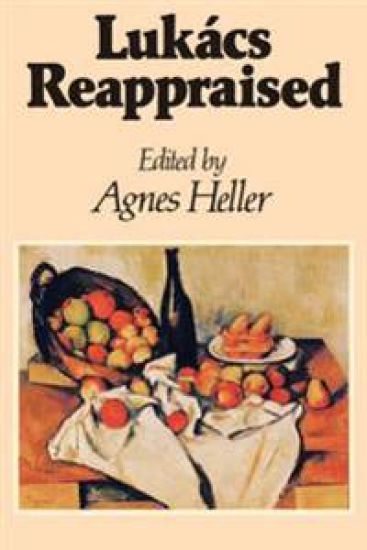
Lukacs Reappraised

Lukacs Reappraised

Agnes Heller

Columbia University Press
1984
pokkari
This authoritative survey traces the development of LukAcs' thought from his conversion to Marxism to his renunciation of History and Class Consciousness, from his remarkably fertile 'essay period' to the Ontology, The essays explore the evolution of his work in relation to that of his contemporaries, among them Brecht, Bloch, and Husserl. They reflect at every turn the contributors' broad commitment to LukAcs' philosophy, but they are always critical in their approach. LukAcs' ambiguities are noted without compromise and his inconsistencies deftly exposed.