

Kirjojen hintavertailu – 12 859 827 kirjaa ja 27 kauppaa

Kirjailija

Ahilan Ponnusamy

Kirjat ja teokset yhdessä paikassa: 2 kirjaa, julkaisuja vuosilta 2023–2026, suosituimpiin kuuluu Governance-First AI. Vertaile teosten hintoja ja tarkista saatavuus suomalaisista kirjakaupoista.

2 kirjaa

Kirjojen julkaisuvuodet: 2023–2026.

Governance-First AI

Governance-First AI

M Maruf Hossain; Ahilan Ponnusamy

APress
2026
Nidottu
As Generative AI shifts from early excitement to real-world implementation, organizations face a critical crossroads. Executives demand rapid returns on investment, yet deployment is frequently stalled by risk, compliance, and governance barriers, and the rise of unmanaged Shadow AI systems has elevated the stakes. Governance-First AI confronts this tension head‑on, offering a practical, execution-ready guide for leaders seeking to move beyond hype and into secure, scalable adoption. This book bridges the gap with a unified, governance‑first approach that enables enterprises to operationalise Generative AI confidently and responsibly. It confronts a landmark MIT NANDA finding — that 95% of enterprise generative AI initiatives deliver no measurable return — and traces the failure to its root: a systemic disconnect between solution architecture and enterprise governance. The authors present a cohesive framework for achieving Certified Operational Velocity, helping organisations evolve from experimental pilots to compliant, production-grade systems. At its core, the book translates stringent governance principles—including platform engineering and platform‑as‑a‑product thinking—into fifteen concrete architectural patterns. These blueprints address the full spectrum of enterprise AI challenges, from retrieval-augmented generation (RAG) deployment to context management, legacy system integration, and the auditable controls required for autonomous Agentic AI systems. Each chapter delivers step-by-step guidance for building secure, measurable, and future-proof AI capabilities. By introducing a unified governance-first architecture and pairing it with repeatable, production-ready use cases, Governance-First AI becomes the missing guide for unlocking AI’s true impact. It equips organizations to achieve transformative productivity gains—without compromising compliance—while preparing for the era of safe, autonomous AI. What you will learn: Implement a unified, governance‑first architectural framework to reliably scale Generative AI from POC experiments to fully compliant enterprise systems. Apply 15 production‑ready architectural blueprints to unlock significant value and achieve 70–80% efficiency gains across core enterprise use cases. Enforce essential technical governance controls—such as DLAC, retrieval‑time access checks, and immutable audit logs—to ensure complete auditability and legal defensibility. Design and deploy autonomous Agentic AI systems with strict safeguards, including policy‑as‑code enforcement, accountability layers, and robust human‑in‑the‑loop protocols. Who this book is for: The book is designed for C‑suite leaders—including CDOs, CTOs, CIOs, CISOs—along with Enterprise Architects and Directors of AI/ML Engineering who are responsible for scaling AI across the enterprise. It also serves Compliance Officers, Risk Managers, and senior ML engineers deploying LLMs in highly regulated sectors such as finance, pharma, manufacturing, and legal. Readers should have foundational knowledge of enterprise IT or cloud architecture and a basic understanding of Generative AI and LLMs.
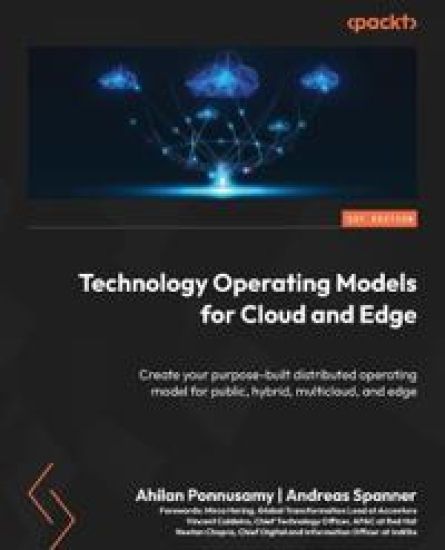
Technology Operating Models for Cloud and Edge

Technology Operating Models for Cloud and Edge

Ahilan Ponnusamy; Andreas Spanner; Mirco Hering; Vincent Caldeira; Neetan Chopra

PACKT PUBLISHING LIMITED
2023
nidottu
Align your operating model with your organization's goals and enable leadership, culture, engineering, and operations to tame the complexities of the distributed future Purchase of the print or Kindle book includes a free PDF eBook Key Features Get hands-on with creating your operating model across on-premises, cloud, and edge Learn how to group, construct, and scope operating model dimensions Tackle operating model complexities like architecture, stakeholder management, platform operations, compliance, security, and technology selection Book DescriptionCloud goals, such as faster time to market, lower total cost of ownership (TCO), capex reduction, self-service enablement, and complexity reduction are important, but organizations often struggle to achieve the desired outcomes. With edge computing gaining momentum across industries and making it possible to move workloads seamlessly between cloud and edge locations, organizations need working recipes to find ways of extracting the most value out of their cloud and edge estate. This book provides a practical way to build a strategy-aligned operating model while considering various related factors such as culture, leadership, team structures, metrics, intrinsic motivators, team incentives, tenant experience, platform engineering, operations, open source, and technology choices. Throughout the chapters, you’ll discover how single, hybrid, or multicloud architectures, security models, automation, application development, workload deployments, and application modernization can be reutilized for edge workloads to help you build a secure yet flexible technology operating model. The book also includes a case study which will walk you through the operating model build process in a step-by-step way. By the end of this book, you’ll be able to build your own fit-for-purpose distributed technology operating model for your organization in an open culture way. What you will learn Get a holistic view of technology operating models and linked organization goals, strategy, and teams Overcome challenges of extending tech operating models to distributed cloud and edge environments Discover key architectural considerations in building operating models Explore the benefits of using enterprise-ready open-source products Understand how open hybrid cloud and modern dev and ops practices improve outcomes Who this book is forIf you are a cloud architect, solutions architect, DevSecOps or platform engineering manager, CTO, CIO, or IT decision maker tasked with leading cloud and edge computing initiatives, creating architectures and enterprise capability models, aligning budgets, or showing your board the value of your technology investments, then this book is for you. Prior knowledge of cloud computing, application development, and edge computing concepts will help you get the most out of this book.