Kirjojen hintavertailu – 12 903 725 kirjaa ja 27 kauppaa

Kirjailija

Ahmed Kovacevic

Kirjat ja teokset yhdessä paikassa: 6 kirjaa, julkaisuja vuosilta 2005–2014, suosituimpiin kuuluu Power Recovery from Low Grade Heat by Means of Screw Expanders. Vertaile teosten hintoja ja tarkista saatavuus suomalaisista kirjakaupoista.

6 kirjaa

Kirjojen julkaisuvuodet: 2005–2014.

Power Recovery from Low Grade Heat by Means of Screw Expanders

Power Recovery from Low Grade Heat by Means of Screw Expanders

Ian K Smith; Nikola Stosic; Ahmed Kovacevic

Woodhead Publishing Ltd
2014
sidottu
Current concerns with climate change have resulted in greatly increased interest in power recovery from low grade heat sources. This includes both hot fluid streams which can be expanded directly to produce mechanical power and those which act as a source of heat to closed cycle power generation systems. Power recovery from low grate heat by means of screw expanders with a generalised overview of how best to recover power from such sources, based on thermodynamic considerations, which differs to the approach used in classical thermodynamics textbooks and which includes an introductory description of the types of working fluid that are used in systems used to recover power from such sources and the criteria that must be taken into account in their selection. This is followed by a description of the mathematical modelling of twin screw machine geometry. The modelling of the thermodynamics and fluid flow through such machines is then given, together with how this is used to predict their performance. Finally a detailed description is given of systems currently used or projected both for direct expansion of the source fluid and by recovery of heat from it, which includes those which are particularly suited to the use of screw expanders in place of turbines.

Screw Compressors

Screw Compressors

Ahmed Kovacevic; Nikola Stosic; Ian Smith

Springer-Verlag Berlin and Heidelberg GmbH Co. K
2010
nidottu
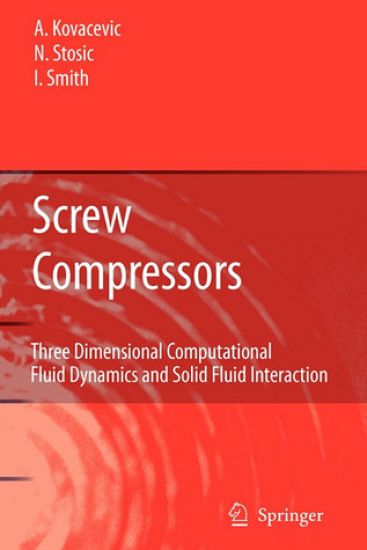
This book presents the most up-to-date methods of three-dimensional modeling of the fluid dymanics and the solid-fluid interaction within these machines, which are still being developed. Adding modeling to the design process makes it possible not only to predict flow patterns more accurately, and also to determine distorting effects on rotors and casing of pressure and temperature distribution within the compressor. Examples outline the scope of the applied mathematical model.
Screw Compressors

Screw Compressors

Nikola Stosic; Ian Smith; Ahmed Kovacevic

Springer-Verlag Berlin and Heidelberg GmbH Co. K
2010
nidottu
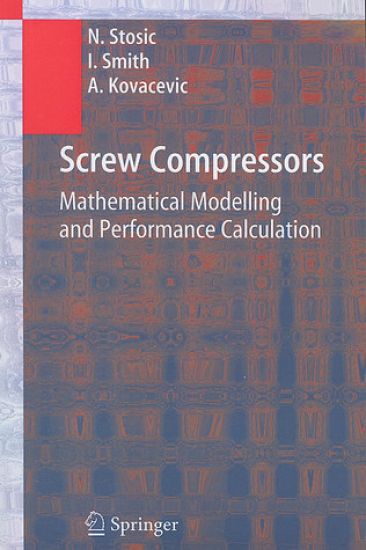
Althoughtheprinciplesofoperationofhelicalscrewmachines,ascompressors or expanders, have been well known for more than 100 years, it is only during the past 30 years that these machines have become widely used. The main reasons for the long period before they were adopted were their relatively poor e?ciency and the high cost of manufacturing their rotors. Two main developments led to a solution to these di?culties. The ?rst of these was the introduction of the asymmetric rotor pro?le in 1973. This reduced the bl- hole area, which was the main source of internal leakage by approximately 90%, and thereby raised the thermodynamic e?ciency of these machines, to roughly the same level as that of traditional reciprocating compressors. The second was the introduction of precise thread milling machine tools at - proximately the same time. This made it possible to manufacture items of complex shape, such as the rotors, both accurately and cheaply. From then on, as a result of their ever improving e?ciencies, high rel- bility and compact form, screw compressors have taken an increasing share of the compressor market, especially in the ?elds of compressed air production, and refrigeration and air conditioning, and today, a substantial proportion of compressors manufactured for industry are of this type. Despite, the now wide usage of screw compressors and the publication of many scienti?c papers on their development, only a handful of textbooks have been published to date, which give a rigorous exposition of the principles of their operation and none of these are in English.
Screw Compressors

Screw Compressors

Ahmed Kovacevic; Nikola Stosic; Ian Smith

Springer-Verlag Berlin and Heidelberg GmbH Co. K
2006
sidottu
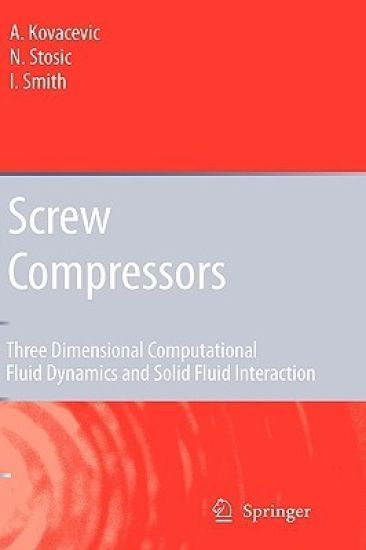
This book presents the most up-to-date methods of three-dimensional modeling of the fluid dymanics and the solid-fluid interaction within these machines, which are still being developed. Adding modeling to the design process makes it possible not only to predict flow patterns more accurately, and also to determine distorting effects on rotors and casing of pressure and temperature distribution within the compressor. Examples outline the scope of the applied mathematical model.
Screw Compressors

Screw Compressors

Nikola Stosic; Ian Smith; Ahmed Kovacevic

Springer-Verlag Berlin and Heidelberg GmbH Co. K
2005
sidottu
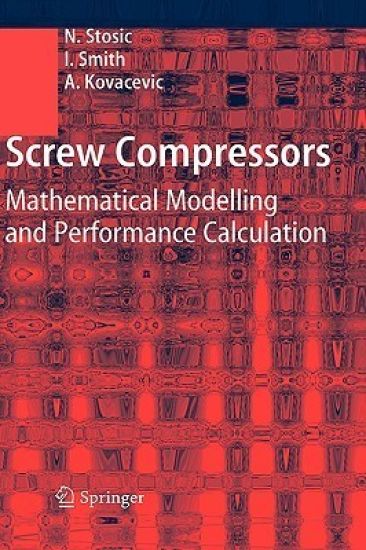
Althoughtheprinciplesofoperationofhelicalscrewmachines,ascompressors or expanders, have been well known for more than 100 years, it is only during the past 30 years that these machines have become widely used. The main reasons for the long period before they were adopted were their relatively poor e?ciency and the high cost of manufacturing their rotors. Two main developments led to a solution to these di?culties. The ?rst of these was the introduction of the asymmetric rotor pro?le in 1973. This reduced the bl- hole area, which was the main source of internal leakage by approximately 90%, and thereby raised the thermodynamic e?ciency of these machines, to roughly the same level as that of traditional reciprocating compressors. The second was the introduction of precise thread milling machine tools at - proximately the same time. This made it possible to manufacture items of complex shape, such as the rotors, both accurately and cheaply. From then on, as a result of their ever improving e?ciencies, high rel- bility and compact form, screw compressors have taken an increasing share of the compressor market, especially in the ?elds of compressed air production, and refrigeration and air conditioning, and today, a substantial proportion of compressors manufactured for industry are of this type. Despite, the now wide usage of screw compressors and the publication of many scienti?c papers on their development, only a handful of textbooks have been published to date, which give a rigorous exposition of the principles of their operation and none of these are in English.