Kirjojen hintavertailu – 12 903 725 kirjaa ja 27 kauppaa

Kirjailija

Aimé Césaire

Kirjat ja teokset yhdessä paikassa: 32 kirjaa, julkaisuja vuosilta 1983–2026, suosituimpiin kuuluu Decadent, Stricken, Dying. Vertaile teosten hintoja ja tarkista saatavuus suomalaisista kirjakaupoista.

Nimi esiintyy myös muodoissa: Aime Cesaire

32 kirjaa

Kirjojen julkaisuvuodet: 1983–2026.

The Tragedy of King Christophe

The Tragedy of King Christophe

Aimé Césaire

Northwestern University Press
2015
nidottu
The Tragedy of King Christophe (1963, revised 1970) is recognized as the Martiniquan writer and activist Aime Cesaire's greatest play. Set in the period of upheaval in Haiti after the assassination of Jean-Jacques Dessalines in 1806, it follows the historical figure of Henri Christophe, a slave who rose to become a general in Toussaint Louverture's army. Christophe declared himself king in 1811 and ruled the northern part of Haiti until 1820. Cesaire employs Shakespearean plotting and revels in the inexhaustible possibilities of language to convey the tragedy of Christophe's transformation from a charismatic leader sensitive to the oppression of his people to an oppressor himself. Paul Breslin and Rachel Ney's nimble, accurate translation includes an introduction and explanatory notes to guide students, scholars, and general readers alike.
Like a Misunderstood Salvation and Other Poems

Like a Misunderstood Salvation and Other Poems

Aimé Césaire

Northwestern University Press
2013
nidottu
Annette Smith and Dominic Thomas’s new translations of Aimé Césaire’s Like a Misunderstood Salvation and Solar Throat Slashed expose to a new audience a pivotal figure in twentieth-century French literature. This collection presents the early and last stages of a po­et’s course, encapsulating in one volume Césaire’s entire literary career and creative evolution.
Solar Throat Slashed

Solar Throat Slashed

Aimé Césaire

Wesleyan University Press
2011
sidottu
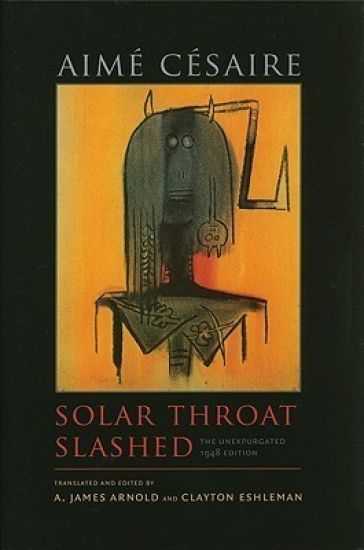
Soleil cou coupé (Solar Throat Slashed) is Aimé Césaire's most explosive collection of poetry. Animistically dense, charged with eroticism and blasphemy, and imbued with an African and Vodun spirituality, this book takes the French surrealist adventure to new heights and depths. A Césaire poem is an intersection at which metaphoric traceries create historically aware nexuses of thought and experience, jagged solidarity, apocalyptic surgery, and solar dynamite. The original 1948 French edition of Soleil cou coupé has a dense magico-religious frame of reference. In the late 1950s, Césaire was increasingly politically focused and seeking a wider audience, when he, in effect, gelded the 1948 text-eliminating 31 of the 72 poems, and editing another 29. Until now, only the revised 1961 edition, called Cadastre, has been translated. The revised text lacks the radical originality of Soleil cou coupé. This Wesleyan edition presents all the original poems en face with the new English translations. Includes an introduction by A. James Arnold and notes by Clayton Eshleman.
A Tempest

A Tempest

Aime Cesaire

Oberon Books Ltd
2002
nidottu
A Tempest is Aime Cesaire's anti-colonialist refashioning of Shakespeare. Alongside The Tragedy of King Cristophe and A Season in the Congo, it completes a 'triptych' of plays that examine the effects of colonialism. This translation premiered at The Gate Theatre, London.
A Tempest

A Tempest

Aime Cesaire

Theatre Communications Group Inc.,U.S.
2002
nidottu
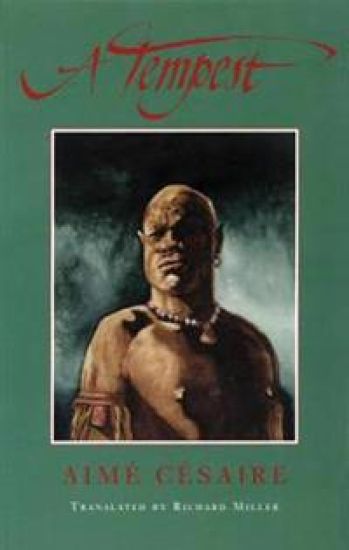
A troupe of black actors perform their own "Tempest." Cesaire's rich and insightful adaptation draws on contemporary Caribbean society, the African-American experience and African mythology to raise questions about colonialism, racism and their lasting effects. Aime Cesaire, who was born in Martinique in 1913, is one of this century's major writers. In his poetry, plays and political activities he has waged a lifelong struggle to restore dignity to colonized people. His best known work is "Return to My Native Land" first published in 1949 and his "Collected Poems" are published by the University of California Press.
Notebook of a Return to the Native Land

Notebook of a Return to the Native Land

Aimé Césaire

Wesleyan University Press
2001
nidottu
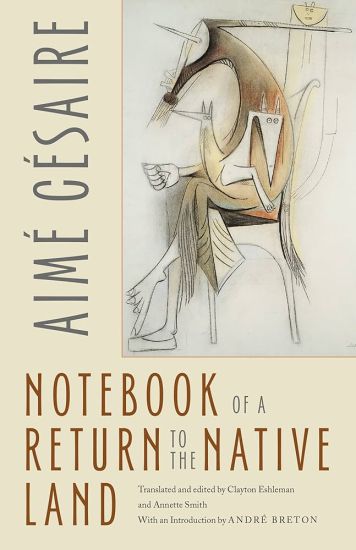
Aimé Césaire's masterpiece, Notebook of a Return to the Native Land, is a work of immense cultural significance and beauty. The long poem was the beginning of Césaire's quest for négritude, and it became an anthem of Blacks around the world. With its emphasis on unusual juxtapositions of object and metaphor, manipulation of language into puns and neologisms, and rhythm, Césaire considered his style a "beneficial madness" that could "break into the forbidden" and reach the powerful and overlooked aspects of black culture. Clayton Eshleman and Annette Smith achieve a laudable adaptation of Césaire's work to English by clarifying double meanings, stretching syntax, and finding equivalent English puns, all while remaining remarkably true to the French text. Their treatment of the poetry is marked with imagination, vigor, and accuracy that will clarify difficulties for those already familiar with French, and make the work accessible to those who are not. André Breton's introduction, A Great Black Poet, situates the text and provides a moving tribute to Césaire. Notebook of a Return to the Native Land is recommended for readers in comparative literature, post-colonial literature, African American studies, poetry, modernism, and French.
Discourse on Colonialism

Discourse on Colonialism

Aimé Césaire

MONTHLY REVIEW PRESS
2001
nidottu

Halvin toimitettuna 19,40 €

"C saire's essay stands as an important document in the development of third world consciousness--a process in which he] played a prominent role."--Library Journal This classic work, first published in France in 1955, profoundly influenced the generation of scholars and activists at the forefront of liberation struggles in Africa, Latin America, and the Caribbean. Nearly twenty years later, when published for the first time in English, Discourse on Colonialism inspired a new generation engaged in the Civil Rights, Black Power, and anti-war movements and has sold more than 75,000 copies to date. Aim C saire eloquently describes the brutal impact of capitalism and colonialism on both the colonizer and colonized, exposing the contradictions and hypocrisy implicit in western notions of "progress" and "civilization" upon encountering the "savage," "uncultured," or "primitive." Here, C saire reaffirms African values, identity, and culture, and their relevance, reminding us that "the relationship between consciousness and reality are extremely complex. . . . It is equally necessary to decolonize our minds, our inner life, at the same time that we decolonize society." An interview with C saire by the poet Ren Depestre is also included.
Discourse on Colonialism

Discourse on Colonialism

Aimé Césaire

MONTHLY REVIEW PRESS
2000
sidottu
This classic work, first published in France in 1955, profoundly influenced the generation of scholars and activists at the forefront of liberation struggles in Africa, Latin America, and the Caribbean. Nearly twenty years later, when published for the first time in English, Discourse on Colonialism inspired a new generation engaged in the Civil Rights and Black Power and anti-war movements. Aim C saire eloquently describes the brutal impact of capitalism and colonialism on both the colonizer and colonized, exposing the contradictions and hypocrisy implicit in western notions of "progress" and "civilization" upon encountering the "savage", "uncultured," or "primitive."
Notebook of a Return to My Native Land

Notebook of a Return to My Native Land

Aime Cesaire

Bloodaxe Books Ltd
1995
nidottu

Halvin toimitettuna 23,90 €

French-English bilingual edition. André Breton called Césaire's Cahier 'nothing less than the greatest lyrical monument of this time'. It is a seminal text in Surrealist, French and Black literatures - published in full in English for the first time in Bloodaxe's bilingual Contemporary French Poets series. Aimé Césaire (1913-2008) was born in in Basse-Pointe, a village on the north coast of Martinique, a former French colony in the Caribbean (now an overseas departement of France). His book Discourse on Colonialism (1950) is a classic of French political literature. Notebook of a Return to My Native Land (1956) is the foundation stone of francophone Black literature: it is here that the word Negritude appeared for the first time. Negritude has come to mean the cultural, philosophical and political movement co-founded in Paris in the 1930s by three Black students from French colonies: the poets Léon-Gontran Damas from French Guiana; Leopold Senghor, later President of Senegal; and Aimé Césaire, who became a deputy in the French National Assembly for the Revolutionary Party of Martinique and was repeatedly elected Mayor of Fort-de-France. As a poet, Cesaire believed in the revolutionary power of language, and in the Notebook he combined high literary French with Martinican colloquialisms, and archaic turns of phrase with dazzling new coinages. The result is a challenging and deeply moving poem on the theme of the future of the negro race which presents and enacts the poignant search for a Martinican identity. The Notebook opposes the ideology of colonialism by inventing a language that refuses assimilation to a dominant cultural norm, a language that teaches resistance and liberation.
The Collected Poetry

The Collected Poetry

Aime Cesaire

University of California Press
1983
pokkari
This edition, containing an extensive introduction, notes, the French original, and a new translation of Cesaire's poetry - the complex and challenging later works as well as the famous Notebook - will remain the definitive Cesaire in English.