Kirjojen hintavertailu – 12 903 725 kirjaa ja 27 kauppaa

Kirjailija

Ainslie T. Embree

Kirjat ja teokset yhdessä paikassa: 8 kirjaa, julkaisuja vuosilta 1995–2024, suosituimpiin kuuluu Frontiers into Borders. Vertaile teosten hintoja ja tarkista saatavuus suomalaisista kirjakaupoista.

8 kirjaa

Kirjojen julkaisuvuodet: 1995–2024.

Frontiers into Borders

Frontiers into Borders

Ainslie T. Embree

OUP India
2020
sidottu
Following the death of the great historian, Ainslie T. Embree, this remarkable document was found in his study, a project to which he had devoted the last years of his life. It is an insightful exploration of how the boundaries of the modern South Asian states were created in the late 18th and early 19th centuries, based on a careful examination of original materials in archives in England and India. Artfully written with rich local detail, this book reveals the fascinating interplay of colonial and local interests as the modern states were carved into being. It is destined to be a classic in the history of South Asian nation building.
Utopias in Conflict

Utopias in Conflict

Ainslie T. Embree

University of California Press
2024
sidottu
This compact, incisive study by a senior scholar explores two sources of violent conflict in India: religion and nationalism. Showing how the political aspects of religion and the ideological character of nationalism have led inexorably to struggle, Ainslie T. Embree argues that the tension between competing visions of the just society has determined the social and political life of India. In India, as elsewhere in the world at the end of the twentieth century, religions legitimized violence as people struggled for what they regarded as their legitimate claims upon the future. As examples of the tension between religious and nationalist visions of the good society, Embree examines two explosive cases—one involving Muslim-Hindu communal encounters, the other, the separatist movement of the Sikhs. Thought-provoking and searching, Utopias in Conflict should interest anyone concerned about fundamentalism, the problems of national integration, and politics and religion in the Third World. This title is part of UC Press's Voices Revived program, which commemorates University of California Press’s mission to seek out and cultivate the brightest minds and give them voice, reach, and impact. Drawing on a backlist dating to 1893, Voices Revived makes high-quality, peer-reviewed scholarship accessible once again using print-on-demand technology. This title was originally published in 1990.

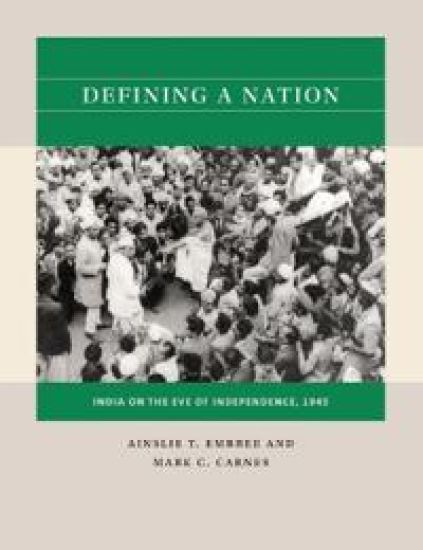
Defining a Nation

Defining a Nation

Ainslie T. Embree; Mark C. Carnes

THE UNIVERSITY OF NORTH CAROLINA PRESS
2022
pokkari
Defining a Nation is set at Simla, in the foothills of the Himalayas, where the British viceroy has invited leaders of various religious and political constituencies to work out the future of Britain's largest colony. Will the British transfer power to the Indian National Congress, which claims to speak for all Indians? Or will a separate Muslim state&8213;Pakistan&8213;be carved out of India to be ruled by Muslims, as the Muslim League proposes? And what will happen to the vulnerable minorities&8213;such as the Sikhs and untouchables&8213;or the hundreds of princely states? As British authority wanes, tensions among Hindus, Muslims, and Sikhs smolder and increasingly flare into violent riots that threaten to ignite all India. Towering above it all is the frail but formidable figure of Gandhi, whom some revere as an apostle of nonviolence and others regard as a conniving Hindu politician. Students struggle to reconcile religious identity with nation building&8213;perhaps the most intractable and important issue of the modern world. Texts include the literature of Hindu revival (Chatterjee, Tagore, and Tilak); the Koran and the literature of Islamic nationalism (Iqbal); and the writings of Ambedkar, Nehru, Jinnah, and Gandhi.
Utopias in Conflict

Utopias in Conflict

Ainslie T. Embree

University of California Press
2018
pokkari
This compact, incisive study by a senior scholar explores two sources of violent conflict in India: religion and nationalism. Showing how the political aspects of religion and the ideological character of nationalism have led inexorably to struggle, Ainslie T. Embree argues that the tension between competing visions of the just society has determined the social and political life of India. In India, as elsewhere in the world at the end of the twentieth century, religions legitimized violence as people struggled for what they regarded as their legitimate claims upon the future. As examples of the tension between religious and nationalist visions of the good society, Embree examines two explosive cases—one involving Muslim-Hindu communal encounters, the other, the separatist movement of the Sikhs. Thought-provoking and searching, Utopias in Conflict should interest anyone concerned about fundamentalism, the problems of national integration, and politics and religion in the Third World. This title is part of UC Press's Voices Revived program, which commemorates University of California Press’s mission to seek out and cultivate the brightest minds and give them voice, reach, and impact. Drawing on a backlist dating to 1893, Voices Revived makes high-quality, peer-reviewed scholarship accessible once again using print-on-demand technology. This title was originally published in 1990.
Defining a Nation

Defining a Nation

Ainslie T. Embree; Mark C. Carnes

WW Norton Co
2014
nidottu
Defining a Nation is set at Simla, in the foothills of the Himalayas, where the British viceroy has invited leaders of various religious and political constituencies to work out the future of Britain’s largest colony. Will the British transfer power to the Indian National Congress, which claims to speak for all Indians? Or will a separate Muslim state—Pakistan—be carved out of India to be ruled by Muslims, as the Muslim League proposes? And what will happen to the vulnerable minorities—such as the Sikhs and untouchables—or the hundreds of princely states? As British authority wanes, tensions among Hindus, Muslims and Sikhs smolder and increasingly flare into violent riots that threaten to ignite all India. Towering above it all is the frail but formidable figure of Gandhi, whom some revere as an apostle of nonviolence and others regard as a conniving Hindu politician. Students struggle to reconcile religious identity with nation building—perhaps the most intractable and important issue of the modern world. Texts include the literature of Hindu revival (Chatterjee, Tagore, and Tilak); the Koran and the literature of Islamic nationalism (Iqbal); and the writings of Ambedkar, Nehru, Jinnah, and Gandhi.