Kirjojen hintavertailu – 12 859 828 kirjaa ja 27 kauppaa

Kirjailija

Ajay Singh

Kirjat ja teokset yhdessä paikassa: 50 kirjaa, julkaisuja vuosilta 2014–2026, suosituimpiin kuuluu Gestione del punteruolo dello stelo, Chilo partellus Swinhoe, nel mais. Vertaile teosten hintoja ja tarkista saatavuus suomalaisista kirjakaupoista.

50 kirjaa

Kirjojen julkaisuvuodet: 2014–2026.

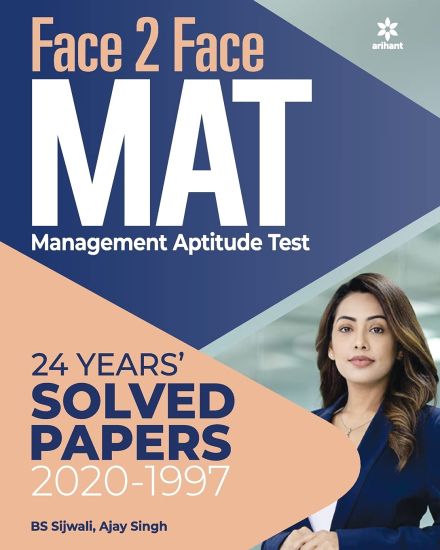
Face to Face Mat with 23 Years Solved Papers 2021

Face to Face Mat with 23 Years Solved Papers 2021

B.S. Sijwalii; Ajay Singh

Arihant Publication
2020
nidottu
1. FACE 2 FACE MAT is a complete collection of 24 years' Solved Papers 2. The book is divided into 5 section 3. Solved Papers are provided for the practice of the question 4. We detailed answers are given for every question for better understanding Here comes "FACE 2 FACE MAT 24 years' Solved Paper (2020 - 1997)" prepared under the close guidance of experts by keeping in mind to meet all the needs of students preparing for this exam and to gain entry into top business schools. Following the methodical approach this book gives comprehensive treatment to all the 5 sections as prescribed by the board. Ample numbers of solved questions (2020-1997) are mentioned in this book giving clear guidance on how to attempt the various types of questions with tips and tricks. Solved Papers are given to get acquainted with the paper pattern and question types. Adopting the unique style of teaching this book helps students to not only learn about the concepts but also managing time in during exam. Based on the latest syllabus and providing such a huge amount of solved papers, this book is a perfect study manual assuring success at your upcoming examination. TABLE OF CONTENT MAT SOLVED PAPER (Sept 2020), MAT SOLVE PAPER (May 2019), MAT SOLVED PAPER (May 2018), SECTION I: (Language & Comprehension), SECTION II: Intelligence & Critical Thinking, SECTION III: Mathematical Skills, SECTION IV: Data Analysis & Sufficiency, SECTION V: Indian & Global Environment.
Energy Saving at Kathmandu University. A Project Design to Lower Energy Consumption and Costs in the Girls' Hostel, Block-17
Project Report from the year 2016 in the subject Engineering - Power Engineering, grade: 5.00, Kathmandu University, language: English, abstract: This project report draws attention to the energy management process and opportunities in girls' hostel (Block-17) of Kathmandu University and different energy saving strategies with economic analysis and risks involved. The major energy consumption in the building is the lighting sources and consumes 73kWh/day in average with maximum loading of 8.652 kW. The major lighting sources, which consumes electricity, are Fluorescent Tube Lights (FTLs) and Compact Tube Lights (CFLs) used in building lighting design. The calculated cost of electrical energy by these sources are NRs.22746.30 under certain assumptions. The expected saving opportunities in building are by meeting state-of-the-art in lighting technology achieved by replacement of CFLs and FTLs by LED technology and Boost the building by green energy. The first opportunity save electricity 39kWh/day in average and thus reduction in cost by 53.3%. The second one option goes to green energy but have higher cost of energy. The both saving opportunities have its own financial and environmental risks involved. Two models are therefore developed: i) Replacement of CFLS and FTLs by LED in stages and ii) Solar-Grid Hybrid System. Each of the developed models save energy and cost and both have low environmental and financial risks involved in it.
Energy Consumption Survey of Kathmandu University and Comparative Study of Solar PV Installation and Diesel Generator Sets
Project Report from the year 2015 in the subject Energy Sciences, grade: 10.0, Kathmandu University, course: Planning and Operation of Energy System, language: English, abstract: The project entitled "Energy consumption survey of Kathmandu University and Comparative Study of Solar PV Installation and Diesel Generator Sets" is an initial step toward energy management in Kathmandu University. It is the study on Kathmandu University to find out how and where energy is used and to identify methods for energy savings. The major works included in our project consists of visual inspection and data collection, observations on the general condition of the facility and equipment and quantification, identification/verification of energy consumption and other parameters by measurements, detailed calculations, analyses and assumptions. This report is just a step of simple indication towards our destination of achieving energy efficiency in Kathmandu University. We would like to emphasize that an energy audit is a continuous process.
Particle Swarm Optimization Approach for Distributed Generation Planning to Improve the Voltage Profile Margin
Master's Thesis from the year 2017 in the subject Engineering - Mechanical Engineering, grade: 4.00, Kathmandu University (School of Engineering), course: Planning and Operation of Energy System, language: English, abstract: In power system, research area is widening and one is Distributed Generation (DG) integration in a distribution system. It restructures the power system and also helps in distribution system planning. This dissertation addresses the issue of voltage margin improvement by integrating DG unit and, therefore, this dissertation presents the model to enhance the candidate bus voltage of distribution system by optimal integration of DG units. The technical analysis is performed for radial distribution system (RDS). The proposed algorithm evaluates the base condition of loss and bus voltage and then generate populations of solutions at first stage. Optimization of DG unit size and locate the optimal bus can be done with the particle swarm optimization (PSO) method. The proposed paradigm works with the objective that minimize the active power loss under a constraint of voltage limit and DG size limit. Finally, the conclusion is that DG unit can locate optimally with optimized size to the distribution system for the voltage profile improvement of the buses and also the total loss of system is reduced. It is also concluded that the model can be used for any radial distribution systems.