Kirjojen hintavertailu – 12 859 829 kirjaa ja 27 kauppaa
Kirjailija
Ajith Abraham
Kirjat ja teokset yhdessä paikassa: 29 kirjaa, julkaisuja vuosilta 2009–2025, suosituimpiin kuuluu Intelligent Web Data Management: Software Architectures and Emerging Technologies. Vertaile teosten hintoja ja tarkista saatavuus suomalaisista kirjakaupoista.
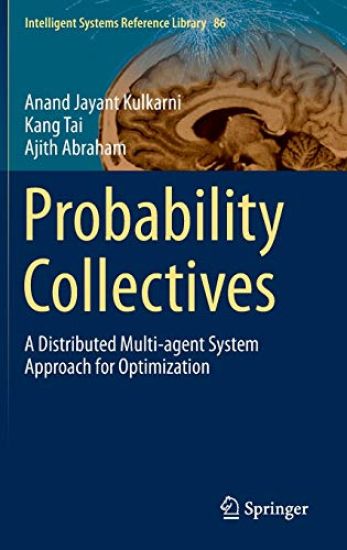
This book provides an emerging computational intelligence tool in the framework of collective intelligence for modeling and controlling distributed multi-agent systems referred to as Probability Collectives. In the modified Probability Collectives methodology a number of constraint handling techniques are incorporated, which also reduces the computational complexity and improved the convergence and efficiency. Numerous examples and real world problems are used for illustration, which may also allow the reader to gain further insight into the associated concepts.
This book examines distributed video coding (DVC) and multiple description coding (MDC), two novel techniques designed to address the problems of conventional image and video compression coding. Covering all fundamental concepts and core technologies, the chapters can also be read as independent and self-sufficient, describing each methodology in sufficient detail to enable readers to repeat the corresponding experiments easily. Topics and features: provides a broad overview of DVC and MDC, from the basic principles to the latest research; covers sub-sampling based MDC, quantization based MDC, transform based MDC, and FEC based MDC; discusses Sleplian-Wolf coding based on Turbo and LDPC respectively, and comparing relative performance; includes original algorithms of MDC and DVC; presents the basic frameworks and experimental results, to help readers improve the efficiency of MDC and DVC; introduces the classical DVC system for mobile communications, providing the developmental environment in detail.
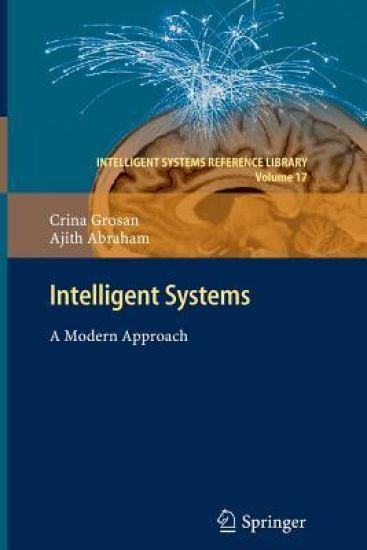
Computational intelligence is a well-established paradigm, where new theories with a sound biological understanding have been evolving. The current experimental systems have many of the characteristics of biological computers (brains in other words) and are beginning to be built to perform a variety of tasks that are difficult or impossible to do with conventional computers. As evident, the ultimate achievement in this field would be to mimic or exceed human cognitive capabilities including reasoning, recognition, creativity, emotions, understanding, learning and so on. This book comprising of 17 chapters offers a step-by-step introduction (in a chronological order) to the various modern computational intelligence tools used in practical problem solving. Staring with different search techniques including informed and uninformed search, heuristic search, minmax, alpha-beta pruning methods, evolutionary algorithms and swarm intelligent techniques; the authors illustrate the design of knowledge-based systems and advanced expert systems, which incorporate uncertainty and fuzziness. Machine learning algorithms including decision trees and artificial neural networks are presented and finally the fundamentals of hybrid intelligent systems are also depicted. Academics, scientists as well as engineers engaged in research, development and application of computational intelligence techniques, machine learning and data mining would find the comprehensive coverage of this book invaluable.
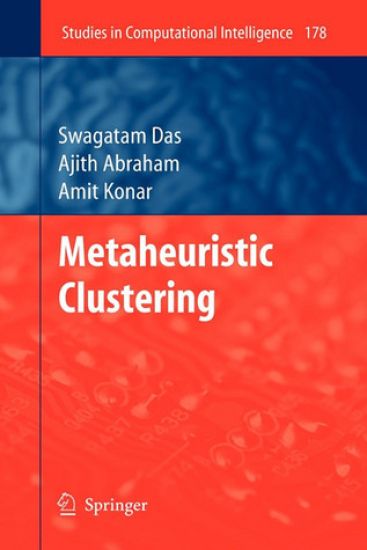
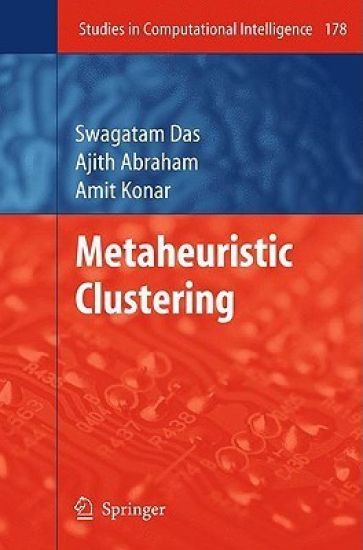
Cluster analysis means the organization of an unlabeled collection of objects or patterns into separate groups based on their similarity. The task of computerized data clustering has been approached from diverse domains of knowledge like graph theory, multivariate analysis, neural networks, fuzzy set theory, and so on. Clustering is often described as an unsupervised learning method but most of the traditional algorithms require a prior specification of the number of clusters in the data for guiding the partitioning process, thus making it not completely unsupervised. Modern data mining tools that predict future trends and behaviors for allowing businesses to make proactive and knowledge-driven decisions, demand fast and fully automatic clustering of very large datasets with minimal or no user intervention. In this volume, we formulate clustering as an optimization problem, where the best partitioning of a given dataset is achieved by minimizing/maximizing one (single-objective clustering) or more (multi-objective clustering) objective functions. Using several real world applications, we illustrate the performance of several metaheuristics, particularly the Differential Evolution algorithm when applied to both single and multi-objective clustering problems, where the number of clusters is not known beforehand and must be determined on the run. This volume comprises of 7 chapters including an introductory chapter giving the fundamental definitions and the last Chapter provides some important research challenges. Academics, scientists as well as engineers engaged in research, development and application of optimization techniques and data mining will find the comprehensive coverage of this book invaluable.
Cluster analysis means the organization of an unlabeled collection of objects or patterns into separate groups based on their similarity. The task of computerized data clustering has been approached from diverse domains of knowledge like graph theory, multivariate analysis, neural networks, fuzzy set theory, and so on. Clustering is often described as an unsupervised learning method but most of the traditional algorithms require a prior specification of the number of clusters in the data for guiding the partitioning process, thus making it not completely unsupervised. Modern data mining tools that predict future trends and behaviors for allowing businesses to make proactive and knowledge-driven decisions, demand fast and fully automatic clustering of very large datasets with minimal or no user intervention. In this volume, we formulate clustering as an optimization problem, where the best partitioning of a given dataset is achieved by minimizing/maximizing one (single-objective clustering) or more (multi-objective clustering) objective functions. Using several real world applications, we illustrate the performance of several metaheuristics, particularly the Differential Evolution algorithm when applied to both single and multi-objective clustering problems, where the number of clusters is not known beforehand and must be determined on the run. This volume comprises of 7 chapters including an introductory chapter giving the fundamental definitions and the last Chapter provides some important research challenges. Academics, scientists as well as engineers engaged in research, development and application of optimization techniques and data mining will find the comprehensive coverage of this book invaluable.