Kirjailija
Alain Badiou
Kirjat ja teokset yhdessä paikassa: 155 kirjaa, julkaisuja vuosilta 1999–2026, suosituimpiin kuuluu Ahmed the Philosopher. Vertaile teosten hintoja ja tarkista saatavuus suomalaisista kirjakaupoista.
155 kirjaa
Kirjojen julkaisuvuodet: 1999–2026.
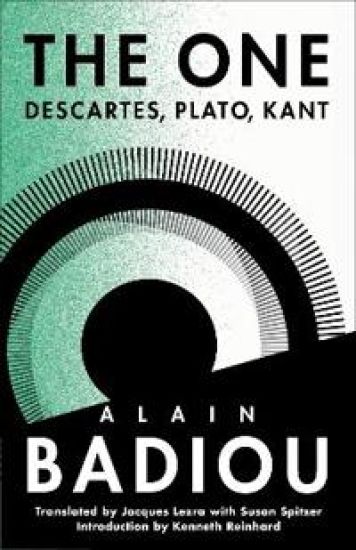
Alain Badiou’s 1983–1984 lecture series on “the One” is the earliest of his seminars that he has chosen to publish. It focuses on the philosophical concept of oneness in the works of Descartes, Plato, and Kant—a crucial foil for his signature metaphysical concept, the multiple. Badiou declares that there is no “One”: there is no fundamental unit of being; being is inherently multiple. What is novel in Badiou’s view of multiplicity is his reliance on mathematics, and set theory in particular. A set is a collection of things—yet, as he observes, it often is taken to “count as one” operationally for the purposes of mathematical transformations. In this seminar, distinguishing between “the One” and “counting as one” emerges as essential to Badiou’s ontological project. His analysis of reflections on oneness in Descartes, Plato, and Kant prefigures core arguments of his defining work, Being and Event. Showcasing the seeds of Badiou’s key ideas and later thought, The One features singular readings, breathtaking theorizations, and frequently astonishing offhand remarks.
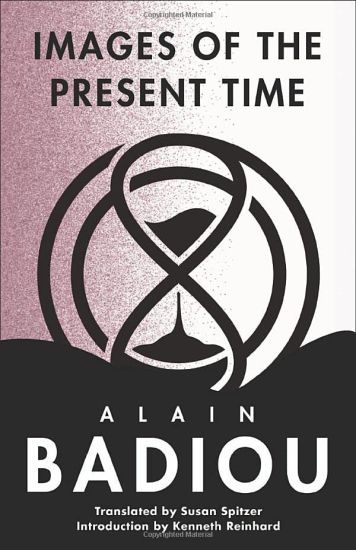
Finalist, 2024 Translation Prize - Nonfiction, French-American FoundationAlain Badiou began the twenty-first century by considering the relationship between philosophy and notions of “the present.” In this period of his ongoing annual lecture series, the acclaimed philosopher took up the existential problem of how to be contemporary with one’s own time—that is, how to not simply inhabit a passing moment but bring a real present into existence. Images of the Present Time presents nearly three years of Badiou’s seminars, held from 2001 to 2004, partly against the backdrop of the war in Iraq. Given while Badiou was writing Logics of Worlds, the second of the three volumes of Being and Event, these lectures address some of the same questions of existence in a particular world in a more personal and conversational tone, with reference to literature, philosophy, and contemporary politics and culture. He proposes a new concept of living in a real present as the twisting together of something from the past and something of the future. Featuring some of the philosopher’s most inspiring and approachable work, Images of the Present Time is an important book for all readers interested in the practical as well as conceptual possibilities of Badiou’s thought.
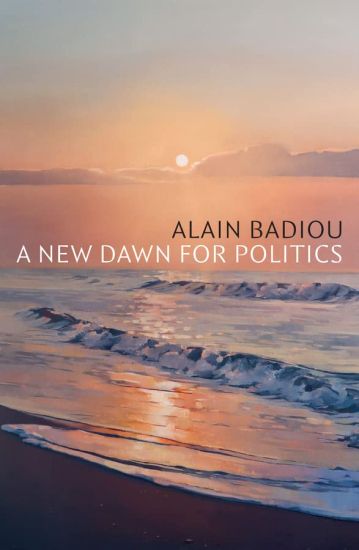
A New Dawn for Politics
Alain Badiou
JOHN WILEY AND SONS LTD
2022
sidottu
Halvin toimitettuna 53,30 €
What is the relation between politics and the world? It might seem that global capitalism has created one world, but this is an illusion because capitalism creates a world of objects and money that divides human existence into regions separated by fences and walls built to keep some people out. In place of this falsely unified world of global capitalism, we need to assert a fundamental principle – namely, that there is one world of living subjects. This, in Badiou's view, is the categorical imperative of all true politics. The one world of living subjects is the place where an infinity of differences and identities exist. Hence foreigners are not a problem but rather an opportunity and a gift. They bear witness to the youth of the world in its infinite variety, and it is with this youth that the politics of the future rests. Foreignness is the means by which existence is re-evaluated, and all true politics is a new dawn of existence. This collection of essays by Badiou, in which he draws out the political implications of recent events and social movements, will be of value to anyone interested in the great social and political questions of our time.
An accessible introduction to Badiou's key ideas In this short and accessible book, the French philosopher Alain Badiou provides readers with a unique introduction to his system of thought, summed up in the trilogy of Being and Event, Logics of Worlds, and The Immanence of Truths. Taking the form of an interview and two talks and keeping in mind a broad audience without any prior knowledge of his work, the book touches upon the central concepts and major preoccupations of Badiou's philosophy: fundamental ontology, mathematics, politics, poetry, and love. Well-chosen examples illuminate his thinking in regards to being and universality, worlds and singularity, and the infinite and the absolute, among other topics. A veritable tour de force of pedagogical clarity, this new student-friendly work is perhaps the single best general introduction to the work of this prolific and committed thinker. If, for Badiou, the task of philosophy consists in thinking through the truths of our time, the texts collected in this small volume could not be timelier.
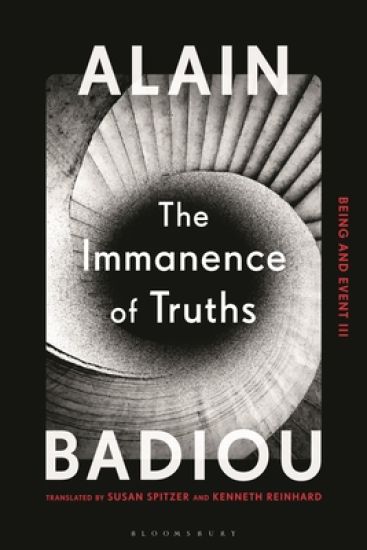
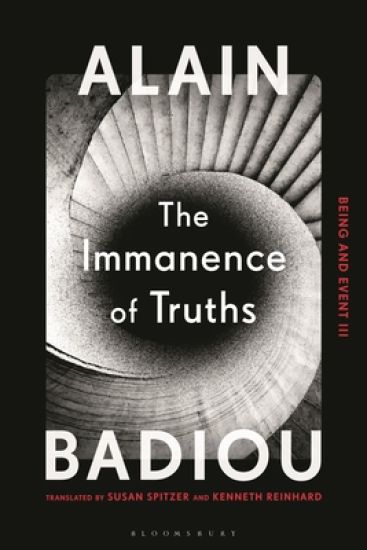
The Being and Event trilogy is the philosophical basis of Alain Badiou's entire oeuvre. It is formed of three major texts, which constitute a kind of metaphysical saga: Being and Event (1988). ), Logics of the Worlds (2006) and finally The Immanence of Truths, which he has been working on for 15 years. The new volume reverses the perspective adopted in Logics of Worlds. Where in that book, Badiou saw fit to analyze how truths, qua events, appear from the perspective of particular worlds that by definition exclude them, in The Immanence of Truths Badiou asks instead how the irruption of truths transforms the worlds within which they by necessity must arise. An emphasis on regularity and continuity has given way to an attempt, one unquestionable in its philosophical power and implications, to formalize rupture and reconfiguration. The Being and Event trilogy is a unique and ambitious work that reveals how truths can be at once context-specific and universal, situational and eternal.
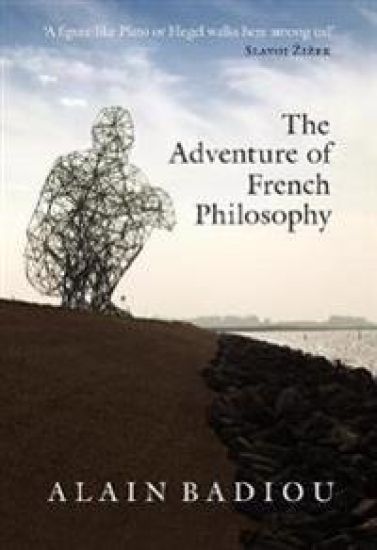
The Adventure of French Philosophy is essential reading for anyone interested in what Badiou calls the "French moment" in contemporary thought. Badiou explores the exceptionally rich and varied world of French philosophy in a number of groundbreaking essays, published here for the first time in English or in a revised translation. Included are the often-quoted review of Louis Althusser's canonical works For Marx and Reading Capital and the scathing critique of "potato fascism" in Gilles Deleuze and Félix Guattari's A Thousand Plateaus. There are also talks on Michel Foucault and Jean-Luc Nancy, and reviews of the work of Jean-François Lyotard and Barbara Cassin, notable points of interest on an expansive tour of modern French thought. Guided by a small set of fundamental questions concerning the nature of being, the event, the subject, and truth, Badiou pushes to an extreme the polemical force of his thinking. Against the formless continuum of life, he posits the need for radical discontinuity; against the false modesty of finitude, he pleads for the mathematical infinity of everyday situations; against the various returns to Kant, he argues for the persistence of the Hegelian dialectic; and against the lure of ultraleftism, his texts from the 1970s vindicate the role of Maoism as a driving force behind the communist Idea.
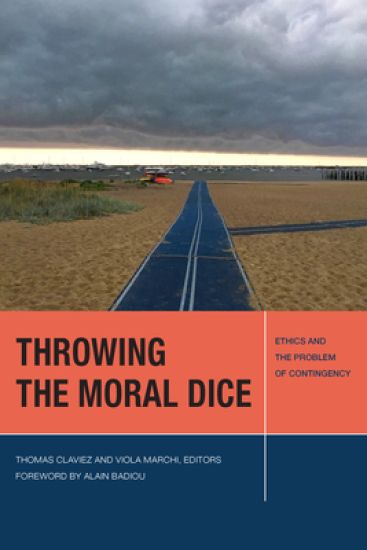
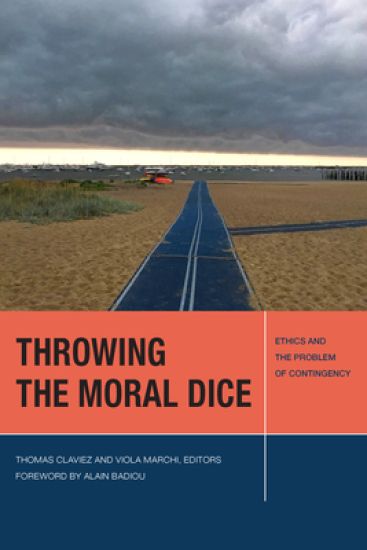
More than a purely philosophical problem, straddling the ambivalent terrain between necessity and impossibility, contingency has become the very horizon of everyday life. Often used as a synonym for the precariousness of working conditions under neoliberalism, for the unknown threats posed by terrorism, or for the uncertain future of the planet itself, contingency needs to be calculated and controlled in the name of the protection of life. The overcoming of contingency is not only called upon to justify questionable mechanisms of political control; it serves as a central legitimating factor for Enlightenment itself. In this volume, nine major philosophers and theorists address a range of questions around contingency and moral philosophy. How can we rethink contingency in its creative aspects, outside the dominant rhetoric of risk and dangerous exposure? What is the status of contingency—as the unnecessary and law-defying—in or for ethics? What would an alternative "ethics of contingency"—one that does not simply attempt to sublate it out of existence—look like? The volume tackles the problem contingency has always posed to both ethical theory and dialectics: that of difference itself, in the difficult mediation between the particular and the universal, same and other, the contingent singularity of the event and the necessary generality of the norms and laws. From deconstruction to feminism to ecological thought, some of today's most influential thinkers reshape many of the most debated concepts in moral philosophy: difference, agency, community, and life itself. Contributors: Étienne Balibar, Rosi Braidotti, Thomas Claviez, Drucilla Cornell, Hans Ulrich Gumbrecht, Viola Marchi, Michael Naas, Cary Wolfe, Slavoj Žižek
Throwing the Moral Dice
Alain Badiou
Fordham University Press
2021
sidottu
Halvin toimitettuna 126,60 €
More than a purely philosophical problem, straddling the ambivalent terrain between necessity and impossibility, contingency has become the very horizon of everyday life. Often used as a synonym for the precariousness of working conditions under neoliberalism, for the unknown threats posed by terrorism, or for the uncertain future of the planet itself, contingency needs to be calculated and controlled in the name of the protection of life. The overcoming of contingency is not only called upon to justify questionable mechanisms of political control; it serves as a central legitimating factor for Enlightenment itself. In this volume, nine major philosophers and theorists address a range of questions around contingency and moral philosophy. How can we rethink contingency in its creative aspects, outside the dominant rhetoric of risk and dangerous exposure? What is the status of contingency—as the unnecessary and law-defying—in or for ethics? What would an alternative "ethics of contingency"—one that does not simply attempt to sublate it out of existence—look like? The volume tackles the problem contingency has always posed to both ethical theory and dialectics: that of difference itself, in the difficult mediation between the particular and the universal, same and other, the contingent singularity of the event and the necessary generality of the norms and laws. From deconstruction to feminism to ecological thought, some of today's most influential thinkers reshape many of the most debated concepts in moral philosophy: difference, agency, community, and life itself. Contributors: Étienne Balibar, Rosi Braidotti, Thomas Claviez, Drucilla Cornell, Hans Ulrich Gumbrecht, Viola Marchi, Michael Naas, Cary Wolfe, Slavoj Žižek
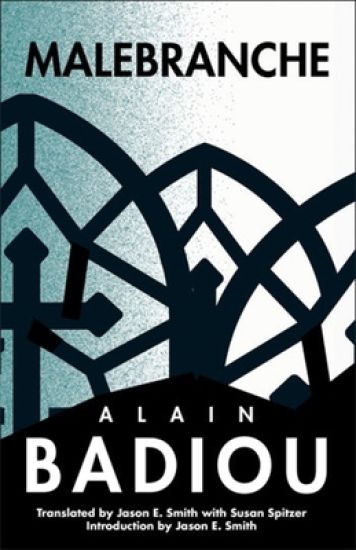
Alain Badiou is perhaps the world’s most significant living philosopher. In his annual seminars on major topics and pivotal figures, Badiou developed vital aspects of his thinking on a range of subjects that he would go on to explore in his influential works. In this seminar, Badiou offers a tour de force encounter with a lesser-known seventeenth-century philosopher and theologian, Nicolas Malebranche, a contemporary and peer of Spinoza and Leibniz. The seminar is at once a record of Badiou’s thought at a key moment in the years before the publication of his most important work, Being and Event, and a lively interrogation of Malebranche’s key text, the Treatise on Nature and Grace. Badiou develops a rigorous yet novel analysis of Malebranche’s theory of grace, retracing his claims regarding the nature of creation and the relation between God and world and between God and Jesus. Through Malebranche, Badiou develops a radical concept of truth and the subject. This book renders a seemingly obscure post-Cartesian philosopher fascinating and alive, restoring him to the philosophical canon. It occupies a pivotal place in Badiou’s reflections on the nature of being that demonstrates the crucial role of theology in his thinking.
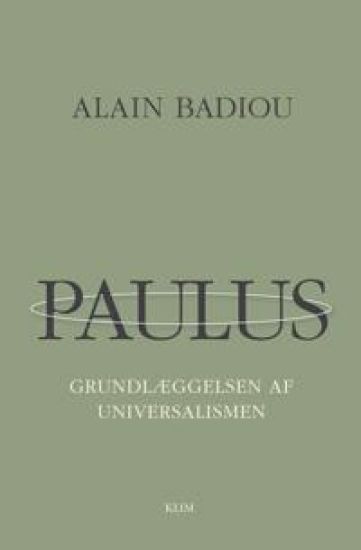
Hvem var Paulus, og hvad er hans relevans i dag? Den franske filosof Alain Badiou cementerer Paulus som en central og vedkommende figur, ikke kun for kristne og ikke kun i bibelsk tid, men for enhver i ”moderne politisk refleksion”. Paulus er relevant i dag netop på grund af hans budskab om universalisme, som Badiou fremhæver som det, der kan skabe fælles grund i vor tids polariserede debat. Paulus siger: ”Tænk ikke hver især på jeres eget, men tænk alle lige præcis på de andres el” (Filipperbrevet 2,4), og med det som udgangspunkt muliggør han eksistensen af både særidentitet og universalisme, i én og samme verden. Vi eksisterer i fællesskab, på grund af, og ikke på trods af, vores forskelle. Det er Kristusbegivenhedens radikale budskab ifølge ateisten Badious Paulus – og det henvender sig til os alle, med et universelt og aktivistisk budskab. Bogen er forsynet med en kyndigt efterskrift af Troels Engberg-Pedersen, professor i teologi og forfatter til bogen ‘Paulus og identitet’.
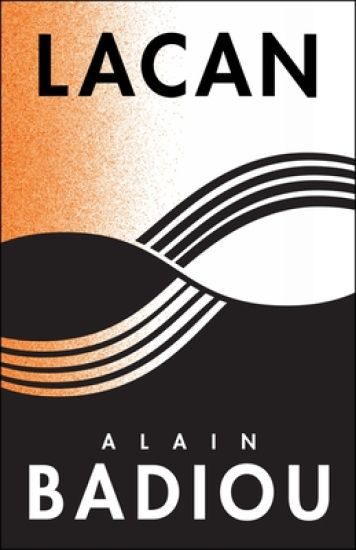
Alain Badiou is arguably the most significant philosopher in Europe today. Badiou’s seminars, given annually on major conceptual and historical topics, constitute an enormously important part of his work. They served as laboratories for his thought and public illuminations of his complex ideas yet remain little known. This book, the transcript of Badiou’s year-long seminar on the psychoanalytic theory of Jacques Lacan, is the first volume of his seminars to be published in English, opening up a new and vital aspect of his thinking. In a highly original and compelling account of Lacan’s theory and therapeutic practice, Badiou considers the challenge that Lacan poses to fundamental philosophical topics such as being, the subject, and truth. Badiou argues that Lacan is a singular figure of the “anti-philosopher,” a series of thinkers stretching back to Saint Paul and including Kierkegaard and Nietzsche, with Lacan as the last great anti-philosopher of modernity. The book offers a forceful reading of an enigmatic yet foundational thinker and sheds light on the crucial role that Lacan plays in Badiou’s own thought. This seminar, more accessible than some of Badiou’s more difficult works, will be profoundly valuable for the many readers across academic disciplines, art and literature, and political activism who find his thought essential.
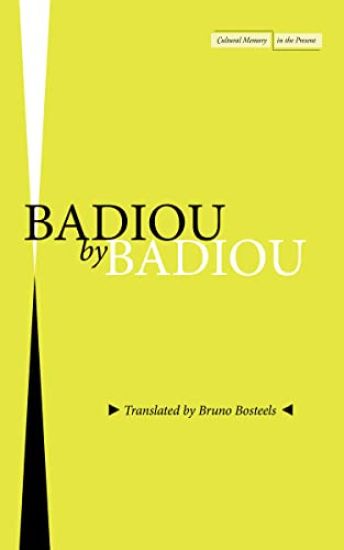
Ecrits autour de la pensée d'Alain Badiou
Alain Badiou; Oliver Feltham; Bruno Besana
La philosophie en commun
2020
nidottu
The question of migration has come to dominate the news agenda in many countries, but what does the word ‘migrant’ really mean today and how should we respond to those who are labelled ‘migrants’? In this short book Alain Badiou argues that our way of thinking about migration should be governed both by an ethical duty to welcome the migrant in the name of hospitality and also by the urgent need to put an end to the global capitalist oligarchy that has produced the migrant as a figure of contemporary crisis. For the ‘migrant,’ argues Badiou, is in fact a nomadic proletarian. Today, our homeland is the world, and any meaningful politics must include those who come to us and who represent the universal nomadic proletariat. Writing with the rigor, clarity, and polemical flair that have made him one of the world’s most influential philosophers, and drawing on a rich body of material including contemporary poetry and the words of an anonymous migrant, Badiou develops a powerful riposte to those who have stoked the fear of migrants and exploited the migration question for political ends.
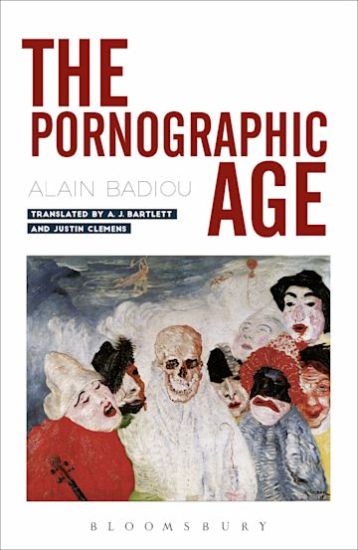
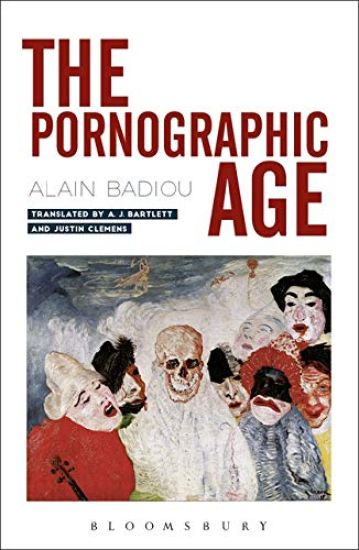
Offering a piercing indictment of what we have let ourselves become, this short, critical work is a damning critique of the current age and of the democratic systems that characterize it. Alain Badiou argues that any truly radical politics must begin with dismantling the obscene (or pornographic) qualities of neoliberal capitalism. In The Pornographic Age he asks us to hold up a mirror to ourselves and confront the debasement of the political realities in which we live, the shock of which must galvanize us into action. It is only through this realization, this crucial confrontation with the perversity with which we conduct our daily lives that we can prompt true revolution. Including an afterword from international Badiou scholars A. J. Bartlett and Justin Clemens and a commentary by William Watkin, this book is a philosophical call to arms: Badiou’s radical indictment of the current age is an exciting, no-holds-barred exploration of both how we live and how we might live.
Alain Badiou har er i en sen alder opnået fornyet popularitet. Hans politiske tænkning har sprængkraft og aktualitet i en tid, der præges af popularisme og neoliberalisme. Denne bog samler to meget kritiske tekster om Donald Trump og samtidens politiske landskab - herunder ikke blot USAs men også Europas. Badiou advarer om, at vi bruger for meget krudt på Trumps mediecirkus og opfordrer i stedet til at se populisternes fremmarch som et symptom, der kalder på noget radikalt nyt. Badiou understreger i den forbindelse nødvendigheden af et reelt alternativ til ‘the establishment’ på venstrefløjen, og her er det naturligvis Bernie Sanders snarere end Hilary Clinton, der peges på.