Kirjojen hintavertailu – 12 903 725 kirjaa ja 27 kauppaa

Kirjailija

Alain Prochiantz

Kirjat ja teokset yhdessä paikassa: 3 kirjaa, julkaisuja vuosilta 1995–2002, suosituimpiin kuuluu Mind-Machine / Machine-esprit. Vertaile teosten hintoja ja tarkista saatavuus suomalaisista kirjakaupoista.

3 kirjaa

Kirjojen julkaisuvuodet: 1995–2002.

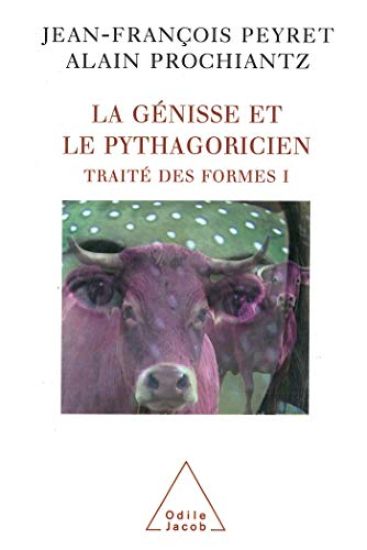
Heifer and the Pythagorean: Treatise on Forms I / La Génisse et le Pythagorien: Traité des formes I
? Trait des Passions is not a play. Neither is it an essay about the dangerous liaisons between art and science, nor about their unlikely encounter. It is not even the transcription of yet another conversation between a scientist and an artist who have jumped onto the overcrowded interdisciplinary bandwagon together: for how could anyone hope to define the common ground between such completely different subjects as Ovid's poetry and development biology? ? Instead, the theatre director experiments here with the juxtaposition between the poetic force of some early Western fables, The Metamorphoses, and several modern scientific texts. And the biologist is obliged to think and work within the framework of this experiment. Ours is a hybrid art. We have crossed dramatic with scientific literature, truth with fiction, and traditional with contemporary texts in an attempt to link them.? We met not simply to converse, but to create something together. And that'something was a theatrical production about metamorphoses, nutrition, the relations between animal and human, between Apollo and Dionysus, between Orpheus and Pythagoras. What more could we have dreamt of to make us succumb to the desire to play with forms as well as to play together? What more did we need to confI'm that what we have in common is a code of conscientious professionalI'm and ironic distance, a minimum of tact The performance took place. Let's wager that this ?notebook? containing the material we accumulated ? and that'sometimes takes on the form of tiny explosions ? is worthy of publication. The necessary, risky job of cutting and selecting the material was done in the course of rehearsals and production work. It is now up to the readers to make their own selection, and fied their own mirror.? J.-F. Peyret and A. ProchiantzTrait des passions was first produced at Strasbourg's Th tre National in April 2002. It will be performed again at the Th tre de Gennevilliers, near Paris, from 8 November to 7 December 2002. Jean-Fran ois Peyret is a theatre director who is known for his productions based on texts by Montaigne, Lucretius, Shakespeare and W. H. Auden. He recently directed the series Trait des passions (Treatise on Passions), at MC93, a theatre in the Paris suburb of Bobigny. He is the co-author, with Jean-Didier Vincent, of Faust, une histoire naturelle. He teaches at the University of Paris-III. Alain Prochiantz heads the department of biology at the cole Normale Sup rieure. He is the author of La Biologie dans le boudoir, Anatomies de la pens e, Machine-esprit and Strat gies de l?embryon.

Mind-Machine / Machine-esprit

Mind-Machine / Machine-esprit

Alain Prochiantz

Odile Jacob
2000
nidottu
In La Biologie dans le Boudoir, a pastiche of a work by the Marquis de Sade, Alain Prochiantz had already suggested that the development of the brain is governed by a few genes, and that, paradoxically, this leads to an assertion of freedom that abolishes the very notion of nature. In Machine-Esprit, his long-awaited new book, Prochiantz adopts a more serious but equally lively tone to confront some of the most significant of today's biological theories. What, among all other physical phenomena, confers upon a living creature its particular characteristics? What is biology's place among other scientific subjects, with which it is often in conflict? The author re-examines the works of D'Arcy Thompson, Schr dinger, Brillouin, as well as those of Turing and Dawkins, and shows the problems that have resulted from efforts to reduce "life" to mathematical, physical, cybernetic or thermodynamic categories. What is characteristic of a living creature? Its iedividuality, says the author. But what is an iedividual -- and, more specifically, a human iedividual? Prochiantz says the answer can be found by studying development -- and not only from an evolutionary or genetic point of view. This leads him to trace the development of the human brain. He concludes with an examination of the originality of the thought process, which, despite its biological basis, is neither a substance nor a mechanI'm, but the relation between an iedividual and his or her environment. There is enough material here to fuel the growing debate on the current efforts to abolish the frontiers between the natural sciences and the humanities, in the name of the oneness of all knowledge, whatever its source. Alain Prochiantz heads the laboratory on the development and evolution of the nervous system (CNRS) at the Ecole Normale Sup rieure. He is the author of Les Strat gies de l'Embryon, Claude Bernard: La R volution Physiologique, La Biologie dans le Boudoir and Les Anatomies de la Pens e.
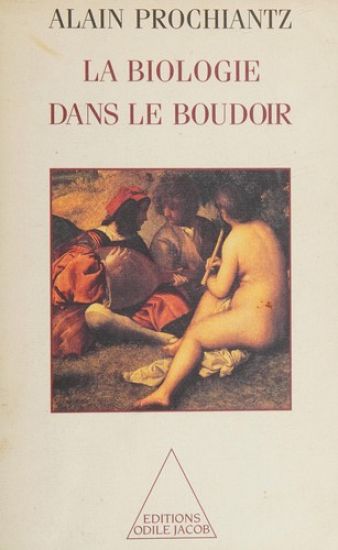
Biology in the Bedroom / La Biologie dans le boudoir
Inspiring himself from La Philosophie dans le boudoir by Sade and the major philosophical works of the 18th century, Alain Prochiantz, who is a neurobiologist, explains by means of a dialogue, the progress of embryology and neurobiology and gives us the elements so that we can understand and measure the stakes of the recent discovery of the genes of development. Alain Prochiantz heads the Laboratory for the Development and Evolution of the Nervous System at the cole normale sup rieure. He is notably the author of Strategies of the Embryo, and Claude Bernard, the Physiological Revolution.