Kirjojen hintavertailu – 12 903 725 kirjaa ja 27 kauppaa

Kirjailija

Alan Liu

Kirjat ja teokset yhdessä paikassa: 7 kirjaa, julkaisuja vuosilta 2004–2023, suosituimpiin kuuluu Software Engineering. Vertaile teosten hintoja ja tarkista saatavuus suomalaisista kirjakaupoista.

7 kirjaa

Kirjojen julkaisuvuodet: 2004–2023.

Software Engineering

Software Engineering

Jonathan Lee; Alan Liu

Apple Academic Press Inc.
2023
sidottu
Providing readers with essential knowledge in software engineering, this book contains the best practices that are ready to use for real problems. It emphasizes open source tools and covers up-to-date challenges of software development with easy-to-understand case studies. Not bound by a single theory and concept alone, readers can use it as a tool book to attack real life problems as well as a reference book to keep up with the current trends and core knowledge in software engineering.
Friending the Past

Friending the Past

Alan Liu

University of Chicago Press
2018
sidottu
Can today’s society, increasingly captivated by a constant flow of information, share a sense of history? How did our media-making forebears balance the tension between the present and the absent, the individual and the collective, the static and the dynamic—and how do our current digital networks disrupt these same balances? Can our social media, with its fleeting nature, even be considered social at all? In Friending the Past, Alan Liu proposes fresh answers to these innovative questions of connection. He explores how we can learn from the relationship between past societies whose media forms fostered a communal and self-aware sense of history—such as prehistorical oral societies with robust storytelling cultures, or the great print works of nineteenth-century historicism—and our own instantaneous present. He concludes with a surprising look at how the sense of history exemplified in today’s JavaScript timelines compares to the temporality found in Romantic poetry. Interlaced among these inquiries, Liu shows how extensive “network archaeologies” can be constructed as novel ways of thinking about our affiliations with time and with each other. These conceptual architectures of period and age are also always media structures, scaffolded with the outlines of what we mean by history. Thinking about our own time, Liu wonders if the digital, networked future can sustain a similar sense of history.
Friending the Past

Friending the Past

Alan Liu

University of Chicago Press
2018
pokkari
Can today’s society, increasingly captivated by a constant flow of information, share a sense of history? How did our media-making forebears balance the tension between the present and the absent, the individual and the collective, the static and the dynamic—and how do our current digital networks disrupt these same balances? Can our social media, with its fleeting nature, even be considered social at all? In Friending the Past, Alan Liu proposes fresh answers to these innovative questions of connection. He explores how we can learn from the relationship between past societies whose media forms fostered a communal and self-aware sense of history—such as prehistorical oral societies with robust storytelling cultures, or the great print works of nineteenth-century historicism—and our own instantaneous present. He concludes with a surprising look at how the sense of history exemplified in today’s JavaScript timelines compares to the temporality found in Romantic poetry. Interlaced among these inquiries, Liu shows how extensive “network archaeologies” can be constructed as novel ways of thinking about our affiliations with time and with each other. These conceptual architectures of period and age are also always media structures, scaffolded with the outlines of what we mean by history. Thinking about our own time, Liu wonders if the digital, networked future can sustain a similar sense of history.
Local Transcendence

Local Transcendence

Alan Liu

University of Chicago Press
2008
nidottu
Driven by global economic forces to innovate, today's society paradoxically looks forward to the future while staring only at the nearest, most local present - the most recent financial quarter, the latest artistic movement, the instant message or blog post at the top of the screen. Postmodernity is lived, it seems, at the end of history. In the essays collected in "Local Transcendence", Alan Liu takes the pulse of such postmodern historicism by tracking two leading indicators of its acceleration in the late twentieth and early twenty-first centuries: postmodern cultural criticism - including the new historicism, the new cultural history, cultural anthropology, the new pragmatism, and postmodern and postindustrial theory - and digital information technology. What is the relation between the new historicist anecdote and the database field, Liu asks, and can either have a critical function in the age of postmodern historicism? "Local Transcendence" includes one previously unpublished essay and a synthetic introduction in which Liu traverses from his earlier work on the theory of historicism to his recent studies of information culture to propose a theory of contingent method incorporating a special inflection of history: media history.

Local Transcendence

Local Transcendence

Alan Liu

University of Chicago Press
2008
sidottu
Driven by global economic forces to innovate, today's society paradoxically looks forward to the future while staring only at the nearest, most local present - the most recent financial quarter, the latest artistic movement, the instant message or blog post at the top of the screen. Postmodernity is lived, it seems, at the end of history. In the essays collected in "Local Transcendence", Alan Liu takes the pulse of such postmodern historicism by tracking two leading indicators of its acceleration in the late twentieth and early twenty-first centuries: postmodern cultural criticism - including the new historicism, the new cultural history, cultural anthropology, the new pragmatism, and postmodern and postindustrial theory - and digital information technology. What is the relation between the new historicist anecdote and the database field, Liu asks, and can either have a critical function in the age of postmodern historicism? "Local Transcendence" includes one previously unpublished essay and a synthetic introduction in which Liu traverses from his earlier work on the theory of historicism to his recent studies of information culture to propose a theory of contingent method incorporating a special inflection of history: media history.

The Laws of Cool

The Laws of Cool

Alan Liu

University of Chicago Press
2004
sidottu
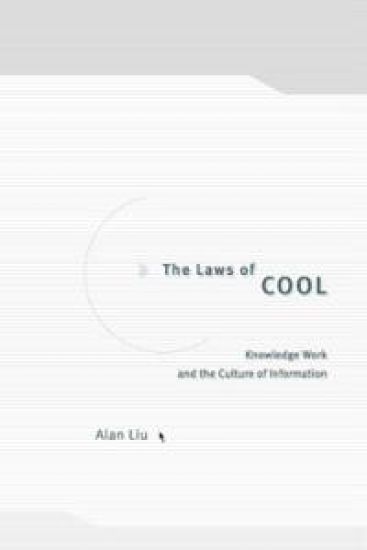
Knowledge work is now the reigning business paradigm and affects even the world of higher education. But what perspective can the knowledge of the humanities and arts contribute to a world of knowledge work whose primary mission is business? And what is the role of information technology as both the servant of the knowledge economy and the medium of a new technological cool? In The Laws of Cool, Alan Liu reflects on these questions as he considers the emergence of new information technologies and their profound influence on the forms and practices of knowledge. Liu first explores the nature of postindustrial corporate culture, studies the rise of digital technologies, and charts their dramatic effect on business. He then shows how such technologies have given rise to a new high-tech culture of cool. At the core of this book are an assessment of this new cool and a measured consideration of its potential and limitations as a popular new humanism. According to Liu, cool at once mimics and resists the postindustrial credo of innovation and creative destruction, which holds that the old must perpetually give way to the new. Information, he maintains, is no longer used by the cool just
The Laws of Cool

The Laws of Cool

Alan Liu

University of Chicago Press
2004
nidottu
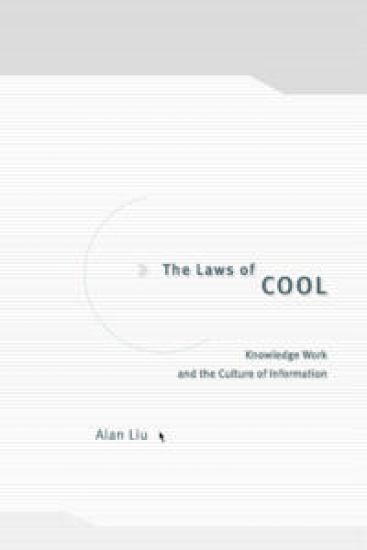
Knowledge work is now the reigning business paradigm and affects even the world of higher education. But what perspective can the knowledge of the humanities and arts contribute to a world of knowledge work whose primary mission is business? And what is the role of information technology as both the servant of the knowledge economy and the medium of a new technological cool? In The Laws of Cool, Alan Liu reflects on these questions as he considers the emergence of new information technologies and their profound influence on the forms and practices of knowledge. Liu first explores the nature of postindustrial corporate culture, studies the rise of digital technologies, and charts their dramatic effect on business. He then shows how such technologies have given rise to a new high-tech culture of cool. At the core of this book are an assessment of this new cool and a measured consideration of its potential and limitations as a popular new humanism. According to Liu, cool at once mimics and resists the postindustrial credo of innovation and creative destruction, which holds that the old must perpetually give way to the new. Information, he maintains, is no longer used by the cool just