Kirjojen hintavertailu – 12 859 826 kirjaa ja 27 kauppaa

Kirjailija

Alan S. Kaufman

Kirjat ja teokset yhdessä paikassa: 8 kirjaa, julkaisuja vuosilta 1998–2016, suosituimpiin kuuluu Intelligent Testing with the WISC-V. Vertaile teosten hintoja ja tarkista saatavuus suomalaisista kirjakaupoista.

Nimi esiintyy myös muodoissa: Alan S. Kaufman

8 kirjaa

Kirjojen julkaisuvuodet: 1998–2016.

Intelligent Testing with the WISC-V

Intelligent Testing with the WISC-V

Alan S. Kaufman; Susan Engi Raiford; Diane L. Coalson

John Wiley Sons Inc
2016
sidottu

Halvin toimitettuna 81,40 €

Interpret the WISC–V to help diagnose learning disabilities and to translate profiles of test scores to educational action The Wechsler Intelligence Scale for Children—Fifth Edition (WISC–V) is a valuable tool for assessing children and adolescents with learning disorders—and Intelligent Testing with the WISC–V offers the comprehensive guidance you need to administer, score, and interpret WISC–V profiles for informing diagnoses and making meaningful educational recommendations. This essential resource provides you with cutting-edge expertise on how to interpret the WISC–V, which has an expanded test structure, additional subtests, and an array of new composites. Intelligent Testing offers valuable advice from experienced professionals with regard to clinically applying the WISC–V in an effort to understand a child's strengths and weaknesses—and to create a targeted, appropriate intervention plan. Ultimately, this book equips you with the information you need to identify the best theory-based methods for interpreting each child's profile of test scores within the context of his or her background and behaviors. Intelligent Testing provides a strong theoretical basis for interpreting the WISC–V from several vantage points, such as neuropsychological processing theory and the Cattell-Horn-Carroll (CHC) model, yet it permits you to interpret children's profiles using simple, straightforward steps. The most frequently used IQ test in the world, the WISC–V (like previous versions of the WISC) plays an integral role in evaluating children for learning and intellectual disabilities, developmental and language delays, and gifted and talented classifications. As such, understanding how to use the latest version of WISC is extremely important when assessing children and adolescents ages 6 to 16 years. Explore all aspects of both the conventional WISC–V and WISC–V DigitalRead objective, independent test reviews of the WISC–V from independent, highly-respected expert sourcesReview 17 clinical case reports that spotlight experiences of children and adolescents referred to psychologists for diverse reasons such as reading problems, specific learning disabilities, ADHD, intellectual giftedness, and autistic spectrum disordersLearn how a broad-based, multi-faceted approach to interpretation that calls upon several scientific concepts from the fields of cognitive neuroscience, clinical and school neuropsychology, neuropsychological processing, and the CHC model, can benefit children by providing meaningful recommendations to parents, teachers, and often to the children and adolescents themselvesUse the results of WISC–V as a helping agent to assist in creating the best intervention plan, rather than allowing test results to dictate placement or labeling Intelligent Testing with the WISC–V is an indispensable resource for professionals who work with the WISC–V, including school psychologists, clinical psychologists, educational diagnosticians, and more.
Essentials of Child and Adolescent Psychopathology

Essentials of Child and Adolescent Psychopathology

Linda Wilmshurst; Alan S. Kaufman; Nadeen L. Kaufman

John Wiley Sons Inc
2015
nidottu
A concise guide to the fundamentals of child psychopathology, complete with the latest developments Essentials of Child and Adolescent Psychopathology, Second Edition provides a concise, accessible overview of the major theories, assessment practices, and key issues. This updated Second Edition describes the significant changes in the way DSM?-5 conceptualizes disorders in children and adolescents, and includes a new chapter on child abuse, child maltreatment, and self-injurious behavior. Using practical case examples to illustrate key points, the book addresses specific disorders and problems prevalent among this age group—including anxiety, mood disorders, and traumatic stress. Each chapter features reader-friendly elements like Rapid Reference, Caution, and Don't Forget boxes that call out important information, facilitating easy look-up and quick navigation. This invaluable resource fills the need for an overview of the most current issues and changes in the field, allowing readers to: Review the development, theories, and influences in child and adolescent psychopathologyUnderstand neurodevelopmental disorders including intellectual and developmental disabilities, ADHD, and specific learning disabilities or disordersCompare and contrast the manifestations of internalized vs. externalized disordersExamine later-onset disorders and special topics including eating disorders, substance abuse, and trauma-related disorders The book also includes appendices on ethical conduct, assessment instruments, and IDEA 2004, providing readers the guidance and tools that can help increase positive outcomes. Whether used as a secondary text or as a professional reference, Essentials of Child and Adolescent Psychopathology, Second Edition provides an authoritative briefing on this evolving area of practice.
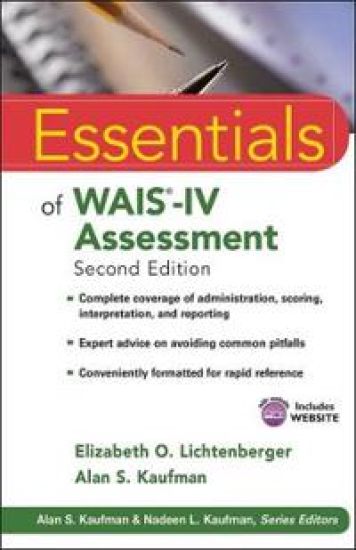
Essentials of WAIS-IV Assessment

Essentials of WAIS-IV Assessment

Elizabeth O. Lichtenberger; Alan S. Kaufman

John Wiley Sons Inc
2012
nidottu

Halvin toimitettuna 54,70 €

Quickly acquire the knowledge and skills you need to confidently administer, score, and interpret the WAIS®-IV Coauthored by Alan S. Kaufman, who was mentored by David Wechsler—the creator of the Wechsler scales—Essentials of WAIS®-IV Assessment, Second Edition is thoroughly revised and updated to provide beginning and seasoned clinicians with comprehensive step-by-step guidelines for effective use of the WAIS®-IV. This invaluable guide provides clinicians with a brand new interpretive process, overhauling its system of profile interpretation to be equally powerful across the entire WAIS®-IV age range. Like all the volumes in the Essentials of Psychological Assessment series, this book is designed to help busy mental health professionals quickly acquire the basic knowledge and skills they need to make optimal use of a major psychological assessment instrument. Each concise chapter features numerous callout boxes highlighting key concepts, bulleted points, and extensive illustrative material, as well as test questions that help you gauge and reinforce your grasp of the information covered. The new edition explores timely topics including gender and ethnic differences, as well as the role of the Flynn Effect in capital punishment court cases. Along with an accompanying Website containing scoring tables and case report material, the Second Edition includes information and advice on how to administer Q-interactive™—the new digital version of the test—for administration of the WAIS®-IV via iPad® Essentials of Assessment Report Writing Essentials of WISC®-IV Assessment, Second Edition Essentials of WMS®-IV Assessment Essentials of Cross-Battery Assessment, Third Edition Essentials of WJ III™ Tests of Achievement Assessment Essentials of WJ III™ Cognitive Abilities Assessment, Second Edition Essentials of Neuropsychological Assessment, Second Edition Visit us on the Web at: wiley.com/psychology
IQ Testing 101

IQ Testing 101

Alan S. Kaufman

Springer Publishing Co Inc
2009
nidottu
Alan Kaufman's informal, accessible writing style never sacrifices precision. In ten short chapters, he provides an astonishing depth and breadth of information, including engaging personal anecdotes that offer fresh and revealing insights even for a very experienced professional in the field..." --John O. Willis, EdDRivier College Alan Kaufman has a knack for teaching complicated psychological constructs in a way that is simultaneously sophisticated and easily understood. In IQ Testing 101, he applies this gift masterfully to the complex, controversial field of intelligence testing.... If you want to know about intelligence testing-real IQ testing, not pop culture tests from the web or magazines, this is the book to read. -Cecil R. Reynolds, PhDEmeritusTexas A&M University Does your IQ really measure your intelligence? Is IQ genetic? Can your IQ vary? Do we get smarter or dumber as we get older? How will IQ tests be different in the future? Dr. Kaufman, a leading expert on the development of IQ tests, explores these critical questions and many more in IQ Testing 101. This book provides a brief, compelling introduction to the topic of IQ testing-its mysteries, misconceptions, and truths. This newest edition to the popular Psych 101 Series presents a common-sense approach to what IQ is and what it is not. In lucid, engaging prose, Kaufman explains the nature of IQ testing, as well as where it came from, and where it's going in the future. A quick, fun, even enlightening read, not only for psychologists and educators, but for anyone interested in the study of intelligence. The Psych 101 Series Short, reader-friendly introductions to cutting-edge topics in psychology. With key concepts, controversial topics, and fascinating accounts of up-to-the-minute research, The Psych 101 Series is a valuable resource for all students of psychology and anyone interested in the field. REVIEWS: In IQ Testing 101, Alan Kaufman gives a well thought out, articulate account of the historical development of intelligent IQ testing. It provides non-expert readers, like me, with a better understanding of IQ and its important clinical ramifications. Kaufman's engaging style of presentation makes you feel as if you are in the thick of this important field of inquiry... --Jeffrey W. Kirsch, PhDExecutive DirectorReuben H. Fleet Science Center This impressive book is replete with meaningful material, wonderful anecdotes, excellent examples, profound truths, and solid empiricism, backed an abundance of clinical experience.... This volume provides an outstanding introduction and a great refresher for readers interested in the topic of intelligence and its assessment." --Bruce A. Bracken, PhDThe College of William & Mary Professor Kaufman has made this remarkably accessible for all readers by using a personal journey of discovery style. So, whether you are a clinical psychologist or an interested lay person, 101 will tell you everything you wanted to know about IQ testing; don't be afraid to read it." --Thomas Dillon, PhDGroup Senior Vice President retiredScience Applications International Corporation Dr. Kaufman's superb writing makes one feel he is in the room talking to you.... Psychologists, parents, educators and research scientists could all profit from reading this most important work by a master writer and thinker." --Sara S. Sparrow, PhDYale University Child Study Center Kaufman provides an outstanding look at the field of intelligence and intelligence testing in a manner that is understandable and at the same time very sophisticated....with a marvelous mixture of science, good sense, his own experience as a test developer, and a dose of humor.--Jack A. Naglieri, PhDSenior Research ScientistDevereux Center for Resilient Children IQ Testing 101 is a must read for anyone (including IQ test administrators) looking for a clear, erudite, thought provoking, even entertaining introduction to the important issues surrounding IQ including the definitions, measurements, and development of human intelligence. So much is at stake with IQ testing and these ideas cannot be ignored. " --Scott Barry Kaufman, PhD (unrelated)Yale University, Dept of PsychologyCo-Editor of The Cambridge Handbook of Intelligence (with Robert J. Sternberg) [T]his book will find its way into many college syllabi, not only because of the depth and breath of its coverage, but because of the wonderful way in which Dr Kaufman is able to make a difficult, often misunderstood topic so clear and thoroughly enjoyable." --Ron Dumont, EdD, NCSPDirector of the Masters and Doctoral Programs in School PsychologyFairleigh-Dickinson University This essentially tiny volume manages to cover the history of intelligence measurement, genetic versus environmental sources of intelligence, controversial issues in psychometrics and usage, summaries of research on cognitive profiles of specific populations, the future of the IQ construct, and measurement of cognitive abilities in general. To get that much perspective into such small print space requires an experienced and objective author and Alan Kaufman manages the task very well." Elaine Fletcher-Janzen, Ed. D., NCSP, ABPdN The Chicago School of Professional Psychology
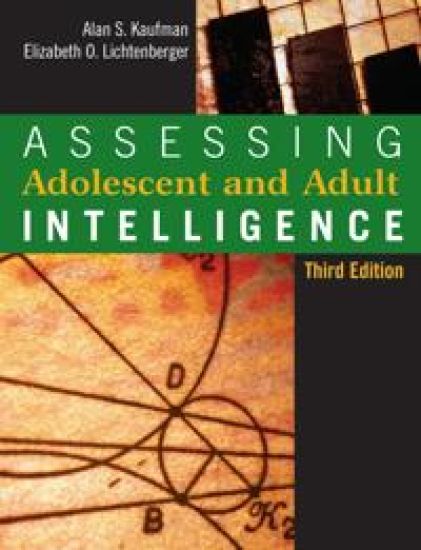
Assessing Adolescent and Adult Intelligence

Assessing Adolescent and Adult Intelligence

Alan S. Kaufman; Elizabeth O. Lichtenberger

John Wiley Sons Inc
2005
sidottu
The classic text--now updated with a new interpretive approach to the WAIS?-III Assessing Adolescent and Adult Intelligence, the classic text from Alan Kaufman and Elizabeth Lichtenberger, has consistently provided the most comprehensive source of information on cognitive assessment of adults and adolescents. The newly updated Third Edition provides important enhancements and additions that highlight the latest research and interpretive methods for the WAIS?-III. Augmenting the traditional "sequential" and "simultaneous" WAIS?-III interpretive methods, the authors present a new approach derived from Cattell-Horn-Carroll (CHC) theory. This approach combines normative assessment (performance relative to age peers) with ipsative assessment (performance relative to the person's own mean level). Following Flanagan and Kaufman's work to develop a similar CHC approach for the WISC?-IV, Kaufman and Lichtenberger have applied this system to the WAIS?-III profile of scores along with integrating recent WAIS?-III literature. Four appendices present the new method in depth. In addition to a detailed description, the authors provide a blank interpretive worksheet to help examiners make the calculations and decisions needed for applying the additional steps of the new system, and norms tables for the new WAIS?-III subtest combinations added in this approach. Assessing Adolescent and Adult Intelligence remains the premier resource for the field, covering not only the WAIS?-III but also the WJ III?, the KAIT, and several brief measures of intelligence, as well as laying out a relevant, up-to-date discussion of the discipline. The new, theory-based interpretive approach for the WAIS?-III makes this a vital resource for practicing psychologists, as well as a comprehensive text for graduate students.
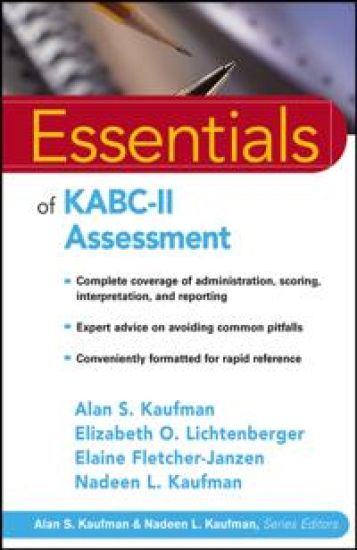
Essentials of KABC-II Assessment

Essentials of KABC-II Assessment

Alan S. Kaufman

John Wiley Sons Inc
2005
nidottu
Quickly acquire the knowledge and skills you need to confidently administer, score, and interpret the KABC-II Now designed for children aged three to eighteen, the KABC-II is among the top tier of children's tests of cognitive ability. Alan and Nadeen Kaufman, authors of the KABC-II, joined forces with Elizabeth Lichtenberger and Elaine Fletcher-Janzen to produce Essentials of KABC-II Assessment. The best source of information on the new edition of the K-ABC, Essentials of KABC-II Assessment provides students and practitioners with an unparalleled resource for learning and application, including expert assessment of the test's relative strengths and weaknesses, valuable advice on its clinical applications, and illuminating case reports. Like all the volumes in the Essentials of Psychological Assessment series, this book is designed to help busy mental health professionals quickly acquire the knowledge and skills they need to make optimal use of a major psychological assessment instrument. Each concise chapter features numerous callout boxes highlighting key concepts, bulleted points, and extensive illustrative material, as well as test questions that help you gauge and reinforce your grasp of the information covered.
Essentials of Cognitive Assessment with KAIT and Other Kaufman Measures

Essentials of Cognitive Assessment with KAIT and Other Kaufman Measures

Elizabeth O. Lichtenberger; Debra Y. Broadbooks; Alan S. Kaufman

John Wiley Sons Inc
2000
nidottu
*Complete coverage of administration, scoring, interpretation, and reporting *Expert advice on avoiding common pitfalls *Conveniently formatted for rapid reference Quickly acquire the knowledge and skills you need to confidently administer, score, and interpret the Kaufman assessment tests The seven Kaufman measures include the Kaufman Adolescent and Adult Intelligence Test (KAIT); Kaufman Assessment Battery for Children (K-ABC); Kaufman Brief Intelligence Test (K-BIT); Kaufman Functional Academic Skills Test (K-FAST); Kaufman Short Neuropsychological Assessment Procedure (K-SNAP); Early Screening Profiles (ESP); and Kaufman Survey of Early Academic and Language Skills (K-SEALS). In order to use them properly, professionals need authoritative advice and guidance on how to administer, score, and interpret these tests. Essentials of Cognitive Assessment with KAIT and Other Kaufman Measures is that source. Like all the volumes in the Essentials of Psychological Assessment series, this book is designed to help busy mental health practitioners quickly acquire the knowledge and skills they need to make optimal use of major psychological assessment instruments. Each concise chapter features numerous callout boxes highlighting key concepts, bulleted points, and extensive illustrative material, as well as test questions that help you gauge and reinforce your grasp of the information covered. Essentials of Cognitive Assessment with KAIT and Other Kaufman Measures includes vital information about each of the seven Kaufman tests, including information on how to integrate the measures and recommendations of related readings. In addition to step-by-step guidance on test administration, scoring, and interpretation, the authors provide their expert assessment of the tests’ relative strengths and weaknesses, valuable advice on their clinical applications, and several illuminating case reports. Other titles in the Essentials of Psychological Assessment series: Essentials of WAIS-III Assessment Essentials of Bayley Scales of Infant Development-II Assessment Essentials of WISC-III and WPPSI-R Assessment Essentials of Myers-Briggs Type Indicator® Assessment Essentials of Rorschach Assessment Essentials of Career Interest Assessment Essentials of Nonverbal Assessment Essentials of Cross-Battery Assessment
Advances in Cross-Cultural Assessment

Advances in Cross-Cultural Assessment

Ronald J. Samuda; Reuven Feuerstein; Alan S. Kaufman; John E. Lewis; Robert J. Sternberg; n/a Associates

SAGE Publications Inc
1998
nidottu
Presenting the major trends, theories, and practices in assessing culturally diverse clients, Advances in Cross-Cultural Assessment comprises chapters from some of the key leading authors in intelligence and intelligence testing. Author Ronald J. Samuda and associates contend that classic IQ tests and traditional standardized tests of cognitive ability are only appropriate for middle-class mainstream individuals, not for those of different cultural backgrounds. For those who grow up in deficient "environmental backgrounds" (inadequate rearing, serious economic stress), the traditional objective standardized tests are neither valid nor reliable in measuring intelligence. A number of scholars, some of whom are among the bookÆs contributing authors, have introduced alternative approaches to assessing cognitive ability in persons from such backgrounds. A groundbreaking volume that encourages professionals to treat individuals on an individual basis, Advances in Cross-Cultural Assessment will heighten the awareness of professionals and academics in clinical and counseling psychology, educational psychology, social work, psychology, public health, and ethnic studies.