Kirjojen hintavertailu – 12 859 818 kirjaa ja 27 kauppaa

Kirjailija

Alan Trachtenberg

Kirjat ja teokset yhdessä paikassa: 10 kirjaa, julkaisuja vuosilta 1979–2018, suosituimpiin kuuluu You Have Seen Their Faces. Vertaile teosten hintoja ja tarkista saatavuus suomalaisista kirjakaupoista.

10 kirjaa

Kirjojen julkaisuvuodet: 1979–2018.

You Have Seen Their Faces

You Have Seen Their Faces

Erskine Caldwell; Alan Trachtenberg

University of Georgia Press
2018
sidottu
In the middle years of the Great Depression, Erskine Caldwell and photographer Margaret Bourke-White spent eighteen months traveling across the back roads of the Deep South—from South Carolina to Arkansas—to document the living conditions of the sharecropper. Their collaboration resulted in You Have Seen Their Faces, a graphic portrayal of America's desperately poor rural underclass. First published in 1937, it is a classic comparable to Jacob Riis's How the Other Half Lives, and James Agee and Walker Evans's Let Us Now Praise Famous Men, which it preceded by more than three years. Caldwell lets the poor speak for themselves. Supported by his commentary, they tell how the tenant system exploited whites and blacks alike and fostered animosity between them. Bourke-White, who sometimes waited hours for the right moment, captures her subjects in the shacks where they lived, the depleted fields where they plowed, and the churches where they worshipped.
You Have Seen Their Faces

You Have Seen Their Faces

Erskine Caldwell; Alan Trachtenberg

University of Georgia Press
1995
pokkari
In the middle years of the Great Depression, Erskine Caldwell and photographer Margaret Bourke-White spent eighteen months traveling across the back roads of the Deep South—from South Carolina to Arkansas—to document the living conditions of the sharecropper. Their collaboration resulted in You Have Seen Their Faces, a graphic portrayal of America's desperately poor rural underclass. First published in 1937, it is a classic comparable to Jacob Riis's How the Other Half Lives, and James Agee and Walker Evans's Let Us Now Praise Famous Men, which it preceded by more than three years. Caldwell lets the poor speak for themselves. Supported by his commentary, they tell how the tenant system exploited whites and blacks alike and fostered animosity between them. Bourke-White, who sometimes waited hours for the right moment, captures her subjects in the shacks where they lived, the depleted fields where they plowed, and the churches where they worshipped.
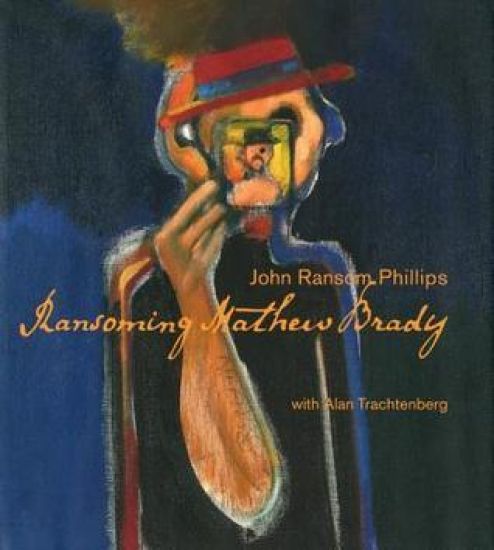
Ransoming Mathew Brady

Ransoming Mathew Brady

John Ransom Phillips; Alan Trachtenberg

Hudson Hills Press Inc.,U.S.
2010
sidottu
In a series of oils, watercolours, and prose full of wit and wisdom and rich with historical allusion, John Ransom Phillips portrays the complexity of nineteenth-century photographer, Mathew Brady. The photographs Brady made have long served to illustrate an era in American history, most notably his portraits of Abraham Lincoln and the images from the Civil War battlefields he captured. Pairing these photographs with his own work, Phillips explores the career of this artist who wanted to make history: An ambitious half-blind man with blue-tinted glasses, straw hat and duster who had the genius to look beyond his thriving New York portrait studio to the battles of the Civil War and was one of the first photographers to shoot in the open air. Paradoxically, Brady sent assistants to photograph his most famous scenes, the battlefields at Gettysburg, Vicksburg, and Antietam, instructing them to re-arrange the dead to create images that would enhance public notions about death and dying.
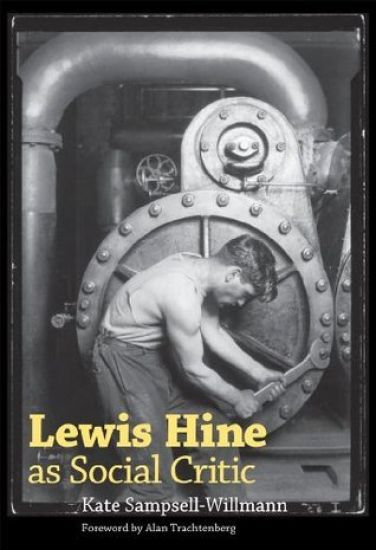
Lewis Hine As Social Critic

Lewis Hine As Social Critic

Kate Sampsell-Willmann; Alan Trachtenberg

University Press of Mississippi
2009
sidottu
This is the first full-length examination of Lewis H. Hine (1874-1940), the intellectual and aesthetic father of social documentary photography. Kate Sampsell-Willmann assesses Hine's output through the lens of his photographs, his political and philosophical ideologies, and his social and aesthetic commitments to the dignity of labor and workers. Using Hine's images, published articles, and private correspondence, Lewis Hine as Social Critic places the artist within the context of the Progressive Era and its associated movements and periodicals, such as the Works Progress Administration, Tennessee Valley Authority, the Chicago School of Social Work, and Rex Tugwell's American Economic Life and the Means of Its Improvement. This intellectual history, heavily illustrated with HIne's photography, compares his career and concerns with other prominent photographers of the day--Jacob Riis, Alfred Stieglitz, Paul Strand, Walker Evans, Dorothea Lange, and Margaret Bourke-White. Through detailed analysis of how Hine's images and texts intersected with concepts of urban history and social democracy, this volume reestablishes the artist's intellectual preeminence in the development of American photography as socially conscious art.
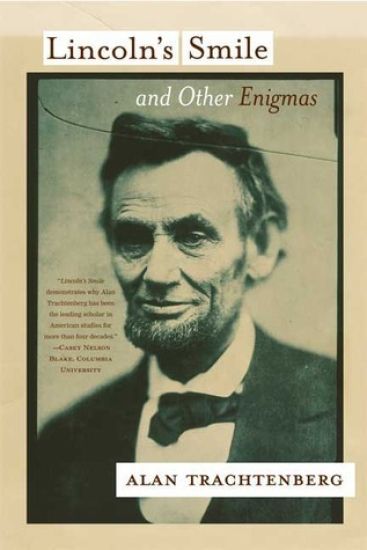
Lincoln's Smile and Other Enigmas

Lincoln's Smile and Other Enigmas

Alan Trachtenberg

St. Martins Press-3PL
2008
pokkari
""Lincoln's Smile" demonstrates why Alan Trachtenberg has been the leading scholar in American studies for more than four decades." Casey Nelson Blake, Columbia University Alan Trachtenberg has always been interested in cultural artifacts that register meanings and feelings that Americans share even when they disagree about them. Some of the most beloved ones like the famous last photograph of Abraham Lincoln, taken at the time of his second inaugural are downright puzzling, and it is their obscure, riddlelike aspects that draw his attention in the scintillating essays of "Lincoln's Smile and Other Enigmas." With matchless authority, Trachtenberg moves from daguerreotypes to literary texts to subjects as diverse as Louis Sullivan's Auditorium Building, the Brooklyn Bridge, and the early works of Lewis Mumford."
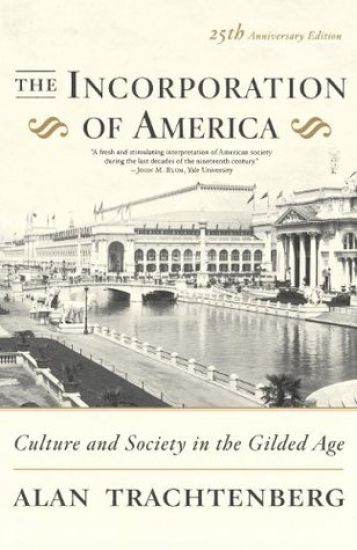
The Incorporation of America

The Incorporation of America

Alan Trachtenberg

HILL WANG INC.,U.S.
2007
pokkari
A classic examination of the roots of corporate culture, newly revised and updated for the twenty first century Alan Trachtenberg presents a balanced analysis of the expansion of capitalist power in the last third of the nineteenth century and the cultural changes it brought in its wake. In America's westward expansion, labor unrest, newly powerful cities, and newly mechanized industries, the ideals and ideas by which Americans lived were reshaped, and American society became more structured, with an entrenched middle class and a powerful business elite. Here, in an updated edition which includes a new introduction and a revised bibliographical essay, is a brilliant, essential work on the origins of America's corporate culture and the formation of the American social fabric after the Civil War.
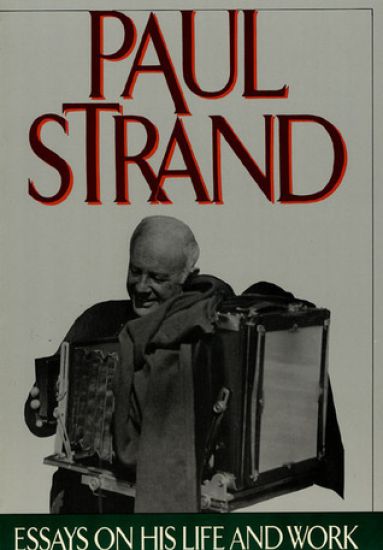
Paul Strand: Essays on His Life and Work

Paul Strand: Essays on His Life and Work

Maren Stang; Alan Trachtenberg

APERTURE
1991
nidottu

Halvin toimitettuna 26,20 €

"Paul Strand is universally acclaimed as a master. His pictures rank highly among the most often reproduced masterworks of photography and have an honored place within the canon of modern art as such. People viewing his work for the first or the hundredth time find themselves captivated within a visual domain of extraordinary immediacy and freshness, not just in textures, shapes, and forms but in subtleties which make for resonating coherences within and among images."--Alan Trachtenberg, author of" Reading American Photographs: Images as History, Mathew Brady to Walker Evans," excerpted from the" Introduction" "In Strand's pictures, we find the work of a quiet but intense man who transmuted the real into the ideal, "the ordinary in man and the transitory in nature converted into eternal symbols.""--Estelle Jussim, author of "Slave to Beauty: The Eccentric Life and Controversial Career of F. Holland Day, Photographer, Publisher, Aesthete," from her essay A visionary artist of the twentieth century, Paul Strand was much more than a gifted imagemaker. Throughout his long and productive life which ended in 1976, Strand was a leading advocate of photography as a fine art and a political activist deeply committed to social issues. He was an innovative filmmaker and a pioneer in developing photography books that combined images with words. To celebrate the centenary of Paul Strand's birth, an international team of scholars and writers, many of whom knew or worked with Strand, has produced a volume of essays and meditations on his life and work. Alan Trachtenberg, professor of English and American Studies at Yale University, provides the insightful introduction. Gloria Naylor, Russell Banks, Jim Harrison, Carolyn Forch , Jerome Liebling, Charles Simic, and Reynolds Price respond, each uniquely, to individual photographs. Naomi Rosenblum, Jan-Christopher Horak, Robert Adams, Milton Brown, Richard Benson, Estelle Jussim, and Anne Tucker, among others, offer lively scholarship and comment. Jussim discusses Strand's aesthetic ideals; Horak contributes an evaluation of the motion picture "Manhatta," produced in 1921 by Paul Strand and Charles Sheeler; Benson writes from personal experience about Strand's darkroom practices; and internationally-regarded photographic-historian Naomi Rosenblum offers a fresh account of Strand's early development. Drawing on letters, journals, interviews, and previously unpublished writings, these thoughtful essays span Strands lifetime, from his remarkable debut in Alfred Stieglitz's periodical, "Camera Work," to his travels in the American Southwest and in Mexico, and his final years in Europe and Africa. These essays are an unsurpassed chronicle of artistic genius and a vital addition to the library of every serious photographer, Strand aficionado, cultural historian, and print collector. Published in the 100th anniversary of Paul Strand's birth. Robert Adams, William Alexander, Russell Banks, Richard Benson, Milton W. Brown, Basil Davidson, Edmundo Desnoes, Catherine Duncan, Carolyn Forch , Brewster Ghiselin, Jim Harrison, Jan-Christopher Horak, Estelle Jussim, Jerome Liebling, Gloria Naylor, Reynolds Price, Belinda Rathbone, John Rohrbach, Naomi Rosenblum, Walter Rosenblum, Charles Simic, Alan Trachtenberg, Anne Tucker, Katherine C. Ware, Mike Weaver, Steve Yates

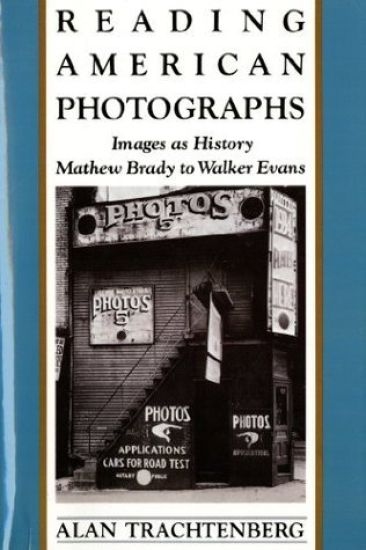
Reading American Photographs: Images as History-Mathew Brady to Walker Evans
Winner of the Charles C. Eldredge Prize In this book, Alan Trachtenberg reinterprets some of America's most significant photographs, presenting them not as static images but rather as rich cultural texts suffused with meaning and historical content. Reading American Photographs is lavishly illustrated with the work of such luminaries as Mathew Brady, Timothy O'Sullivan, and Walker Evans--pictures that document the American experience from 1839 to 1938. In an outstanding analysis, Trachtenberg eloquently articulates how the art of photography has both followed and shaped the course of American history, and how images captured decades ago provocatively illuminate the present.
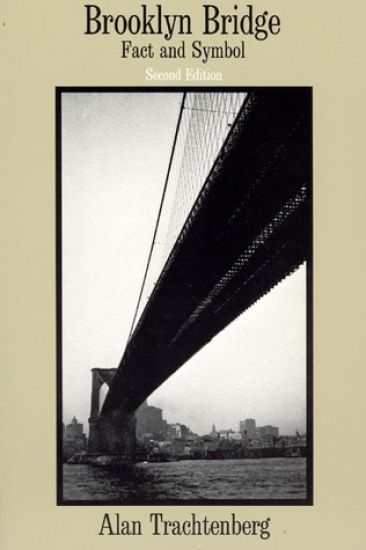
Brooklyn Bridge

Brooklyn Bridge

Alan Trachtenberg

University of Chicago Press
1979
nidottu
Fourteen of Walker Evans's evocative photographs of Brooklyn Bridge, most of which have never been published, appear in this edition of Alan Trachenberg's Brooklyn Bridge: Fact and Symbol. In the new afterword Trachenberg explores the history of Hart Crane's The Bridge, especially the poem's integral relationship with the powerful photography of Evans. "[Brooklyn Bridge] is familiar in so many movies, in so many stage sets and, as Mr. Trachtenberg shows in this brilliant . . . book, it is at least as much a symbol as a reality. . . . Mr. Trachtenberg is always exciting and illuminating."—Times Literary Supplement "The book is a skillful and insightful synthesis of materials about Brooklyn Bridge from such diverse fields as history, engineering, literature and art. Essentially it asks the question of why Brooklyn Bridge achieved such great impact on the nineteenth century American imagination and why it has continued to have a significant impact on twentieth century art and literature. In addition to its exploration of the bridge's symbolic significance, which includes perceptive analyses of such particular works as Hart Crane's great poem cycle and the paintings of artists like Joseph Stella, the book also includes a solidly researched account of the conception, planning and construction of the bridge. Trachtenberg's account of the intellectual and cultural sources of the bridge is particularly fascinating in its demonstration of the convergence of many different philosophical and ideological currents of the time around this great engineering enterprise, illustrating as effectively as any discussion I know the complex interplay of ideas and material culture."—John G. Cawelti, University of Chicago "Alan Trachtenberg's Brooklyn Bridge is a fascinating story, the philosophic genesis of the idea in Europe, John Roebling's heroic effort to translate it into masonry and steel, and the meanings that Americans attached to the physical object as an emblem of their aspirations."—Leo Marx, Amherst College, author of The Machine in the Garden