
Kirjojen hintavertailu – 12 903 725 kirjaa ja 27 kauppaa

Kirjailija

Alastair Hemmens

Kirjat ja teokset yhdessä paikassa: 3 kirjaa, julkaisuja vuosilta 2017–2020, suosituimpiin kuuluu The Critique of Work in Modern French Thought. Vertaile teosten hintoja ja tarkista saatavuus suomalaisista kirjakaupoista.

3 kirjaa

Kirjojen julkaisuvuodet: 2017–2020.

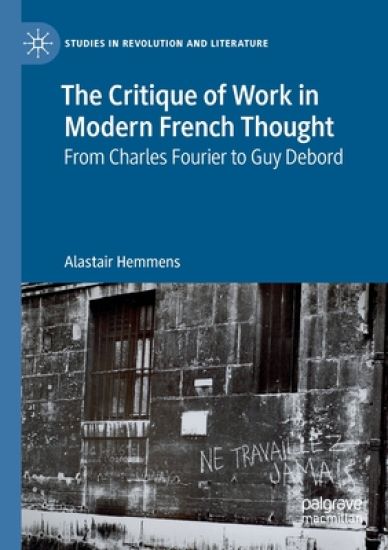
The Critique of Work in Modern French Thought

The Critique of Work in Modern French Thought

Alastair Hemmens

Springer Nature Switzerland AG
2020
nidottu
What is work? Why do we do it? Since time immemorial the answer to these questions, from both the left and the right, has been that work is both a natural necessity and, barring exploitation, a social good. One might criticise its management, its compensation and who benefits from it the most, but never work itself, never work as such. In this book, Alastair Hemmens seeks to challenge these received ideas. Drawing on the new ‘critique-of-value’ school of Marxian critical theory, Hemmens demonstrates that capitalism and its final crisis cannot be properly understood except in terms of the historically specific and socially destructive character of labour. It is from this radical perspective that Hemmens turns to an innovative critical analysis of the rich history of radical French thinkers who, over the past two centuries, have challenged the labour form head on: from the utopian-socialist Charles Fourier, who called for the abolition of the separation between work and play, and Marx’s wayward son-in-law, Paul Lafargue, who demanded The Right to Laziness (1880), to the father of Surrealism, André Breton, who inaugurated a ‘war on work’, and, of course, the French Situationist, Guy Debord, author of the famous graffito, ‘never work’. Ultimately, Hemmens considers normative changes in attitudes to work since the 1960s and the future of anti-capitalist social movements today. This book will be a crucial point of reference for contemporary debates about labour and the anti-work tradition in France.
The Critique of Work in Modern French Thought

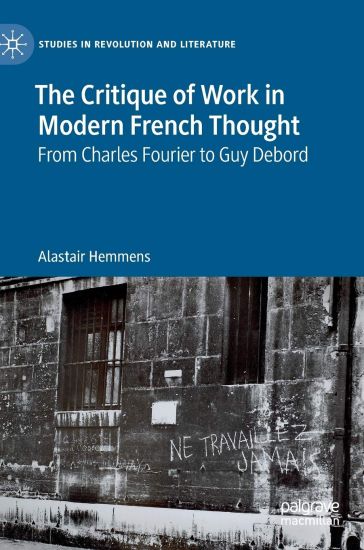
The Critique of Work in Modern French Thought

Alastair Hemmens

Springer Nature Switzerland AG
2019
sidottu
What is work? Why do we do it? Since time immemorial the answer to these questions, from both the left and the right, has been that work is both a natural necessity and, barring exploitation, a social good. One might criticise its management, its compensation and who benefits from it the most, but never work itself, never work as such. In this book, Alastair Hemmens seeks to challenge these received ideas. Drawing on the new ‘critique-of-value’ school of Marxian critical theory, Hemmens demonstrates that capitalism and its final crisis cannot be properly understood except in terms of the historically specific and socially destructive character of labour. It is from this radical perspective that Hemmens turns to an innovative critical analysis of the rich history of radical French thinkers who, over the past two centuries, have challenged the labour form head on: from the utopian-socialist Charles Fourier, who called for the abolition of the separation between work and play, and Marx’s wayward son-in-law, Paul Lafargue, who demanded The Right to Laziness (1880), to the father of Surrealism, André Breton, who inaugurated a ‘war on work’, and, of course, the French Situationist, Guy Debord, author of the famous graffito, ‘never work’. Ultimately, Hemmens considers normative changes in attitudes to work since the 1960s and the future of anti-capitalist social movements today. This book will be a crucial point of reference for contemporary debates about labour and the anti-work tradition in France.
Writing on the Wall, The – On the Decomposition of Capitalism and Its Critics
The 2008 global financial crisis has led to the re-emergence in public discourse of the idea that capitalism could end. For many, it was proof of the notion that capitalist civilisation has an endemic tendency towards crisis that will ultimately bring about its demise. Must we assume, however, that such an eventuality would inevitably result in the liberation of humanity, as many orthodox Marxists claim? Through a collection of specially revised essays, first published in France between 2007 and 2010, Anselm Jappe draws on the radical new perspective of "the critique of value" as a critical tool with which to understand today's world and to re-examine the question of human emancipation. The Writing on the Wall offers a powerful new analysis of the decomposition of capitalism and its critics.