Kirjojen hintavertailu – 12 903 725 kirjaa ja 27 kauppaa
Kirjailija
Albert Feuerwerker
Kirjat ja teokset yhdessä paikassa: 8 kirjaa, julkaisuja vuosilta 1958–2011, suosituimpiin kuuluu Studies in the Economic History of Late Imperial China. Vertaile teosten hintoja ja tarkista saatavuus suomalaisista kirjakaupoista.
""Chinese Communist Studies of Modern Chinese History"" by Albert Feuerwerker is a comprehensive and in-depth exploration of the history of China from the perspective of the Chinese Communist Party (CCP). The book analyzes the CCP's interpretation of major events and figures in modern Chinese history, including the Opium War, the Taiping Rebellion, Sun Yat-sen, Chiang Kai-shek, and Mao Zedong. Feuerwerker provides a detailed examination of the CCP's historical narrative and how it has evolved over time. He also explores the political and ideological factors that have influenced the CCP's interpretation of Chinese history. The book is divided into three parts. Part one focuses on the early years of the CCP and its approach to history. Part two examines the CCP's views on specific historical events and figures. Part three analyzes the CCP's historical narrative in the post-Mao era. Overall, ""Chinese Communist Studies of Modern Chinese History"" is a valuable resource for scholars and students of Chinese history, politics, and ideology. It offers a unique perspective on the country's history and sheds light on the CCP's role in shaping China's national identity. This scarce antiquarian book is a facsimile reprint of the old original and may contain some imperfections such as library marks and notations. Because we believe this work is culturally important, we have made it available as part of our commitment for protecting, preserving, and promoting the world's literature in affordable, high quality, modern editions, that are true to their original work.
Albert Feuerwerker fashioned a distinguished legacy as a scholar of Chinese history. His publications on the nineteenth- and twentieth-century Chinese economy often became the starting point for any further work and staples for graduate training in modern Chinese history. Studies in the Economic History of Late Imperial China gathers seven foundational writings in one place for the first time, and adds one new piece on handicrafts in the sixteenth century to the list. Included is Feuerwerker’s “Handicraft and Manufactured Cotton Textils in China, 1871–1910,” which immediately after its publication in 1970 became the standard for research and argument about economic change in the late Qing. In this classic essay, Feuerwerker addresses the scarcity of quantitative data on the textiles industry in this time period, which prevented historians from interpreting qualitative sources. Along with a descriptive analysis, he presents several quantitative alternatives and weighs them to find which best protrays the fortunes of cotton textile handicrafts during the last four centuries of the Qing. Taken together, the chapters in Studies in the Economic History represent a cross-section of the enormous contributions Feuerwerker made to China scholarship.
The Chinese Economy reproduces two chapters on China’s economy originally published in The Cambridge History of China, vols. 11 (1980) and 12 (1983). These texts were written in the late 1970s, and reflect the state of the published literature on late imperial China and the republican era before the time that research in Ch’ing and republican archives in the People’s Republic of China was possible for foreign (and most Chinese) scholars. As such, they provide an overview of what China scholars knew on the eve of the opportunities that were to come in the post-1980 “open door” era. In part I, Albert Feuerwerker describes agriculture, the handicraft industry, modern industry, trade and commerce, and the fiscal system of China between 1870 and 1911. Slowly and on a very small scale, the Chinese economy began to change in the second half of the nineteenth century. Yet the changes were not dramatic and did not alter the economy’s capacity to grow. The Chinese economy had already reached the limits of development possible with the technology at its disposal, and very little new technology was imported or adopted before 1911. In part II, treating 1912 to 1949, Feuerwerker covers aspects of the economy including population, national income, industry, agriculture, transport, the fiscal system, and foreign trade and investment. In these years, the Chinese economy did not occupy center stage in the unfolding of the drama of Chinese history. The years prior to 1949 saw no “take-off” towards sustiained growth of aggregate output and the possibility of increased individual welfare that might accompany it.
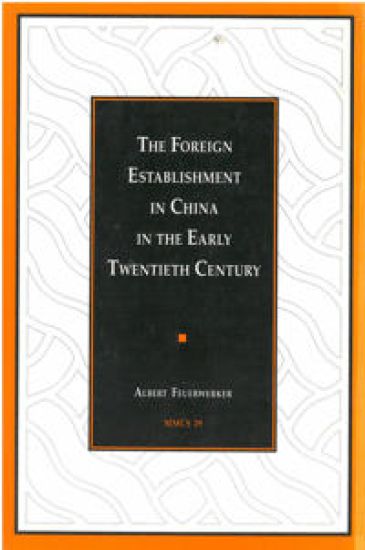
The foreign establishment in early republican china had many facets: territory people, rights established by treaty or unilaterally asserted, armed force, diplomacy, religion, commerce, journalism, freebooting adventure, racial attitudes. Foreign Establishment in China in the Early Twentieth Century describes the dimensions of each of the principle guises in which the foreigner impinged upon the polity, economy, society, and mind of China. [1]
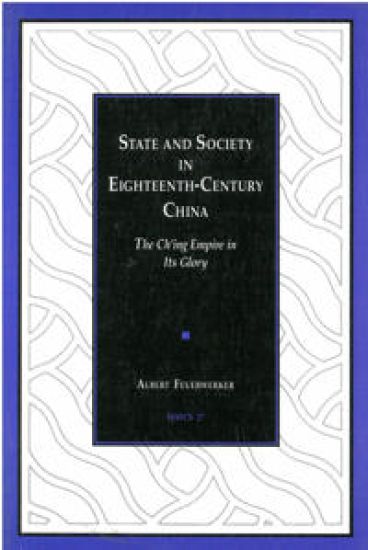
China in the reign of the Ch’ien-lung emperor was confident, prosperous, internally at peace, unchallenged at its frontiers. The Chinese self-image in the eighteenth century was as close to the historical reality from which it was abstracted as any idealized construct. This book describes the conditions that characterized Ch’ing society during its glory days.
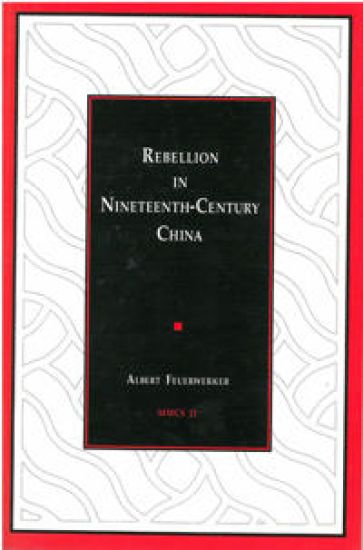
Popular rebellion in China was usually the undertaking of the mostly illiterate lower classes, sometimes inspired or assisted by a handful of disaffected intellectuals. The written record of these events is, on the other hand, overwhelmingly the product of literate men of power and wealth who suppressed these challenges to their authority and status. Added to this imbalance in the written record, an inverse problem has emerged in twentieth-century characterizations by historians in the People’s Republic of China. Communist historiography classifies these events as peasant uprisings (nung-min chi’i-i, literally “righteous uprisings of the peasantry”) in an attempt to construct a new, popular, and progressive past. Charting a course between these two modes, Rebellion in Nineteenth-Century China discusses domestic disorder with more nuance, considering the sources of social dissidence, the varieties of domestic rebellion, the responses of the state and society to such uprisings, and the consequences of rebellion and suppression for a dynasty already shaken by foreign invasion. Emphasizing the number and variety of these uprisings, Feuerwerker places them within a hierarchy of dissidence that distinguishes between 1) spontaneous, usually small-scale and local antiofficial or antilandlord actions, 2) interlineage and communal “feuds”, 3) the religion and secular “underworld”, 4) banditry, 5) rebellion, and 6) revolution. By distinguishing their contexts and causes, Feuerwerker describes and analyzes as one broad social phenomenon a remarkable number and variety of unsuccessful challenges to the Manchu regime.