Kirjojen hintavertailu – 12 903 733 kirjaa ja 27 kauppaa

Kirjailija

Albert Hazen Wright

Kirjat ja teokset yhdessä paikassa: 11 kirjaa, julkaisuja vuosilta 1994–2025, suosituimpiin kuuluu Life-Histories of the Frogs of Okefinokee Swamp, Georgia. Vertaile teosten hintoja ja tarkista saatavuus suomalaisista kirjakaupoista.

11 kirjaa

Kirjojen julkaisuvuodet: 1994–2025.

Life-Histories of the Frogs of Okefinokee Swamp, Georgia

Life-Histories of the Frogs of Okefinokee Swamp, Georgia

Albert Hazen Wright; J. Whitfield Gibbons

Cornell University Press
2002
sidottu
"Whether you spell it as Okefinokee like Wright (1931) or Okefenokee like The New Georgia Guide (1996), the big swamp nestled in the southeastern corner of Georgia and northern edge of Florida with its distinctive flora, fauna, and natural history is the largest swamp in North America."—from the Foreword The Okefenokee Swamp, named a National Wildlife Refuge by President Franklin Delano Roosevelt in 1937, is the country's largest intact wetland. Its continued protection is essential to native amphibian populations. Albert Hazen Wright's survey of the life histories of the frogs found in the Okefenokee at the beginning of the twentieth century is a classic of natural history, long out of print. Wright's "Acknowledgments to Residents" provide a fascinating portrait of the human context of his research. Wright goes on to outline the status of explorations of the region and offers an extensive general discussion of the Okefenokee and its frogs, including habitats, range, coloration, measurements, vocalization, mating, structural differences, ovulation, life periods, tadpoles, growth rates, food, and predators. The book's species accounts give clear and extensive details about the species found in Georgia, still applicable today to frogs throughout the East Coast of the United States. A new foreword by J. Whitfield Gibbons highlights appreciation for Wright's work in the context of amphibian studies today and puts into perspective the value of the Okefenokee Swamp as a nature preserve and as a refuge for native amphibian fauna now in serious decline. It updates common and scientific names and notes the current status of all taxa. Gibbons provides a history of the Cornell Expeditions and mentions the importance and later influence of some of the students who took part.

Our Georgia Florida Frontier, V1: The Okefinokee Swamp, Its History and Cartography
Our Georgia Florida Frontier, Volume 1: The Okefinokee Swamp, Its History And Cartography is a comprehensive book written by Albert Hazen Wright. The book provides an in-depth exploration of the Okefinokee Swamp, which is located in the southeastern United States, straddling the border between Georgia and Florida. The book is divided into two parts, with the first part focusing on the history of the swamp and the second part focusing on its cartography. In the first part of the book, Wright delves into the history of the Okefinokee Swamp, from its formation to its use by Native American tribes, early explorers, and settlers. He also explores the impact of the swamp on the region's economy, including the timber and turpentine industries. The second part of the book focuses on the cartography of the Okefinokee Swamp, including the various maps that have been created of the area over the years. Wright provides a detailed analysis of these maps, discussing their accuracy and their significance in understanding the swamp's history. Overall, Our Georgia Florida Frontier, Volume 1: The Okefinokee Swamp, Its History And Cartography is a comprehensive and informative book that provides readers with a detailed understanding of this unique and important region of the United States. Studies In History, No. 9-14. This scarce antiquarian book is a facsimile reprint of the old original and may contain some imperfections such as library marks and notations. Because we believe this work is culturally important, we have made it available as part of our commitment for protecting, preserving, and promoting the world's literature in affordable, high quality, modern editions, that are true to their original work.
Handbook of Frogs and Toads of the United States and Canada

Handbook of Frogs and Toads of the United States and Canada

Albert Hazen Wright; Anna Allen Wright; Roy W. McDiarmid

Cornell University Press
1995
pokkari
The preeminent naturalists Albert Hazen Wright and Anna Allen Wright spent years assembling the wealth of material on frogs and toads appearing in this widely used handbook, the third edition of which was originally published in 1949. With abundant black-and-white photographs, colorful descriptions, journal notes from the field, and excerpts from the literature, their personalized natural history emphasizes amphibians observed in the wild. In a foreword to the 1995 paperback edition, Roy McDiarmid, a foremost specialist on frogs and toads, brings the book into historical perspective and supplies information to bring it up to date. Accounts of more than 100 species and subspecies cover such topics as common and scientific names, range, habitat, size, and general appearance, as well as color, structure, voice, and breeding. Separate keys are given for secondary sexual characteristics, eggs, tadpoles, families, and species. Generous quotations from the Wrights' field journals give the reader a sense of the problems and satisfactions of their work.
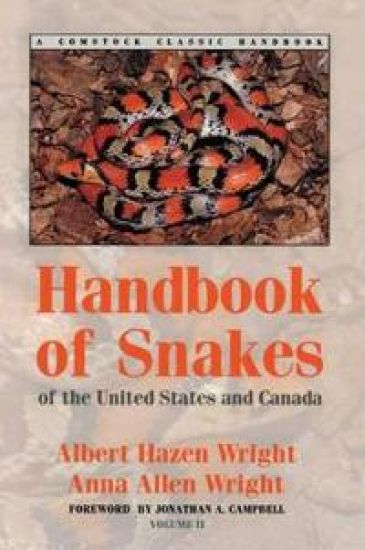
Handbook of Snakes of the United States and Canada

Handbook of Snakes of the United States and Canada

Albert Hazen Wright; Anna Allen Wright; Jonathan A. Campbell

Comstock Publishing Associates
1994
pokkari
For years Albert Hazen Wright and Anna Allen Wright traveled extensively, attempting to observe every species of snake in North America in its natural surroundings and collecting data and live specimens. Their exhaustive research resulted in a famous two-volume sourcebook, first published in 1957. Abundantly and painstakingly illustrated by the authors, this personalized natural history organizes for ready reference a wealth of information on American and Canadian snakes. Across the two volumes of Handbook of Snakes of the United States and Canada are accounts of more than three hundred species and subspecies, accompanied by photographs, drawings, and distribution maps. Generous excerpts from the authors' field journals give the reader a vivid feeling of some of the satisfactions and conclusions of the Wrights' search. Volume I features an introductory section in which the Wrights cover snake names and such features of their biology and behavior as range, size, longevity, distinctive characteristics, color, habitat, period of activity, breeding, ecdysis, food, venom and bite, and enemies. It also includes an informative new foreword written for the 1994 reprint edition by Jonathan A. Campbell, a leading expert on snakes. The main section of Volume I comprises in-depth accounts of twenty-nine snake species, from Leptotyphlopidae (blind snakes) to Opheodrys (green snakes). Volume II includes species accounts of nineteen species, from Oxybelis (pike-headed tree snakes) to Sistrurus (ground rattlesnakes, pigmy rattlesnakes, and massasaugas), as well as a glossary and an index for both volumes
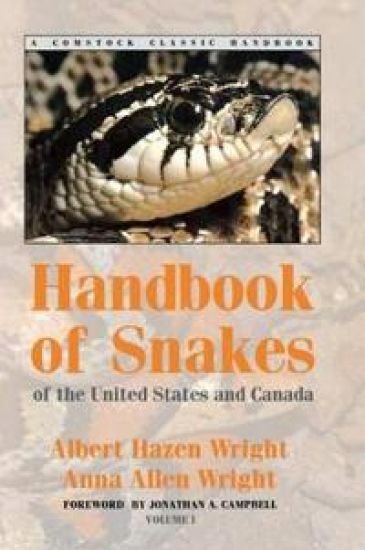
Handbook of Snakes of the United States and Canada

Handbook of Snakes of the United States and Canada

Albert Hazen Wright; Anna Allen Wright; Jonathan A. Campbell

Comstock Publishing Associates
1994
pokkari
For years Albert Hazen Wright and Anna Allen Wright traveled extensively, attempting to observe every species of snake in North America in its natural surroundings and collecting data and live specimens. Their exhaustive research resulted in a famous two-volume sourcebook, first published in 1957. Abundantly and painstakingly illustrated by the authors, this personalized natural history organizes for ready reference a wealth of information on American and Canadian snakes. Across the two volumes of Handbook of Snakes of the United States and Canada are accounts of more than three hundred species and subspecies, accompanied by photographs, drawings, and distribution maps. Generous excerpts from the authors' field journals give the reader a vivid feeling of some of the satisfactions and conclusions of the Wrights' search. Volume I features an introductory section in which the Wrights cover snake names and such features of their biology and behavior as range, size, longevity, distinctive characteristics, color, habitat, period of activity, breeding, ecdysis, food, venom and bite, and enemies. It also includes an informative new foreword written for the 1994 reprint edition by Jonathan A. Campbell, a leading expert on snakes. The main section of Volume I comprises in-depth accounts of twenty-nine snake species, from Leptotyphlopidae (blind snakes) to Opheodrys (green snakes). Volume II includes species accounts of nineteen species, from Oxybelis (pike-headed tree snakes) to Sistrurus (ground rattlesnakes, pigmy rattlesnakes, and massasaugas), as well as a glossary and an index for both volumes