Kirjojen hintavertailu – 12 859 824 kirjaa ja 27 kauppaa

Kirjailija

Albert N. Link

Kirjat ja teokset yhdessä paikassa: 57 kirjaa, julkaisuja vuosilta 1992–2026, suosituimpiin kuuluu Public Support of Private Innovation. Vertaile teosten hintoja ja tarkista saatavuus suomalaisista kirjakaupoista.

Nimi esiintyy myös muodoissa: Albert N Link

57 kirjaa

Kirjojen julkaisuvuodet: 1992–2026.

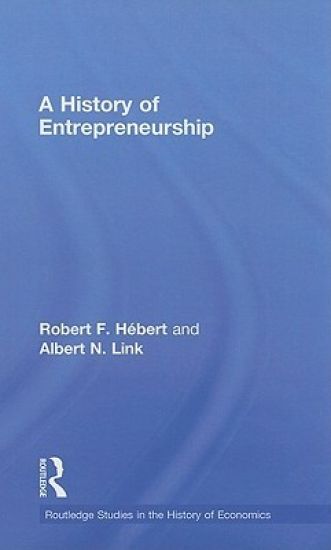
A History of Entrepreneurship

A History of Entrepreneurship

Robert F Hébert; Albert N. Link

Routledge
2012
nidottu
This book establishes a chronological trace of the entrepreneur as treated in economic literature in order to give a more wholesome perspective to contemporary writings and teachings on entrepreneurship. It focuses on the nature and role of the entrepreneur, and of entrepreneurship, as revealed in economic literature as early as the eighteenth century, when Richard Cantillon first coined the term 'entrepreneur'. The authors then trace how Joseph Schumpeter's perspective, among other’s, on entrepreneurship came to dominate the world's understanding of the term. Due to Schumpeter’s dominant influence, entrepreneurship has come to occupy a primary role in the theory of economic development. In this book Hébert and Link discuss various key topics including the German Tradition, the Austrian and the English School of thought as well as individuals such as Alfred Marshall and Jeremy Bentham. The historical survey also illustrates the tension that often exists between "theory" and "practice" and how it has been difficult for economic theory to assimilate a core concept that plays a vital role in social and economic change. Finally, the book exposes the many different facets of entrepreneurship as they have been perceived by some of the great economists throughout the ages.

Valuing an Entrepreneurial Enterprise

Valuing an Entrepreneurial Enterprise

David B. Audretsch; Albert N. Link

Oxford University Press Inc
2012
sidottu
Entrepreneurs generally lack the marketing capabilities necessary to bring their new product to market. To engage the resources required to do this, they must somehow place a value on the enterprise. However, all of the methods of valuation currently available are based on the use of historical or current revenues, and therefore are not applicable to an entrepreneurial enterprise with a first-time product. In Valuing an Entrepreneurial Enterprise, Audretsch and Link present a valuation method uniquely tailored to emerging technology-based ventures that have no revenue history to lean on. Unlike many traditional methods, theirs does not take into account the track record of companies and products similar to that being valuated. Instead, it draws on economic theory to formulate a solution to the problem. The book develops conceptual ground, including trends in entrepreneurship, models of innovation, and the economics of standards and entrepreneurship policy. The authors review the traditional valuation methods and illustrate them numerically with case studies to show how the traditional approach produces an incorrect valuation. The core of the book presents the new methodology and demonstrates how it avoids the pitfalls of past approaches. The authors also show how public policy on technology and infrastructure changes valuations of start-up firms in areas such as stem-cell products and renewable fuels projects. Valuing an Entrepreneurial Enterprise will serve as a valuable resource for advanced students, economists, financial planners, and valuators interested in new valuation methods and the theory behind them, as well as those interested in entrepreneurship.
Public Investments in Energy Technology

Public Investments in Energy Technology

Michael P. Gallaher; Albert N. Link; Alan C. O’Connor

Edward Elgar Publishing Ltd
2012
sidottu
Escalating energy demand may be the most important issue facing the United States and the world today. There is little disagreement that research and development (R&D) is needed to develop new energy technologies for the future; however, there is less agreement over the specific research agenda to be pursued and how that agenda is funded. This book addresses the social importance of new energy technologies, illustrates policy-relevant applications of evaluation techniques and proposes new perspectives for a US energy investment strategy. Through detailed examples related to solar, geothermal, and vehicle technologies, the authors outline the need for robust evaluation methods to document social returns to taxpayers' R&D investments. They argue that such evaluations are necessary for the public sector to make rational decisions about the allocation of its scares resources. The evaluation methods considered involve developing alternative technology and market pathways from which the benefits of government research can be measured. Researchers and graduate students, policy makers involved in energy technology, and energy R&D program managers will all find much of value in this important and timely book.
Public Goods, Public Gains

Public Goods, Public Gains

Albert N. Link; John T. Scott

Oxford University Press Inc
2011
sidottu
In Public Goods, Public Gains, Link and Scott discuss the systematic application of alternative evaluation methods to estimate the social benefits of publicly-financed research and development (R&D). The authors argue that economic theory should be the guiding criterion for any method of program evaluation because it focuses attention on the value and the opportunity costs of the program. The evaluation methods discussed and illustrated are both economics and, for comparison, non-economics based. The book is motivated by four foundation chapters that discuss government's role in innovation from the perspective of economic theory, review public accountability issues from both a constitutional and an historical perspective, overview systematic approaches to program evaluation, and describe the evaluation metrics typically used. Four case studies illustrate the four alternative evaluation approached discussed. These case studies are for the U. S. Advanced Technology Program's intramural research awards program, the U. S. National Institute of Standards and Technology's research on wavelength references for optical fiber communications, the U. S. Malcolm Balridge National Quality Award, and the Advanced Technology Program's focused program on the integration of manufacturing applications.
Public/Private Partnerships

Public/Private Partnerships

Albert N. Link

Springer-Verlag New York Inc.
2010
nidottu
Research and development (R and D) leads to innovation, and innovation leads to technological change. Technological change, in turn, is the primary driver of economic growth. Public/private partnerships -- cooperative relationships among industry, government, and/or universities -- leverage the efficiency of R and D and are thus a critical aspect of a nation’s innovation system. This text is intended for upper-level undergraduate and MBA courses such as Economics and Technology, Economics of Innovation, and Economics of Science and Technology, among others. The first chapter introduces the concept of public/private research partnerships along with other concepts fundamental to an understanding of innovation and technology policy. The framework chapters (2-5) set forth an argument for the public’s role – government’s role – in innovation in general and in public/private partnership in particular. The remaining chapters (6-14) describe a number of public/private partnerships and, to the extent possible, evaluate their social impact.
Government as Entrepreneur

Government as Entrepreneur

Albert N Link; Jamie R Link

Oxford University Press Inc
2009
sidottu
Government acts as entrepreneur when its involvement in market activities is both innovative and characterized by entrepreneurial risk. Thinking of government as entrepreneur is a unique lens through which we characterize in this book a specific subset of government policy actions. As such, our viewpoint underscores the purposeful intent of government, its ability to act in new and innovative ways, and its willingness to undertake policy actions that have uncertain outcomes. Viewing particular policy actions through an entrepreneurial lens could be useful in at least two broad dimensions. First, viewing particular government policy actions as entrepreneurial underscores the forward looking nature of policy makers as well as the need to evaluate the social outputs and outcomes of their behavior in terms of broad spillover impacts. Second, government acting as entrepreneur parallels in concept similar activities that occur in the private sector. The concept of government as entrepreneur is developed in this book using as a backdrop the intellectual history of the entrepreneur - what he/she does and why. The authors'' viewpoint is then illustrated using six specific U. S. public policy examples ranging from the Biomass Research and Development Initiative to the Small Business Innovation Research program. Government as Entrepreneur will serve as a vehicle for policy makers and scholars to think about entrepreneurship, or more specifically the entrepreneurial actors in an economy, in a new way.
A History of Entrepreneurship

A History of Entrepreneurship

Robert F Hébert; Albert N. Link

Routledge
2009
sidottu
This book establishes a chronological trace of the entrepreneur as treated in economic literature in order to give a more wholesome perspective to contemporary writings and teachings on entrepreneurship. It focuses on the nature and role of the entrepreneur, and of entrepreneurship, as revealed in economic literature as early as the eighteenth century, when Richard Cantillon first coined the term 'entrepreneur'. The authors then trace how Joseph Schumpeter's perspective, among other’s, on entrepreneurship came to dominate the world's understanding of the term. Due to Schumpeter’s dominant influence, entrepreneurship has come to occupy a primary role in the theory of economic development. In this book Hébert and Link discuss various key topics including the German Tradition, the Austrian and the English School of thought as well as individuals such as Alfred Marshall and Jeremy Bentham. The historical survey also illustrates the tension that often exists between "theory" and "practice" and how it has been difficult for economic theory to assimilate a core concept that plays a vital role in social and economic change. Finally, the book exposes the many different facets of entrepreneurship as they have been perceived by some of the great economists throughout the ages.

Cyber Security

Cyber Security

Michael P. Gallaher; Albert N. Link; Brent R. Rowe

Edward Elgar Publishing Ltd
2008
sidottu
Cyberspace is the nervous system of today's advanced economies, linking critical infrastructures across public and private institutions. The authors of this book comprehensively explore the many issues surrounding this unique system, including private sector cyber security investment decisions and implementation strategies, public policy efforts to ensure overall security, and government's role in the process. The authors draw primarily on case-based information and focused survey data to describe and critique the economic strategies and broad technical approaches that private sector organizations adopt to secure their information technology infrastructure. Based on an analysis of these strategies, they propose several public policy responses that go beyond those that have come from recent policy reports. These responses include the construction of a national database of reliable and cost-effective information suitable for benchmarking, and public research and development support for innovations and infrastructures. The authors discuss the goal of such efforts: to shift private investments toward more socially-optimal proactive levels and to develop standards and protocols to ensure a more effective use of cyber security technologies. The first systematic analysis of the economics of cyber security, this insightful book will be of great interest to private and public sector managers and strategists involved in cyber security, as well as academics and researchers in the fields of economics, management, information systems, systems engineering, political science, and public policy.
Innovation, Entrepreneurship, and Technological Change

Innovation, Entrepreneurship, and Technological Change

Albert N. Link; Donald S. Siegel

Oxford University Press
2007
nidottu
This book presents a reader-friendly analysis and synthesis of the key approaches in economics and management approaches to innovation, entrepreneurship, and technological change. Link and Siegel provide precise definitions of key concepts, present numerous historical examples to illustrate these concepts, outline a framework for analyzing key topics, compare and contrast different theoretical frameworks, provide a reader-friendly interpretation of quantitative and qualitative findings, and emphasize international comparisons of innovation infrastructure and technology policy. Key topics covered include: · basic concepts of innovation and technological change, · a history of the role of the entrepreneur in innovation, · the impact of innovation and information technology on performance, · the analysis of technological spillovers, · innovation in the service sector, · university technology commercialization and entrepreneurship, including property-based institutions such as research parks and incubators, · entrepreneurship in the public sector, · the first systematic analysis and synthesis of the new interdisciplinary literature on technology commercialization and entrepreneurship at universities. While the book reflects the complexities of debate around these topics, it will be an important guide to the area for academics, graduate, and advanced undergraduate students of Business Studies, Economics, Entrepreneurship, and Innovation Studies. The book also provides a roadmap of specific recommendations for managers and policymakers.
Innovation, Entrepreneurship, and Technological Change

Innovation, Entrepreneurship, and Technological Change

Albert N. Link; Donald S. Siegel

Oxford University Press
2007
sidottu
This book presents a reader-friendly analysis and synthesis of the key economic and management approaches to innovation, entrepreneurship, and technological change. Link and Siegel provide precise definitions of key concepts, present numerous historical examples to illustrate these concepts, outline a framework for analyzing key topics, compare and contrast different theoretical frameworks, provide a reader-friendly interpretation of quantitative and qualitative findings, and emphasize international comparisons of innovation infrastructure and technology policy. Key topics covered include: · basic concepts of innovation and technological change, · a history of the role of the entrepreneur in innovation, · the impact of innovation and information technology on performance, · the analysis of technological spillovers, · innovation in the service sector, · university technology commercialization and entrepreneurship, including property-based institutions such as research parks and incubators, · entrepreneurship in the public sector, · the first systematic analysis and synthesis of the new interdisciplinary literature on technology commercialization and entrepreneurship at universities. While the book reflects the complexities of debate around these topics, it will be an important guide to the area for academics, graduate, and advanced undergraduate students of Business Studies, Economics, Entrepreneurship, and Innovation Studies. The book also provides a roadmap of specific recommendations for managers and policymakers.
Innovation in the U.S. Service Sector

Innovation in the U.S. Service Sector

Michael P. Gallaher; Albert N. Link; Jeffrey E. Petrusa

Routledge
2006
sidottu
Using a cutting-edge structure, where a current description of the service sector and up-to-date case studies are compared and contrasted with innovative activity in manufacturing, this book contributes towards a better theoretical understanding of innovation in the U. S. service sector. The U. S. service sector is the largest sector in the U. S. economy and accounts for an increasingly significant share of U. S. gross domestic product, currently 68 percent. Both in the United States, as well as in other industrialized nations, the service sector is a dynamic component of economic activity and growth. As pervasive and economically important as the service sector is, innovative activity in service-sector firms remains somewhat of an enigma; it is not well understood and not well defined because it differs dramatically from the traditional model of innovation in manufacturing. Innovation in the U. S. Service Sector fills this void, placing emphasis on the United States, but with global relevance. It is essential reading for all students of business and management, economics and political science.
Public/Private Partnerships

Public/Private Partnerships

Albert N. Link

Springer-Verlag New York Inc.
2006
sidottu
Research and development (R and D) leads to innovation, and innovation leads to technological change. Technological change, in turn, is the primary driver of economic growth. Public/private partnerships -- cooperative relationships among industry, government, and/or universities -- leverage the efficiency of R and D and are thus a critical aspect of a nation’s innovation system. This text is intended for upper-level undergraduate and MBA courses such as Economics and Technology, Economics of Innovation, and Economics of Science and Technology, among others. The first chapter introduces the concept of public/private research partnerships along with other concepts fundamental to an understanding of innovation and technology policy. The framework chapters (2-5) set forth an argument for the public’s role – government’s role – in innovation in general and in public/private partnership in particular. The remaining chapters (6-14) describe a number of public/private partnerships and, to the extent possible, evaluate their social impact.
Technological Change and Economic Performance

Technological Change and Economic Performance

Albert N. Link; Donald Siegel

Routledge
2003
sidottu
This useful new book reviews the literature on technology and economic growth covering historical and theoretical developments such as: *new models for measuring productivity *sources of technical knowledge and technological spillovers *stock market reactions to investment in technology Such a comprehensive survey is likely to be welcomed by students and academics involved in business economics, strategy and technology, as well as being extremely useful for public sector employees concerned with science and technology policy and planning, and private sector employees in research and development.
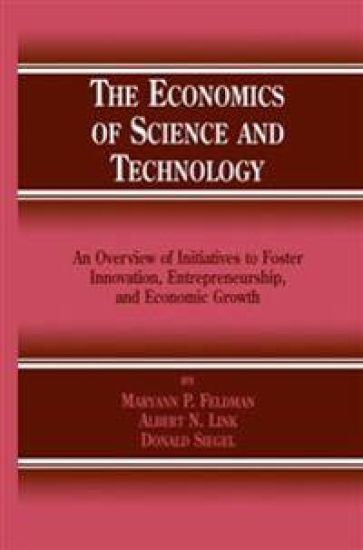
The Economics of Science and Technology

The Economics of Science and Technology

M.P. Feldman; Albert N. Link; Donald S. Siegel

Springer-Verlag New York Inc.
2002
sidottu
Science and technology have long been regarded as important determinants of economic growth. Edwin Mansfield (1971, pp. 1- 2), a pioneer in the economics of technological change, noted: Technological change is an important, if not the most important, factor responsible for economic growth . . . without question, [it] is one of the most important determinants of the shape and evolution of the American economy. Science and technology are even more important in the "new economy," with its greater emphasis on the role of intellectual property and knowledge transfer. Therefore, it is unfortunate that most individuals rarely have the opportunity to explore the economic implications of science and technology. As a result, the antecedents and consequences of technological change are poorly understood by many in the general public. This lack of understanding is reflected in a recent survey conducted by the National Science Board (2000), summarized in Science & Engineering Indicators. ' As shown in Table 1. 1, the findings of the survey indicated that many Americans, despite a high level of interests in such matters, are not as well-informed about technological issues as they are about other policy issues. As shown in the table, individuals self assess, based on a scale from 1 to 100, their interest in science and technology policy issues as being relatively high, yet they self assess their knowledge or informedness about these issues relatively lower.
Public Accountability

Public Accountability

Albert N. Link; John T. Scott

Springer
1998
sidottu
Public Accountability: Evaluating Technology-Based Institutions presents guidelines for evaluating the research performance of technology-based public institutions, and illustrates these guidelines through case studies conducted at one technology-based public institution, the National Institute of Standards and Technology (NIST). The aim of this book is to demonstrate that a clear, more precise response to the question of performance accountability is possible through the systematic application of evaluation methods to document value. The authors begin with a review of the legislative history of fiscal accountability beginning with the Budget and Accounting Act of 1921, and ending with the Government Performance and Results Act of 1993. A discussion of existing applicable economic models, methods, and associated metrics follows. The book concludes with evaluation case studies.
Government’s Role in Innovation

Government’s Role in Innovation

Dennis Patrick Leyden; Albert N. Link

Springer
1992
sidottu
Inadequate investment in innovation is particularly costly in today's globally competitive environment where continued technological advancements are critical to sustaining economic prosperity. The government has a critical role in ensuring that society's general interest in innovation, and the public good associated with innovation, is represented in private-sector decision making. This can be accomplished through a variety of programs and initiatives that reward innovation at all levels. The various activities that make this possible fall into two general categories: (1) the creation and maintenance of a legal environment that encourages private sector investment in innovation (patents and the relaxation of antitrust); and (2) the provision of incentives to overcome the natural inclination of private parties to consider only their private benefits when choosing the level of innovation in which to invest (governmental grants and contracts to targeted tax incentives). The role of government, more specifically, can be found in three key areas: (1) funding of research and development performed in the private sector; (2) funding of Federal laboratory research activities and the effective transfer of that knowledge to the private sector; and (3) encouraging the industry-university collaboration in research and development. It is these three areas of research that generate technologies fundamental to increasing the rate of technological development in the private sector, and it is these areas that are the focus of this book.