Kirjojen hintavertailu – 12 876 058 kirjaa ja 26 kauppaa

Kirjailija

Albert R. Jonsen

Kirjat ja teokset yhdessä paikassa: 5 kirjaa, julkaisuja vuosilta 1990–2008, suosituimpiin kuuluu Bioethics Beyond the Headlines. Vertaile teosten hintoja ja tarkista saatavuus suomalaisista kirjakaupoista.

5 kirjaa

Kirjojen julkaisuvuodet: 1990–2008.

A Short History of Medical Ethics

A Short History of Medical Ethics

Albert R. Jonsen

Oxford University Press Inc
2008
nidottu
A physician says "I have an ethical obligation never to cause the death of a patient," another responds, "My ethical obligation is to relieve pain even if the patient dies." The current argument over the role of physicians in assisting patients to die constantly refers to the ethical duties of the profession. References to the Hippocratic Oath are often heard. Many modern problems, from assisted suicide to accessible health care, raise questions about the traditional ethics of medicine and the medical profession. However, few know what the traditional ethics are and how they came into being. This book provides a brief tour of the complex story of medical ethics evolved over centuries in both Western and Eastern culture. It sets this story in the social and cultural contexts in which the work of healing was practised and suggest that, behing the many different perceptions about the ethical duties of physicians, certain themes appear constantly, and may be relevant to modern debates. The book begins with the Hippocratic medicine of ancient Greece, moves through the Middle Ages, Renaissance and Enlightenment in Europe, and the long history of Indian and Chinese medicine, ending as the problems raised modern medical science and technology challenge the settled ethics of the long tradition.
Bioethics Beyond the Headlines

Bioethics Beyond the Headlines

Albert R. Jonsen

Rowman Littlefield Publishers
2005
sidottu
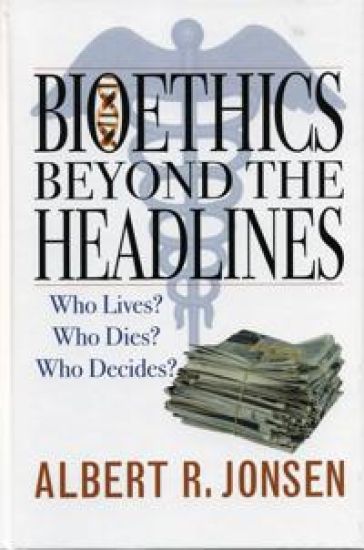
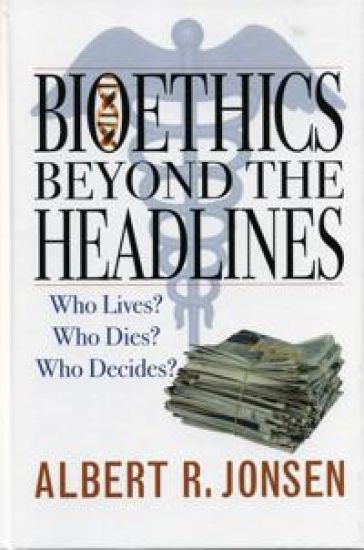
Bioethics asks fundamental questions. 'Who lives? Who dies? Who decides?' These questions are relevant to us all. Too often, the general public's sole encounter with these weighty questions is through sound bites fed to us by the media—where complex, difficult matters are typically presented in superficial and inaccurate terms. Here, renowned bioethicist Albert R. Jonsen equips readers with the tools and background to navigate the fascinating and complex landscape of bioethics. Bioethics Beyond the Headlines is a primer. You will not find convoluted philosophical arguments in this volume. Rather, you will find an engaging sampling of the key questions in bioethics, including euthanasia, assisted reproduction, cloning and stem cells, neuroscience, access to healthcare, and even research on animals and questions of environmental ethics—areas typically overlooked in general introductions to bioethics. But a 'primer' is not merely a first book—it should also 'prime' the interest of the reader, to prepare the mind for a more expansive venture into these issues. Bioethics Beyond the Headlines intends to do just that.
Bioethics Beyond the Headlines

Bioethics Beyond the Headlines

Albert R. Jonsen

Rowman Littlefield Publishers
2005
nidottu
Bioethics asks fundamental questions. "Who lives? Who dies? Who decides?" These questions are relevant to us all. Too often, the general public's sole encounter with these weighty questions is through sound bites fed to us by the media—where complex, difficult matters are typically presented in superficial and inaccurate terms. Here, renowned bioethicist Albert R. Jonsen equips readers with the tools and background to navigate the fascinating and complex landscape of bioethics. Bioethics Beyond the Headlines is a primer. You will not find convoluted philosophical arguments in this volume. Rather, you will find an engaging sampling of the key questions in bioethics, including euthanasia, assisted reproduction, cloning and stem cells, neuroscience, access to healthcare, and even research on animals and questions of environmental ethics—areas typically overlooked in general introductions to bioethics. But a "primer" is not merely a first book—it should also "prime" the interest of the reader, to prepare the mind for a more expansive venture into these issues. Bioethics Beyond the Headlines intends to do just that.
The Patient as Person

The Patient as Person

Paul Ramsey; Margaret Farley; Albert R. Jonsen; Marcia R. Wood

Yale University Press
2002
pokkari
As physicians are faced with new and wonderful options for saving lives, transplanting organs, and furthering research, they also must wrestle with new and troubling choices—who should receive scarce and vital treatment, how we determine when life ends, what limits should be placed on care for the dying, and more. This book by renowned theologian Paul Ramsey, first published thirty years ago, anticipated these moral and ethical issues and addressed them with cogency and power, providing the intellectual foundations for the field of bioethics. This second edition of Ramsey’s classic work includes a new foreword by Margaret Farley and essays by Albert R. Jonsen and William F. May that help to locate and interpret Ramsey historically and intellectually. Praise for the earlier edition: “For its strong, well-argued positions, its documentation and references, and its assistance in bringing confused strands of thought into focus, The Patient as Person willbe used for many years.”—Michael Novak, New York Times “Amid the plethora of books on medical ethics that merely skim the surface, this one solidly examines most aspects of the question––from the definition of death to organ transplantation.”—Christianity Today “Notable for its clear moral reasoning and its thorough examination of all morally relevant issues.”—Journal of Religion “[Ramsey’s] study is a masterpiece of thoroughness in evaluating conflicting moral claims which become explicit in crucial medical situations.”—Dolores Dooley-Clarke, Philosophical Studies
The Abuse of Casuistry

The Abuse of Casuistry

Albert R. Jonsen; Stephen Toulmin

University of California Press
1990
pokkari
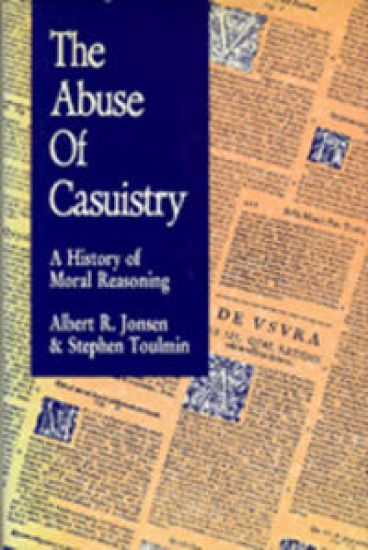
In this engaging study, the authors put casuistry into its historical context, tracing the origin of moral reasoning in antiquity, its peak during the sixteenth and early seventeenth century, and its subsequent fall into disrepute from the mid-seventeenth century.