Kirjojen hintavertailu – 12 903 725 kirjaa ja 27 kauppaa

Kirjailija

Alejandro Colas

Kirjat ja teokset yhdessä paikassa: 9 kirjaa, julkaisuja vuosilta 2001–2021, suosituimpiin kuuluu The War on Terrorism and the American 'Empire' after the Cold War. Vertaile teosten hintoja ja tarkista saatavuus suomalaisista kirjakaupoista.

Nimi esiintyy myös muodoissa: Alejandro Colás

9 kirjaa

Kirjojen julkaisuvuodet: 2001–2021.

Capitalism and the Sea

Capitalism and the Sea

Liam Campling; Alejandro Colas

Verso Books
2021
sidottu

Halvin toimitettuna 27,60 €

Winner of the IPEG 2022 Book PrizeThe global ocean has through the centuries served as a trade route, strategic space, fish bank and supply chain for the modern capitalist economy. While sea beds are drilled for their fossil fuels and minerals, and coastlines developed for real estate and leisure, the oceans continue to absorb the toxic discharges of our carbon civilization - warming, expanding, and acidifying the blue water part of the planet in ways that will bring unpredictable but irreversible consequences for the rest of the biosphere. In this bold and radical new book, Campling and Colás analyse these and other sea-related phenomena through a historical and geographical lens. In successive chapters dealing with the political economy, ecology and geopolitics of the sea, the authors argue that the earth's geographical separation into land and sea has significant consequences for capitalist development. The distinctive features of this mode of production continuously seek to transcend the land-sea binary in an incessant quest for profit, engendering new alignments of sovereignty, exploitation and appropriation in the capture and coding of maritime spaces and resources.
Food, Politics, and Society

Food, Politics, and Society

Alejandro Colas; Jason Edwards; Jane Levi; Sami Zubaida

University of California Press
2018
pokkari
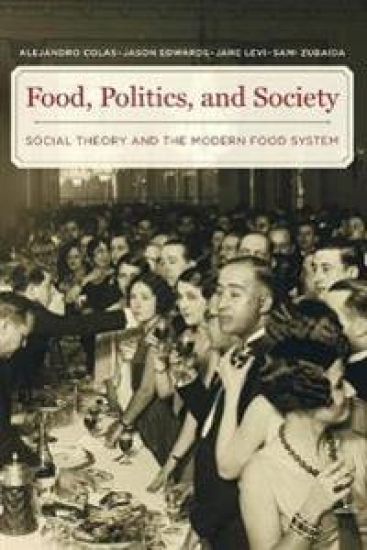
Food and drink has been a focal point of modern social theory since the inception of agrarian capitalism and the industrial revolution. From Adam Smith to Mary Douglas, major thinkers have used key concepts such as identity, exchange, culture, and class to explain the modern food system. Food, Politics, and Society offers a historical and sociological survey of how these various ideas and the practices that accompany them have shaped our understanding and organization of the production, processing, preparation, serving, and consumption of food and drink in modern societies. Divided into twelve chapters and drawing on a wide range of historical and empirical illustrations, this book provides a concise, informed, and accessible survey of the interaction between social theory and food and drink. It is perfect for courses in a wide range of disciplines.
Food, Politics, and Society

Food, Politics, and Society

Alejandro Colas; Jason Edwards; Jane Levi; Sami Zubaida

University of California Press
2018
sidottu
Food and drink has been a focal point of modern social theory since the inception of agrarian capitalism and the industrial revolution. From Adam Smith to Mary Douglas, major thinkers have used key concepts such as identity, exchange, culture, and class to explain the modern food system. Food, Politics, and Society offers a historical and sociological survey of how these various ideas and the practices that accompany them have shaped our understanding and organization of the production, processing, preparation, serving, and consumption of food and drink in modern societies. Divided into twelve chapters and drawing on a wide range of historical and empirical illustrations, this book provides a concise, informed, and accessible survey of the interaction between social theory and food and drink. It is perfect for courses in a wide range of disciplines.
Empire

Empire

Alejandro Colás

Polity Press
2006
nidottu
The notion of empire has in recent years taken on a renewed importance in world politics. US foreign policy has in particular been associated with this concept by both critics and supporters of American global power. But what exactly is an empire? What distinguishes different forms of empire? Is this category still useful in a post-colonial world? These and other related questions are addressed in this historically informed conceptual introduction to the idea of empire. Alejandro Colás draws on interdisciplinary debates surrounding this disputed notion and offers a survey of different imperial experiences across time and place. Successive chapters consider the imperial organization of political space, the role of markets in sustaining imperial rule and the contradictory expressions of imperial culture. Colás argues that in each of these arenas we can establish differences among empires but also contrast imperial polities to other forms of political rule. In addition he suggests that the experiences and legacies of empire are key to an understanding of the world today, including forms of global governance and experiments in nation-building. Using wide-ranging examples, the book discusses some of the major theories of empire and imperialism in an accessible and engaging way. Above all, the text aims to bring the concept of empire alive to those concerned with contemporary world politics and society. It will be of great interest to those studying and teaching world history, international relations, comparative politics or global sociology.
Empire

Empire

Alejandro Colás

Polity Press
2006
sidottu
The notion of empire has in recent years taken on a renewed importance in world politics. US foreign policy has in particular been associated with this concept by both critics and supporters of American global power. But what exactly is an empire? What distinguishes different forms of empire? Is this category still useful in a post-colonial world? These and other related questions are addressed in this historically informed conceptual introduction to the idea of empire. Alejandro Colás draws on interdisciplinary debates surrounding this disputed notion and offers a survey of different imperial experiences across time and place. Successive chapters consider the imperial organization of political space, the role of markets in sustaining imperial rule and the contradictory expressions of imperial culture. Colás argues that in each of these arenas we can establish differences among empires but also contrast imperial polities to other forms of political rule. In addition he suggests that the experiences and legacies of empire are key to an understanding of the world today, including forms of global governance and experiments in nation-building. Using wide-ranging examples, the book discusses some of the major theories of empire and imperialism in an accessible and engaging way. Above all, the text aims to bring the concept of empire alive to those concerned with contemporary world politics and society. It will be of great interest to those studying and teaching world history, international relations, comparative politics or global sociology.
The War on Terrorism and the American 'Empire' after the Cold War
This new study shows how the American-led ‘war on terror’ has brought about the most significant shift in the contours of the international system since the end of the Cold War. A new ‘imperial moment’ is now discernible in US foreign policy in the wake of the neo-conservative rise to power in the USA, marked by the development of a fresh strategic doctrine based on the legitimacy of preventative military strikes on hostile forces across any part of the globe. Key features of this new volume include:* an alternative, critical take on contemporary US foreign policy* a timely, accessible overview of critical thinking on US foreign policy, imperialism and war on terror* the full spectrum of critical view sin a single volume* many of these essays are now ‘contemporary classics’The essays collected in this volume analyse the historical, socio-economic and political dimensions of the current international conjuncture, and assess the degree to which the war on terror has transformed the nature and projection of US global power. Drawing on a range of critical social theories, this collection seeks to ground historically the analysis of global developments since the inception of the new Bush Presidency and weigh up the political consequences of this imperial turn. This book will be of great interest for all students of US foreign policy, contemporary international affairs, international relations and politics.
The War on Terrorism and the American 'Empire' after the Cold War
This new study shows how the American-led ‘war on terror’ has brought about the most significant shift in the contours of the international system since the end of the Cold War. A new ‘imperial moment’ is now discernible in US foreign policy in the wake of the neo-conservative rise to power in the USA, marked by the development of a fresh strategic doctrine based on the legitimacy of preventative military strikes on hostile forces across any part of the globe. Key features of this new volume include:* an alternative, critical take on contemporary US foreign policy* a timely, accessible overview of critical thinking on US foreign policy, imperialism and war on terror* the full spectrum of critical view sin a single volume* many of these essays are now ‘contemporary classics’The essays collected in this volume analyse the historical, socio-economic and political dimensions of the current international conjuncture, and assess the degree to which the war on terror has transformed the nature and projection of US global power. Drawing on a range of critical social theories, this collection seeks to ground historically the analysis of global developments since the inception of the new Bush Presidency and weigh up the political consequences of this imperial turn. This book will be of great interest for all students of US foreign policy, contemporary international affairs, international relations and politics.
International Civil Society

International Civil Society

Alejandro Colás

Polity Press
2001
nidottu
Since the end of the Cold War, activists and scholars alike have celebrated the phenomenal growth of transnational social movements across the globe. This book, aimed at students of politics and sociology, provides a critical survey of recent approaches to the study of civil [society.
International Civil Society

International Civil Society

Alejandro Colás

Polity Press
2001
sidottu
Since the end of the Cold War, activists and scholars alike have celebrated the phenomenal growth of transnational social movements across the globe. For some, this new eruption of grass-roots political activism on a world scale – from the Rio Earth Summit to the Seattle anti-globalization protests – represents the emergence of a global or transnational civil society. This book provides a critical survey of recent approaches to the study of civil society and international relations, presenting an alternative historical and sociological account of the interaction between these two spheres. It makes a theoretical case for the importance of social movements in world politics arguing that modern social movements emerging out of civil society have been instrumental in shaping the contemporary international system. In this wide-ranging engagement with past and present controversies in international relations, Colás shows how a renewed conception of international civil society can illuminate future possibilities for international social movement activity. This book will be of great interest to students and scholars of international relations, political sociology and social history, as well as those who seek to play a part in global politics.