Kirjojen hintavertailu – 12 903 724 kirjaa ja 27 kauppaa

Kirjailija

Alexander Bykov

Kirjat ja teokset yhdessä paikassa: 3 kirjaa, julkaisuja vuosilta 2021–2024, suosituimpiin kuuluu Multi-parameter Mueller Matrix Microscopy for the Expert Assessment of Acute Myocardium Ischemia. Vertaile teosten hintoja ja tarkista saatavuus suomalaisista kirjakaupoista.

3 kirjaa

Kirjojen julkaisuvuodet: 2021–2024.

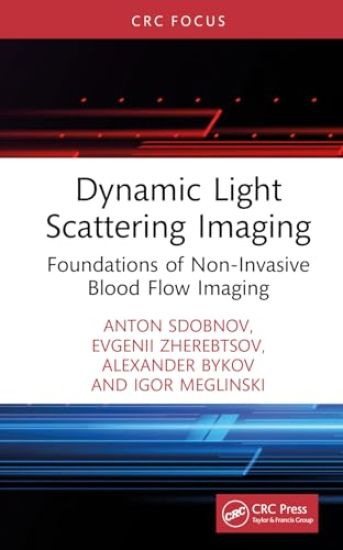
Dynamic Light Scattering Imaging

Dynamic Light Scattering Imaging

Anton Sdobnov; Evgenii Zherebtsov; Alexander Bykov; Igor Meglinski

TAYLOR FRANCIS LTD
2024
sidottu
This book examines Dynamic Light Scattering (DLS) and its derivatives Laser Doppler Flowmetry (LDF), Diffusing Wave Spectroscopy (DWS), Laser Speckle Contrast Imaging (LSCI), and Doppler Optical Coherence Tomography (OCT) for characterizing particle motion in turbid mediums like suspensions and solutions. It focuses on non-invasive blood flow imaging in biological tissues, detailing technological advancements, practical applications, and inherent challenges. Essential for professionals in biomedical optics and medical fields, as well as physics and engineering students, the book highlights its use in brain, skin, and micro-circulation studies, providing key insights and practical guidance. Key Features:• Presents a deep dive into DLS and its derivative techniques.• Emphasizes practical applications, including brain blood flow monitoring, skin perfusion measurements, and micro-circulation characterization.• Delivers insights into the challenges and limitations associated with DLS-based blood flow imaging.

Multi-parameter Mueller Matrix Microscopy for the Expert Assessment of Acute Myocardium Ischemia

Multi-parameter Mueller Matrix Microscopy for the Expert Assessment of Acute Myocardium Ischemia

Victor Bachinsky; Oleh Ya Vanchulyak; Alexander G. Ushenko; Yurii A. Ushenko; Alexander V. Dubolazov; Alexander Bykov; Benjamin Hogan; Igor Meglinski

Springer Verlag, Singapore
2021
nidottu
This book provides an essential overview of the basic principles of imaging modalities, accompanied by examples of their applications in modern clinical and associated pre-clinical studies. The monograph is based on the original results of investigation of the efficiency use of laser light and Mueller-matrix polarimetry approach for assessment of myocardial tissues towards confirmation the cause of death. A morphological analysis of necrotic changes in the myocardial tissue of patients that died due to heart attack, coronary heart disease and acute coronary insufficiency was carried out and the data and histological sections of the myocardium inspected utilizing Mueller-matrix mapping of tissue samples with polarized light. A unified optical model of polycrystalline structure of the myocardium is proposed, and the principles and regulations of Mueller-matrix description of its polarization manifestations are explored and developed. The book also provides a statistical and scale-selective wavelet analysis of polarization and Mueller-matrix maps. Finally, the key forensic medical criteria for the differential diagnosis of the cause of death due to necrotic and pathological changes in the morphological structure of the myocardium have been established
Shedding the Polarized Light on Biological Tissues

Shedding the Polarized Light on Biological Tissues

Igor Meglinski; Liliya Trifonyuk; Victor Bachinsky; Oleh Vanchulyak; Boris Bodnar; Maxim Sidor; Olexander Dubolazov; Alexander Ushenko; Yurii Ushenko; Irina V. Soltys; Alexander Bykov; Benjamin Hogan; Tatiana Novikova

Springer Verlag, Singapore
2021
nidottu
This book explores the early-stage detection of cancer using polarized light. It discusses the diverse properties of the light (temporal and spatial coherence, polarization, fluorescence, etc.) that can be used non-invasively as an optical technique for recognizing precancerous lesions, which could become a reliable and accurate method for cancer screening. The search for the effective means for cancer screening is of particular interest to scientific and medical communities, because cancer takes its toll around the globe with no respect for age or gender. Early detection of the disease is a key factor in increasing the survival rate and patients’ quality of life.