Kirjojen hintavertailu – 12 903 725 kirjaa ja 27 kauppaa

Kirjailija

Alexander Figotin

Kirjat ja teokset yhdessä paikassa: 4 kirjaa, julkaisuja vuosilta 2011–2020, suosituimpiin kuuluu Spectra of Random and Almost-Periodic Operators. Vertaile teosten hintoja ja tarkista saatavuus suomalaisista kirjakaupoista.

4 kirjaa

Kirjojen julkaisuvuodet: 2011–2020.

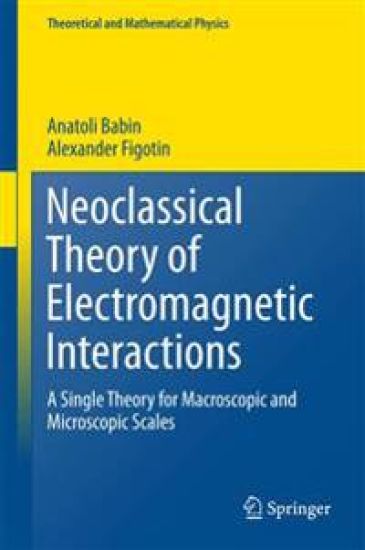
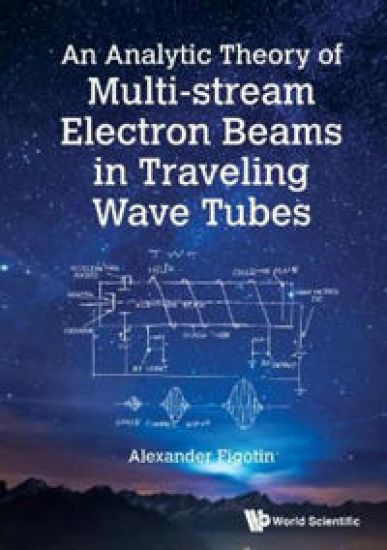
Analytic Theory Of Multi-stream Electron Beams In Traveling Wave Tubes, An

Analytic Theory Of Multi-stream Electron Beams In Traveling Wave Tubes, An

Alexander Figotin

World Scientific Publishing Co Pte Ltd
2020
sidottu
The Traveling Wave Tubes (TWT) is a powerful vacuum electronic device used to amplify radio-frequency (RF) signals as well as numerous applications such as radar, television and telephone satellite communications. This monograph is devoted to the author's original theoretical developments in the theory of a traveling wave tube (TWT). Most of the monograph is the author's original work on an analytical theory of TWTs. It is a constructive Lagrangian field theory of TWT in which the electron beam (e-beam) is represented by one-dimensional multi-stream electron flow and the guiding slow-wave structure is represented by possibly non-uniform multi-transmission line (MTL). The proposed analytic theory accounts for a number of electron plasma phenomena including space-charge effects such as electron-to-electron repulsion (debunching), convective instabilities, wave-particle interaction, amplifying waves and more. It allows, in particular, to (i) identify origins of the wave-particle interaction and the system convective instability (exponential growth); (ii) evaluate the energy transfer rate from the e-beam to the electromagnetic radiation; (iii) identify instability modal branches which under condition of sufficiently strong coupling between the e-beam and the MTL can cover ideally all frequencies.
Neoclassical Theory of Electromagnetic Interactions

Neoclassical Theory of Electromagnetic Interactions

Anatoli Babin; Alexander Figotin

Springer London Ltd
2018
nidottu
In this monograph, the authors present their recently developed theory of electromagnetic interactions. This neoclassical approach extends the classical electromagnetic theory down to atomic scales and allows the explanation of various non-classical phenomena in the same framework. While the classical Maxwell–Lorentz electromagnetism theory succeeds in describing the physical reality at macroscopic scales, it struggles at atomic scales. Here, quantum mechanics traditionally takes over to describe non-classical phenomena such as the hydrogen spectrum and de Broglie waves. By means of modifying the classical theory, the approach presented here is able to consistently explain quantum-mechanical effects, and while similar to quantum mechanics in some respects, this neoclassical theory also differs markedly from it. In particular, the newly developed framework omits probabilistic interpretations of the wave function and features a new fundamental spatial scalewhich, at the size of the free electron, is much larger than the classical electron radius and is relevant to plasmonics and emission physics. This book will appeal to researchers interested in advanced aspects of electromagnetic theory. Treating the classical approach in detail, including non-relativistic aspects and the Lagrangian framework, and comparing the neoclassical theory with quantum mechanics and the de Broglie–Bohm theory, this work is completely self-contained.
Neoclassical Theory of Electromagnetic Interactions

Neoclassical Theory of Electromagnetic Interactions

Anatoli Babin; Alexander Figotin

Springer London Ltd
2016
sidottu
In this monograph, the authors present their recently developed theory of electromagnetic interactions. This neoclassical approach extends the classical electromagnetic theory down to atomic scales and allows the explanation of various non-classical phenomena in the same framework. While the classical Maxwell–Lorentz electromagnetism theory succeeds in describing the physical reality at macroscopic scales, it struggles at atomic scales. Here, quantum mechanics traditionally takes over to describe non-classical phenomena such as the hydrogen spectrum and de Broglie waves. By means of modifying the classical theory, the approach presented here is able to consistently explain quantum-mechanical effects, and while similar to quantum mechanics in some respects, this neoclassical theory also differs markedly from it. In particular, the newly developed framework omits probabilistic interpretations of the wave function and features a new fundamental spatial scalewhich, at the size of the free electron, is much larger than the classical electron radius and is relevant to plasmonics and emission physics. This book will appeal to researchers interested in advanced aspects of electromagnetic theory. Treating the classical approach in detail, including non-relativistic aspects and the Lagrangian framework, and comparing the neoclassical theory with quantum mechanics and the de Broglie–Bohm theory, this work is completely self-contained.
Spectra of Random and Almost-Periodic Operators

Spectra of Random and Almost-Periodic Operators

Leonid Pastur; Alexander Figotin

Springer-Verlag Berlin and Heidelberg GmbH Co. K
2011
nidottu
In the last fifteen years the spectral properties of the Schrodinger equation and of other differential and finite-difference operators with random and almost-periodic coefficients have attracted considerable and ever increasing interest. This is so not only because of the subject's position at the in­ tersection of operator spectral theory, probability theory and mathematical physics, but also because of its importance to theoretical physics, and par­ ticularly to the theory of disordered condensed systems. It was the requirements of this theory that motivated the initial study of differential operators with random coefficients in the fifties and sixties, by the physicists Anderson, 1. Lifshitz and Mott; and today the same theory still exerts a strong influence on the discipline into which this study has evolved, and which will occupy us here. The theory of disordered condensed systems tries to describe, in the so-called one-particle approximation, the properties of condensed media whose atomic structure exhibits no long-range order. Examples of such media are crystals with chaotically distributed impurities, amorphous substances, biopolymers, and so on. It is natural to describe the location of atoms and other characteristics of such media probabilistically, in such a way that the characteristics of a region do not depend on the region's position, and the characteristics of regions far apart are correlated only very weakly. An appropriate model for such a medium is a homogeneous and ergodic, that is, metrically transitive, random field.