Kirjojen hintavertailu – 12 859 819 kirjaa ja 27 kauppaa
Kirjailija
Alexander J. Zaslavski
Kirjat ja teokset yhdessä paikassa: 49 kirjaa, julkaisuja vuosilta 2005–2026, suosituimpiin kuuluu Fixed Point Problems With Infinitely Many Operators. Vertaile teosten hintoja ja tarkista saatavuus suomalaisista kirjakaupoista.
Nimi esiintyy myös muodoissa: Alexander J Zaslavski
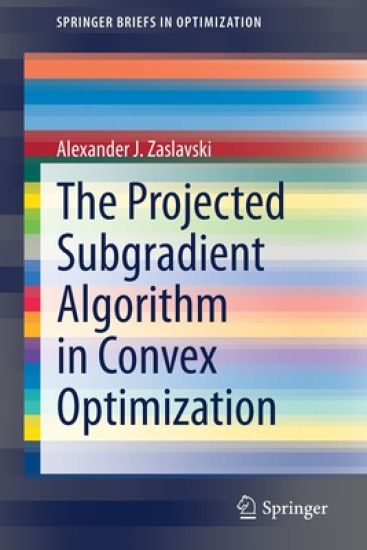
This focused monograph presents a study of subgradient algorithms for constrained minimization problems in a Hilbert space. The book is of interest for experts in applications of optimization to engineering and economics. The goal is to obtain a good approximate solution of the problem in the presence of computational errors. The discussion takes into consideration the fact that for every algorithm its iteration consists of several steps and that computational errors for di?erent steps are di?erent, in general. The book is especially useful for the reader because it contains solutions to a number of difficult and interesting problems in the numerical optimization. The subgradient projection algorithm is one of the most important tools in optimization theory and its applications. An optimization problem is described by an objective function and a set of feasible points. For this algorithm each iteration consists of two steps. The first step requires a calculation of a subgradient of the objective function; the second requires a calculation of a projection on the feasible set. The computational errors in each of these two steps are different. This book shows that the algorithm discussed, generates a good approximate solution, if all the computational errors are bounded from above by a small positive constant. Moreover, if computational errors for the two steps of the algorithm are known, one discovers an approximate solution and how many iterations one needs for this. In addition to their mathematical interest, the generalizations considered in this book have a significant practical meaning.
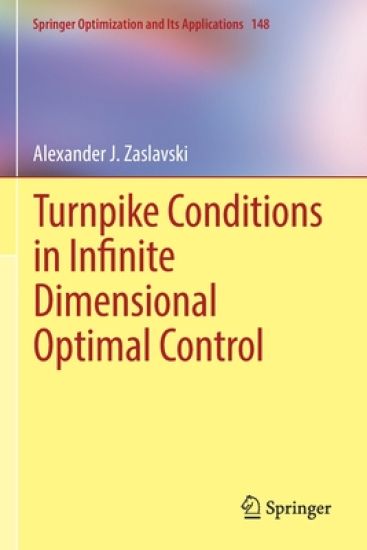
This book provides a comprehensive study of turnpike phenomenon arising in optimal control theory. The focus is on individual (non-generic) turnpike results which are both mathematically significant and have numerous applications in engineering and economic theory. All results obtained in the book are new. New approaches, techniques, and methods are rigorously presented and utilize research from finite-dimensional variational problems and discrete-time optimal control problems to find the necessary conditions for the turnpike phenomenon in infinite dimensional spaces. The semigroup approach is employed in the discussion as well as PDE descriptions of continuous-time dynamics. The main results on sufficient and necessary conditions for the turnpike property are completely proved and the numerous illustrative examples support the material for the broad spectrum of experts. Mathematicians interested in the calculus of variations, optimal control and in applied functional analysis will find this book a useful guide to the turnpike phenomenon in infinite dimensional spaces. Experts in economic and engineering modeling as well as graduate students will also benefit from the developed techniques and obtained results.
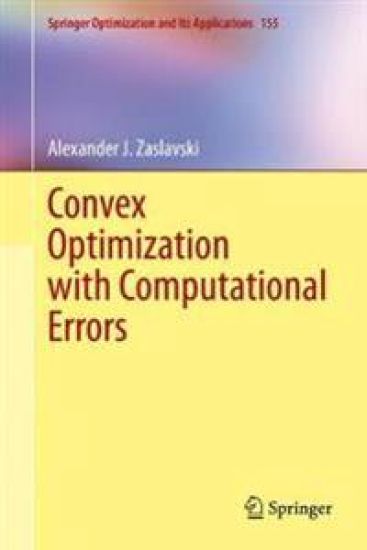
The book is devoted to the study of approximate solutions of optimization problems in the presence of computational errors. It contains a number of results on the convergence behavior of algorithms in a Hilbert space, which are known as important tools for solving optimization problems. The research presented in the book is the continuation and the further development of the author's (c) 2016 book Numerical Optimization with Computational Errors, Springer 2016. Both books study the algorithms taking into account computational errors which are always present in practice. The main goal is, for a known computational error, to find out what an approximate solution can be obtained and how many iterates one needs for this. The main difference between this new book and the 2016 book is that in this present book the discussion takes into consideration the fact that for every algorithm, its iteration consists of several steps and that computational errors for different steps are generally, different. This fact, which was not taken into account in the previous book, is indeed important in practice. For example, the subgradient projection algorithm consists of two steps. The first step is a calculation of a subgradient of the objective function while in the second one we calculate a projection on the feasible set. In each of these two steps there is a computational error and these two computational errors are different in general. It may happen that the feasible set is simple and the objective function is complicated. As a result, the computational error, made when one calculates the projection, is essentially smaller than the computational error of the calculation of the subgradient. Clearly, an opposite case is possible too. Another feature of this book is a study of a number of important algorithms which appeared recently in the literature and which are not discussed in the previous book. This monograph contains 12 chapters. Chapter 1 is an introduction. In Chapter 2 we study the subgradient projection algorithm for minimization of convex and nonsmooth functions. We generalize the results of [NOCE] and establish results which has no prototype in [NOCE]. In Chapter 3 we analyze the mirror descent algorithm for minimization of convex and nonsmooth functions, under the presence of computational errors. For this algorithm each iteration consists of two steps. The first step is a calculation of a subgradient of the objective function while in the second one we solve an auxiliary minimization problem on the set of feasible points. In each of these two steps there is a computational error. We generalize the results of [NOCE] and establish results which has no prototype in [NOCE]. In Chapter 4 we analyze the projected gradient algorithm with a smooth objective function under the presence of computational errors. In Chapter 5 we consider an algorithm, which is an extension of the projection gradient algorithm used for solving linear inverse problems arising in signal/image processing. In Chapter 6 we study continuous subgradient method and continuous subgradient projection algorithm for minimization of convex nonsmooth functions and for computing the saddle points of convex-concave functions, under the presence of computational errors. All the results of this chapter has no prototype in [NOCE]. In Chapters 7-12 we analyze several algorithms under the presence of computational errors which were not considered in [NOCE]. Again, each step of an iteration has a computational errors and we take into account that these errors are, in general, different. An optimization problems with a composite objective function is studied in Chapter 7. A zero-sum game with two-players is considered in Chapter 8. A predicted decrease approximation-based method is used in Chapter 9 for constrained convex optimization. Chapter 10 is devoted tominimization of quasiconvex functions. Minimization of sharp weakly convex functions is discussed in Chapter 11. Chapter 12 is devoted to a generalized projected subgradient method for minimization of a convex function over a set which is not necessarily convex. The book is of interest for researchers and engineers working in optimization. It also can be useful in preparation courses for graduate students. The main feature of the book which appeals specifically to this audience is the study of the influence of computational errors for several important optimization algorithms. The book is of interest for experts in applications of optimization to engineering and economics.
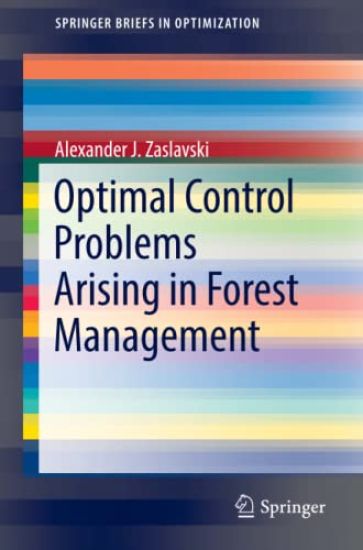
This book is devoted to the study of optimal control problems arising in forest management, an important and fascinating topic in mathematical economics studied by many researchers over the years. The volume studies the forest management problem by analyzing a class of optimal control problems that contains it and showing the existence of optimal solutions over infinite horizon. It also studies the structure of approximate solutions on finite intervals and their turnpike properties, as well as the stability of the turnpike phenomenon and the structure of approximate solutions on finite intervals in the regions close to the end points. The book is intended for mathematicians interested in the optimization theory, optimal control and their applications to the economic theory.
This book provides a comprehensive study of turnpike phenomenon arising in optimal control theory. The focus is on individual (non-generic) turnpike results which are both mathematically significant and have numerous applications in engineering and economic theory. All results obtained in the book are new. New approaches, techniques, and methods are rigorously presented and utilize research from finite-dimensional variational problems and discrete-time optimal control problems to find the necessary conditions for the turnpike phenomenon in infinite dimensional spaces. The semigroup approach is employed in the discussion as well as PDE descriptions of continuous-time dynamics. The main results on sufficient and necessary conditions for the turnpike property are completely proved and the numerous illustrative examples support the material for the broad spectrum of experts. Mathematicians interested in the calculus of variations, optimal control and in applied functional analysis will find this book a useful guide to the turnpike phenomenon in infinite dimensional spaces. Experts in economic and engineering modeling as well as graduate students will also benefit from the developed techniques and obtained results.
This book details approximate solutions to common fixed point problems and convex feasibility problems in the presence of perturbations. Convex feasibility problems search for a common point of a finite collection of subsets in a Hilbert space; common fixed point problems pursue a common fixed point of a finite collection of self-mappings in a Hilbert space. A variety of algorithms are considered in this book for solving both types of problems, the study of which has fueled a rapidly growing area of research. This monograph is timely and highlights the numerous applications to engineering, computed tomography, and radiation therapy planning. Totaling eight chapters, this book begins with an introduction to foundational material and moves on to examine iterative methods in metric spaces. The dynamic string-averaging methods for common fixed point problems in normed space are analyzed in Chapter 3. Dynamic string methods, for common fixed point problemsin a metric space are introduced and discussed in Chapter 4. Chapter 5 is devoted to the convergence of an abstract version of the algorithm which has been called component-averaged row projections (CARP). Chapter 6 studies a proximal algorithm for finding a common zero of a family of maximal monotone operators. Chapter 7 extends the results of Chapter 6 for a dynamic string-averaging version of the proximal algorithm. In Chapters 8 subgradient projections algorithms for convex feasibility problems are examined for infinite dimensional Hilbert spaces.
Devoted to the structure of approximate solutions of discrete-time optimal control problems and approximate solutions of dynamic discrete-time two-player zero-sum games, this book presents results on properties of approximate solutions in an interval that is independent lengthwise, for all sufficiently large intervals. Results concerning the so-called turnpike property of optimal control problems and zero-sum games in the regions close to the endpoints of the time intervals are the main focus of this book. The description of the structure of approximate solutions on sufficiently large intervals and its stability will interest graduate students and mathematicians in optimal control and game theory, engineering, and economics. This book begins with a brief overview and moves on to analyze the structure of approximate solutions of autonomous nonconcave discrete-time optimal control Lagrange problems. Next the structures of approximate solutions of autonomous discrete-time optimal control problems that are discrete-time analogs of Bolza problems in calculus of variations are studied. The structures of approximate solutions of two-player zero-sum games are analyzed through standard convexity-concavity assumptions. Finally, turnpike properties for approximate solutions in a class of nonautonomic dynamic discrete-time games with convexity-concavity assumptions are examined.
This book presents results on the convergence behavior of algorithms which are known as vital tools for solving convex feasibility problems and common fixed point problems. The main goal for us in dealing with a known computational error is to find what approximate solution can be obtained and how many iterates one needs to find it. According to know results, these algorithms should converge to a solution. In this exposition, these algorithms are studied, taking into account computational errors which remain consistent in practice. In this case the convergence to a solution does not take place. We show that our algorithms generate a good approximate solution if computational errors are bounded from above by a small positive constant. Beginning with an introduction, this monograph moves on to study:· dynamic string-averaging methods for common fixed point problems in a Hilbert space · dynamic string methods for common fixed point problems in a metric space· dynamic string-averaging version of the proximal algorithm· common fixed point problems in metric spaces· common fixed point problems in the spaces with distances of the Bregman type· a proximal algorithm for finding a common zero of a family of maximal monotone operators · subgradient projections algorithms for convex feasibility problems in Hilbert spaces
This book studies the approximate solutions of optimization problems in the presence of computational errors. A number of results are presented on the convergence behavior of algorithms in a Hilbert space; these algorithms are examined taking into account computational errors. The author illustrates that algorithms generate a good approximate solution, if computational errors are bounded from above by a small positive constant. Known computational errors are examined with the aim of determining an approximate solution. Researchers and students interested in the optimization theory and its applications will find this book instructive and informative. This monograph contains 16 chapters; including a chapters devoted to the subgradient projection algorithm, the mirror descent algorithm, gradient projection algorithm, the Weiszfelds method, constrained convex minimization problems, the convergence of a proximal point method in a Hilbert space, the continuous subgradient method, penalty methods and Newton’s method.
This book details approximate solutions to common fixed point problems and convex feasibility problems in the presence of perturbations. Convex feasibility problems search for a common point of a finite collection of subsets in a Hilbert space; common fixed point problems pursue a common fixed point of a finite collection of self-mappings in a Hilbert space. A variety of algorithms are considered in this book for solving both types of problems, the study of which has fueled a rapidly growing area of research. This monograph is timely and highlights the numerous applications to engineering, computed tomography, and radiation therapy planning. Totaling eight chapters, this book begins with an introduction to foundational material and moves on to examine iterative methods in metric spaces. The dynamic string-averaging methods for common fixed point problems in normed space are analyzed in Chapter 3. Dynamic string methods, for common fixed point problemsin a metric space are introduced and discussed in Chapter 4. Chapter 5 is devoted to the convergence of an abstract version of the algorithm which has been called component-averaged row projections (CARP). Chapter 6 studies a proximal algorithm for finding a common zero of a family of maximal monotone operators. Chapter 7 extends the results of Chapter 6 for a dynamic string-averaging version of the proximal algorithm. In Chapters 8 subgradient projections algorithms for convex feasibility problems are examined for infinite dimensional Hilbert spaces.
Devoted to the structure of approximate solutions of discrete-time optimal control problems and approximate solutions of dynamic discrete-time two-player zero-sum games, this book presents results on properties of approximate solutions in an interval that is independent lengthwise, for all sufficiently large intervals. Results concerning the so-called turnpike property of optimal control problems and zero-sum games in the regions close to the endpoints of the time intervals are the main focus of this book. The description of the structure of approximate solutions on sufficiently large intervals and its stability will interest graduate students and mathematicians in optimal control and game theory, engineering, and economics. This book begins with a brief overview and moves on to analyze the structure of approximate solutions of autonomous nonconcave discrete-time optimal control Lagrange problems. Next the structures of approximate solutions of autonomous discrete-time optimal control problems that are discrete-time analogs of Bolza problems in calculus of variations are studied. The structures of approximate solutions of two-player zero-sum games are analyzed through standard convexity-concavity assumptions. Finally, turnpike properties for approximate solutions in a class of nonautonomic dynamic discrete-time games with convexity-concavity assumptions are examined.
Individual turnpike results are of great interest due to their numerous applications in engineering and in economic theory; in this book the study is focused on new results of turnpike phenomenon in linear optimal control problems. The book is intended for engineers as well as for mathematicians interested in the calculus of variations, optimal control and in applied functional analysis. Two large classes of problems are studied in more depth. The first class studied in Chapter 2 consists of linear control problems with periodic nonsmooth convex integrands. Chapters 3-5 consist of linear control problems with autonomous convex smooth integrands. Chapter 6 discusses a turnpike property for dynamic zero-sum games with linear constraints. Chapter 7 examines genericity results. In Chapter 8, the description of structure of variational problems with extended-valued integrands is obtained. Chapter 9 ends the exposition with a study of turnpike phenomenon for dynamic games with extended value integrands.
This book is devoted to the study of the turnpike phenomenon and describes the existence of solutions for a large variety of infinite horizon optimal control classes of problems. Chapter 1 provides introductory material on turnpike properties. Chapter 2 studies the turnpike phenomenon for discrete-time optimal control problems. The turnpike properties of autonomous problems with extended-value integrands are studied in Chapter 3. Chapter 4 focuses on large classes of infinite horizon optimal control problems without convexity (concavity) assumptions. In Chapter 5, the turnpike results for a class of dynamic discrete-time two-player zero-sum game are proven. This thorough exposition will be very useful for mathematicians working in the fields of optimal control, the calculus of variations, applied functional analysis and infinite horizon optimization. It may also be used as a primary text in a graduate course in optimal control or as supplementary text for a variety of courses in other disciplines. Researchers in other fields such as economics and game theory, where turnpike properties are well known, will also find this Work valuable.
This book presents an extensive collection of state-of-the-art results and references in nonlinear functional analysis demonstrating how the generic approach proves to be very useful in solving many interesting and important problems. Nonlinear analysis plays an ever-increasing role in theoretical and applied mathematics, as well as in many other areas of science such as engineering, statistics, computer science, economics, finance, and medicine. The text may be used as supplementary material for graduate courses in nonlinear functional analysis, optimization theory and approximation theory, and is a treasure trove for instructors, researchers, and practitioners in mathematics and in the mathematical sciences. Each chapter is self-contained; proofs are solid and carefully communicated. Genericity in Nonlinear Analysis is the first book to systematically present the generic approach to nonlinear analysis. Topics presented include convergence analysis of powers and infinite products via the Baire Category Theorem, fixed point theory of both single- and set-valued mappings, best approximation problems, discrete and continuous descent methods for minimization in a general Banach space, and the structure of minimal energy configurations with rational numbers in the Aubry–Mather theory.
This book presents results on the convergence behavior of algorithms which are known as vital tools for solving convex feasibility problems and common fixed point problems. The main goal for us in dealing with a known computational error is to find what approximate solution can be obtained and how many iterates one needs to find it. According to know results, these algorithms should converge to a solution. In this exposition, these algorithms are studied, taking into account computational errors which remain consistent in practice. In this case the convergence to a solution does not take place. We show that our algorithms generate a good approximate solution if computational errors are bounded from above by a small positive constant. Beginning with an introduction, this monograph moves on to study:· dynamic string-averaging methods for common fixed point problems in a Hilbert space · dynamic string methods for common fixed point problems in a metric space· dynamic string-averaging version of the proximal algorithm· common fixed point problems in metric spaces· common fixed point problems in the spaces with distances of the Bregman type· a proximal algorithm for finding a common zero of a family of maximal monotone operators · subgradient projections algorithms for convex feasibility problems in Hilbert spaces
This book studies the approximate solutions of optimization problems in the presence of computational errors. A number of results are presented on the convergence behavior of algorithms in a Hilbert space; these algorithms are examined taking into account computational errors. The author illustrates that algorithms generate a good approximate solution, if computational errors are bounded from above by a small positive constant. Known computational errors are examined with the aim of determining an approximate solution. Researchers and students interested in the optimization theory and its applications will find this book instructive and informative. This monograph contains 16 chapters; including a chapters devoted to the subgradient projection algorithm, the mirror descent algorithm, gradient projection algorithm, the Weiszfelds method, constrained convex minimization problems, the convergence of a proximal point method in a Hilbert space, the continuous subgradient method, penalty methods and Newton’s method.
Individual turnpike results are of great interest due to their numerous applications in engineering and in economic theory; in this book the study is focused on new results of turnpike phenomenon in linear optimal control problems. The book is intended for engineers as well as for mathematicians interested in the calculus of variations, optimal control and in applied functional analysis. Two large classes of problems are studied in more depth. The first class studied in Chapter 2 consists of linear control problems with periodic nonsmooth convex integrands. Chapters 3-5 consist of linear control problems with autonomous convex smooth integrands. Chapter 6 discusses a turnpike property for dynamic zero-sum games with linear constraints. Chapter 7 examines genericity results. In Chapter 8, the description of structure of variational problems with extended-valued integrands is obtained. Chapter 9 ends the exposition with a study of turnpike phenomenon for dynamic games with extended value integrands.
Nonconvex Optimal Control and Variational Problems is an important contribution to the existing literature in the field and is devoted to the presentation of progress made in the last 15 years of research in the area of optimal control and the calculus of variations. This volume contains a number of results concerning well-posedness of optimal control and variational problems, nonoccurrence of the Lavrentiev phenomenon for optimal control and variational problems, and turnpike properties of approximate solutions of variational problems. Chapter 1 contains an introduction as well as examples of select topics. Chapters 2-5 consider the well-posedness condition using fine tools of general topology and porosity. Chapters 6-8 are devoted to the nonoccurrence of the Lavrentiev phenomenon and contain original results. Chapter 9 focuses on infinite-dimensional linear control problems, and Chapter 10 deals with “good” functions and explores new understandings on the questions of optimality and variational problems. Finally, Chapters 11-12 are centered around the turnpike property, a particular area of expertise for the author. This volume is intended for mathematicians, engineers, and scientists interested in the calculus of variations, optimal control, optimization, and applied functional analysis, as well as both undergraduate and graduate students specializing in those areas. The text devoted to Turnpike properties may be of particular interest to the economics community.
This book is devoted to the study of the turnpike phenomenon and describes the existence of solutions for a large variety of infinite horizon optimal control classes of problems. Chapter 1 provides introductory material on turnpike properties. Chapter 2 studies the turnpike phenomenon for discrete-time optimal control problems. The turnpike properties of autonomous problems with extended-value integrands are studied in Chapter 3. Chapter 4 focuses on large classes of infinite horizon optimal control problems without convexity (concavity) assumptions. In Chapter 5, the turnpike results for a class of dynamic discrete-time two-player zero-sum game are proven. This thorough exposition will be very useful for mathematicians working in the fields of optimal control, the calculus of variations, applied functional analysis and infinite horizon optimization. It may also be used as a primary text in a graduate course in optimal control or as supplementary text for a variety of courses in other disciplines. Researchers in other fields such as economics and game theory, where turnpike properties are well known, will also find this Work valuable.
The structure of approximate solutions of autonomous discrete-time optimal control problems and individual turnpike results for optimal control problems without convexity (concavity) assumptions are examined in this book. In particular, the book focuses on the properties of approximate solutions which are independent of the length of the interval, for all sufficiently large intervals; these results apply to the so-called turnpike property of the optimal control problems. By encompassing the so-called turnpike property the approximate solutions of the problems are determined primarily by the objective function and are fundamentally independent of the choice of interval and endpoint conditions, except in regions close to the endpoints. This book also explores the turnpike phenomenon for two large classes of autonomous optimal control problems. It is illustrated that the turnpike phenomenon is stable for an optimal control problem if the corresponding infinite horizon optimal control problem possesses an asymptotic turnpike property. If an optimal control problem belonging to the first class possesses the turnpike property, then the turnpike is a singleton (unit set). The stability of the turnpike property under small perturbations of an objective function and of a constraint map is established. For the second class of problems where the turnpike phenomenon is not necessarily a singleton the stability of the turnpike property under small perturbations of an objective function is established. Containing solutions of difficult problems in optimal control and presenting new approaches, techniques and methods this book is of interest for mathematicians working in optimal control and the calculus of variations. It also can be useful in preparation courses for graduate students.