Kirjojen hintavertailu – 12 859 828 kirjaa ja 27 kauppaa

Kirjailija

Alexander Kukush

Kirjat ja teokset yhdessä paikassa: 8 kirjaa, julkaisuja vuosilta 2009–2025, suosituimpiin kuuluu Functional Analysis and Operator Theory. Vertaile teosten hintoja ja tarkista saatavuus suomalaisista kirjakaupoista.

8 kirjaa

Kirjojen julkaisuvuodet: 2009–2025.

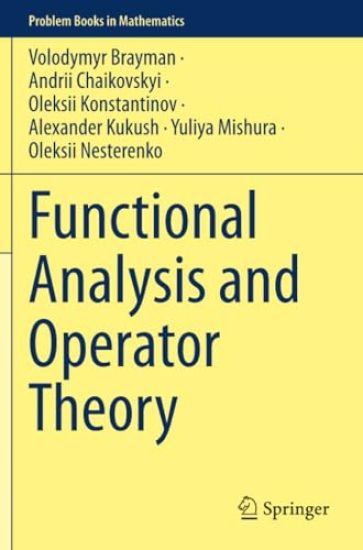
Functional Analysis and Operator Theory

Functional Analysis and Operator Theory

Volodymyr Brayman; Andrii Chaikovskyi; Oleksii Konstantinov; Alexander Kukush; Yuliya Mishura; Oleksii Nesterenko

Springer International Publishing AG
2024
sidottu
The book contains a collection of more than 800 problems from all main chapters of functional analysis, with theoretical background and solutions. It is mostly intended for undergraduate students who are starting to study the course of functional analysis. The book will also be useful for graduate and post- graduate students and researchers who wish to refresh their knowledge and deepen their understanding of the subject, as well as for teachers of functional analysis and related disciplines. It can be used for independent study as well. It is assumed that the reader has mastered standard courses of calculus and measure theory and has basic knowledge of linear algebra, analytic geometry, and differential equations. This collection of problems can help students of different levels of training and different areas of specialization to learn how to solve problems in functional analysis. Each chapter of the book has similar structure and consists of the following sections: Theoretical Background, Examples of Problems with Solutions, and Problems to Solve. The book contains theoretical preliminaries to ensure that the reader understands the statements of problems and is able to successfully solve them. Then examples of typical problems with detailed solutions are included, and this is relevant not only for those students who have significant difficulties in studying this subject, but also for other students who due to various circumstances ?could be deprived of communication with a teacher. There are problems for independent solving, and the corresponding selection of problems reflects all the main plot lines that relate to a given topic. The number of problems is sufficient both for a teacher to give practical lessons, to set homework, to prepare tasks for various forms of control, and for those students who want to study the discipline more deeply. Problems of a computational nature are provided with answers, while theoretical problems, the solutions ofwhich require non-trivial ideas or new techniques, are provided with detailed hints or solutions to introduce the reader to the corresponding ideas or techniques.
Gaussian Measures in Hilbert Space

Gaussian Measures in Hilbert Space

Alexander Kukush

ISTE Ltd
2020
sidottu
At the nexus of probability theory, geometry and statistics, a Gaussian measure is constructed on a Hilbert space in two ways: as a product measure and via a characteristic functional based on Minlos-Sazonov theorem. As such, it can be utilized for obtaining results for topological vector spaces. Gaussian Measures contains the proof for Fernique?s theorem and its relation to exponential moments in Banach space. Furthermore, the fundamental Feldman-Hájek dichotomy for Gaussian measures in Hilbert space is investigated. Applications in statistics are also outlined. In addition to chapters devoted to measure theory, this book highlights problems related to Gaussian measures in Hilbert and Banach spaces. Borel probability measures are also addressed, with properties of characteristic functionals examined and a proof given based on the classical Banach? Steinhaus theorem. Gaussian Measures is suitable for graduate students, plus advanced undergraduate students in mathematics and statistics. It is also of interest to students in related fields from other disciplines. Results are presented as lemmas, theorems and corollaries, while all statements are proven. Each subsection ends with teaching problems, and a separate chapter contains detailed solutions to all the problems. With its student-tested approach, this book is a superb introduction to the theory of Gaussian measures on infinite-dimensional spaces.
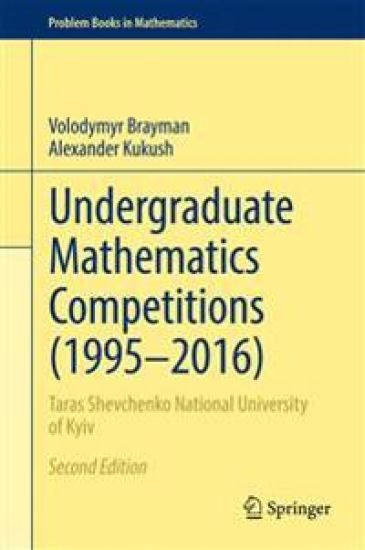
Undergraduate Mathematics Competitions (1995–2016)

Undergraduate Mathematics Competitions (1995–2016)

Volodymyr Brayman; Alexander Kukush

Springer International Publishing AG
2018
nidottu
Versatile and comprehensive in content, this book of problems will appeal to students in nearly all areas of mathematics. The text offers original and advanced problems proposed from 1995 to 2016 at the Mathematics Olympiads. Essential for undergraduate students, PhD students, and instructors, the problems in this book vary in difficulty and cover most of the obligatory courses given at the undergraduate level, including calculus, algebra, geometry, discrete mathematics, measure theory, complex analysis, differential equations, and probability theory. Detailed solutions to all of the problems from Part I are supplied in Part II, giving students the ability to check their solutions and observe new and unexpected ideas. Most of the problems in this book are not technical and allow for a short and elegant solution. The problems given are unique and non-standard; solving the problems requires a creative approach as well as a deep understanding of the material. Nearly all of the problems are originally authored by lecturers, PhD students, senior undergraduates, and graduate students of the mechanics and mathematics faculty of Taras Shevchenko National University of Kyiv as well as by many others from Belgium, Canada, Great Britain, Hungary, and the United States.
Undergraduate Mathematics Competitions (1995–2016)

Undergraduate Mathematics Competitions (1995–2016)

Volodymyr Brayman; Alexander Kukush

Springer International Publishing AG
2017
sidottu
Versatile and comprehensive in content, this book of problems will appeal to students in nearly all areas of mathematics. The text offers original and advanced problems proposed from 1995 to 2016 at the Mathematics Olympiads. Essential for undergraduate students, PhD students, and instructors, the problems in this book vary in difficulty and cover most of the obligatory courses given at the undergraduate level, including calculus, algebra, geometry, discrete mathematics, measure theory, complex analysis, differential equations, and probability theory. Detailed solutions to all of the problems from Part I are supplied in Part II, giving students the ability to check their solutions and observe new and unexpected ideas. Most of the problems in this book are not technical and allow for a short and elegant solution. The problems given are unique and non-standard; solving the problems requires a creative approach as well as a deep understanding of the material. Nearly all of the problems are originally authored by lecturers, PhD students, senior undergraduates, and graduate students of the mechanics and mathematics faculty of Taras Shevchenko National University of Kyiv as well as by many others from Belgium, Canada, Great Britain, Hungary, and the United States.
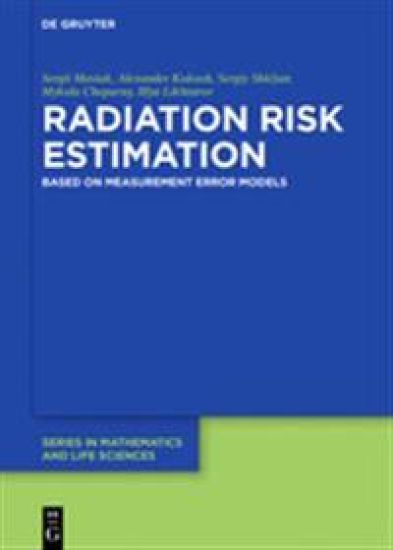
Radiation Risk Estimation

Radiation Risk Estimation

Sergii Masiuk; Alexander Kukush; Sergiy Shklyar; Mykola Chepurny; Illya Likhtarov

De Gruyter
2017
sidottu
This monograph discusses statistics and risk estimates applied to radiation damage under the presence of measurement errors. The first part covers nonlinear measurement error models, with a particular emphasis on efficiency of regression parameter estimators. In the second part, risk estimation in models with measurement errors is considered. Efficiency of the methods presented is verified using data from radio-epidemiological studies. Contents: Part I - Estimation in regression models with errors in covariatesMeasurement error modelsLinear models with classical errorPolynomial regression with known variance of classical errorNonlinear and generalized linear models Part II Radiation risk estimation under uncertainty in exposure dosesOverview of risk models realized in program package EPICUREEstimation of radiation risk under classical or Berkson multiplicative error in exposure dosesRadiation risk estimation for persons exposed by radioiodine as a result of the Chornobyl accidentElements of estimating equations theoryConsistency of efficient methodsEfficient SIMEX method as a combination of the SIMEX method and the corrected score methodApplication of regression calibration in the model with additive error in exposure doses

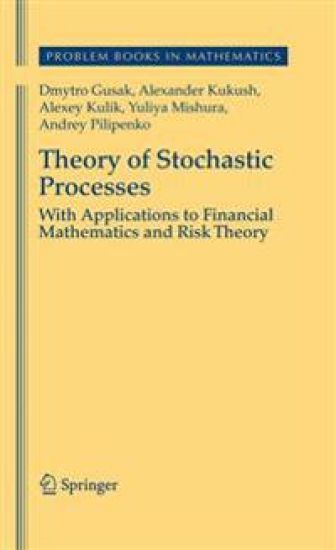
Theory of Stochastic Processes

Theory of Stochastic Processes

Dmytro Gusak; Alexander Kukush; Alexey Kulik; Yuliya Mishura; Andrey Pilipenko

Springer-Verlag New York Inc.
2012
nidottu
Thiscollectionofproblemsisplannedasatextbookforuniversitycoursesinthe theoryofstochasticprocessesandrelatedspecialcourses. Theproblemsinthebook haveawidespectrumofthelevelofdif cultyandcanbeusefulforreaderswith variouslevelsofmasteringinthetheoryofstochasticprocesses. Togetherwithte- nicalandillustrativeproblemsintendedforbeginners,thebookcontainsanumber ofproblemsoftheoreticalnaturethatcanbeusefulforstudentsandundergraduate studentsthatpursueadvancedstudiesinthetheoryofstochasticprocessesandits- plications. Amongothers,theimportantaimofthebookistoprovideateachingstaff anef cienttoolforpreparingseminarstudies,tests,andexamsconcerninguniversity coursesinthetheoryofstochasticprocessesandrelatedtopics. Whilecomposingthe book,theauthorshavepartiallyusedthecollectionsofproblemsinprobabilityt- ory[16,65,75,83]. Also,someexercisesandproblemsfromthemonographsand textbooks[4,9,19,22,82]wereused. Atthesametime,alargepartofourproblem bookcontainsoriginalmaterial. Thebookisorganizedasfollows. Theproblemsarecollectedintochapters,each chapterbeingdevotedtoacertaintopic. Atthebeginningofeachchapter,theth- reticalgroundsforthecorrespondingtopicaregivenbrie ytogetherwiththelistof bibliography,whichthereadercanuseinordertostudythistopicinmoredetail. For themostoftheproblems,eitherhintsorcompletesolutions(oranswers)aregiven, andsomeoftheproblemsareprovidedwithbothhintsandsolutions(answers). H- ever,theauthorsdonotrecommendthatareaderusethehintssystematically,because solvingaproblemwithoutassistanceismuchmoreusefulthanusingaready-made idea. Somestatementsthathaveaparticulartheoreticalinterestareformulatedon theoreticalgrounds,andtheirproofsareformulatedasproblemsforthereader. Such problemsaresuppliedwitheithercompletesolutionsordetailedhints. Inordertoworkwiththeproblembookef ciently,areadershouldbeacquainted withprobabilitytheory,calculus,andmeasuretheorywithinthescopeofresp- tiveuniversity courses. Standard notions, suchas random variable, measurability, independence, Lebesgue measure and integral, and so on are used without ad- tionaldiscussion. Allthenewnotionsandstatementsrequiredforsolvingthepr- lemsaregiveneitherontheoreticalgroundsorintheformulationsoftheproblems vii viii Preface straightforwardly. However,sometimesanotionisusedinthetextbeforeitsformal de nition. Forinstance,theWienerandPoissonprocessesareprocesseswithin- pendentincrementsandthusareformallyintroducedinaTheoreticalgroundsfor Chapter5,buttheseprocessesareusedwidelyintheproblemsofChapters2to4. Theauthorsrecommendthatareaderwhocomestoanunknownnotionorobject usetheIndexinorderto ndthecorrespondingformalde nition. Thesamerec- mendationconcernssomestandardabbreviationsandsymbolslistedattheendofthe book. Someproblemsinthebookformcycles:solutionstooneofthemaregrounded onstatementsofothersoronauxiliaryconstructionsdescribedinsomepreceding solutions. Sometimes,onthecontrary,itisproposedtoprovethesamestatement withindifferentproblemsusingessentiallydifferenttechniques. Theauthorsrec- mendareaderpayspeci cattentiontothesefruitfulinternallinksbetweenvarious topicsofthetheoryofstochasticprocesses. Everypartofthebookwascomposedsubstantiallybyoneauthor. Chapters1-6, and16arecomposedbyA. Kulik,Chapters7,12-15,18,and19byYu. Mishura, Chapters 8-10 by A. Pilipenko, Chapter 17 by A. Kukush, and Chapter 20 by D. Gusak. Chapter11waspreparedjointlybyD. GusakandA. Pilipenko. Atthe sametime,everyauthorhasmadeacontributiontootherpartsofthebookbyprop- ingseparateproblemsorcyclesofproblems,improvingpreliminaryversionsoft- oreticalgrounds,andeditingthe naltext. The authors would like to express their deep gratitude to M. Portenko and A. Ivanovfortheircarefulreadingofapreliminaryversionofthebookandva- ablecommentsthatledtosigni cantimprovementofthetext. Theauthorsarealso gratefultoT. Yakovenko,G. Shevchenko,O. Soloveyko, Yu. Kartashov, Yu. K- menko,A. Malenko,andN. Ryabovafortheirassistanceintranslation,preparing lesandpictures,andcomposingthesubjectindexandreferences. Thetheoryofstochasticprocessesisanextendeddiscipline,andtheauthors- derstandthattheproblembookinitscurrentformmaycausecriticalremarksfrom readers,concerningeitherthestructureofthebookorthecontentofseparatech- ters. Whilepublishingtheproblembookinitscurrentform,theauthorsareopenfor remarks,comments,andpropositions,andexpressinadvancetheirgratitudetoall theircorrespondents. Kyiv DmytroGusak December2008 AlexanderKukush AlexeyKulik YuliyaMishura AndreyPilipenko Contents 1 De?nition of stochastic process. Cylinder?-algebra, ?nite-dimensional distributions, the Kolmogorov theorem...1 Theoreticalgrounds ...1 Bibliography...3 Problems...3 Hints...7 AnswersandSolutions...9 2 Characteristics of a stochastic process. Mean and covariance functions. Characteristic functions...11 Theoreticalgrounds ...11 Bibliography...13 Problems...13 Hints...16 AnswersandSolutions...17 3 Trajectories. Modi?cations. Filtrations...21 Theoreticalgrounds ...21 Bibliography...24 Problems...24 Hints...29 AnswersandSolutions...31 4 Continuity. Differentiability. Integrability...33 Theoreticalgrounds ...33 Bibliography...34 Problems...34 Hints...38 AnswersandSolutions...40 ix x Contents 5 Stochastic processes with independent increments. Wiener and Poisson processes. Poisson point measures...
Theory of Stochastic Processes

Theory of Stochastic Processes

Dmytro Gusak; Alexander Kukush; Alexey Kulik; Yuliya Mishura; Andrey Pilipenko

Springer-Verlag New York Inc.
2009
sidottu
Thiscollectionofproblemsisplannedasatextbookforuniversitycoursesinthe theoryofstochasticprocessesandrelatedspecialcourses. Theproblemsinthebook haveawidespectrumofthelevelofdif cultyandcanbeusefulforreaderswith variouslevelsofmasteringinthetheoryofstochasticprocesses. Togetherwithte- nicalandillustrativeproblemsintendedforbeginners,thebookcontainsanumber ofproblemsoftheoreticalnaturethatcanbeusefulforstudentsandundergraduate studentsthatpursueadvancedstudiesinthetheoryofstochasticprocessesandits- plications. Amongothers,theimportantaimofthebookistoprovideateachingstaff anef cienttoolforpreparingseminarstudies,tests,andexamsconcerninguniversity coursesinthetheoryofstochasticprocessesandrelatedtopics. Whilecomposingthe book,theauthorshavepartiallyusedthecollectionsofproblemsinprobabilityt- ory[16,65,75,83]. Also,someexercisesandproblemsfromthemonographsand textbooks[4,9,19,22,82]wereused. Atthesametime,alargepartofourproblem bookcontainsoriginalmaterial. Thebookisorganizedasfollows. Theproblemsarecollectedintochapters,each chapterbeingdevotedtoacertaintopic. Atthebeginningofeachchapter,theth- reticalgroundsforthecorrespondingtopicaregivenbrie ytogetherwiththelistof bibliography,whichthereadercanuseinordertostudythistopicinmoredetail. For themostoftheproblems,eitherhintsorcompletesolutions(oranswers)aregiven, andsomeoftheproblemsareprovidedwithbothhintsandsolutions(answers). H- ever,theauthorsdonotrecommendthatareaderusethehintssystematically,because solvingaproblemwithoutassistanceismuchmoreusefulthanusingaready-made idea. Somestatementsthathaveaparticulartheoreticalinterestareformulatedon theoreticalgrounds,andtheirproofsareformulatedasproblemsforthereader. Such problemsaresuppliedwitheithercompletesolutionsordetailedhints. Inordertoworkwiththeproblembookef ciently,areadershouldbeacquainted withprobabilitytheory,calculus,andmeasuretheorywithinthescopeofresp- tiveuniversity courses. Standard notions, suchas random variable, measurability, independence, Lebesgue measure and integral, and so on are used without ad- tionaldiscussion. Allthenewnotionsandstatementsrequiredforsolvingthepr- lemsaregiveneitherontheoreticalgroundsorintheformulationsoftheproblems vii viii Preface straightforwardly. However,sometimesanotionisusedinthetextbeforeitsformal de nition. Forinstance,theWienerandPoissonprocessesareprocesseswithin- pendentincrementsandthusareformallyintroducedinaTheoreticalgroundsfor Chapter5,buttheseprocessesareusedwidelyintheproblemsofChapters2to4. Theauthorsrecommendthatareaderwhocomestoanunknownnotionorobject usetheIndexinorderto ndthecorrespondingformalde nition. Thesamerec- mendationconcernssomestandardabbreviationsandsymbolslistedattheendofthe book. Someproblemsinthebookformcycles:solutionstooneofthemaregrounded onstatementsofothersoronauxiliaryconstructionsdescribedinsomepreceding solutions. Sometimes,onthecontrary,itisproposedtoprovethesamestatement withindifferentproblemsusingessentiallydifferenttechniques. Theauthorsrec- mendareaderpayspeci cattentiontothesefruitfulinternallinksbetweenvarious topicsofthetheoryofstochasticprocesses. Everypartofthebookwascomposedsubstantiallybyoneauthor. Chapters1-6, and16arecomposedbyA. Kulik,Chapters7,12-15,18,and19byYu. Mishura, Chapters 8-10 by A. Pilipenko, Chapter 17 by A. Kukush, and Chapter 20 by D. Gusak. Chapter11waspreparedjointlybyD. GusakandA. Pilipenko. Atthe sametime,everyauthorhasmadeacontributiontootherpartsofthebookbyprop- ingseparateproblemsorcyclesofproblems,improvingpreliminaryversionsoft- oreticalgrounds,andeditingthe naltext. The authors would like to express their deep gratitude to M. Portenko and A. Ivanovfortheircarefulreadingofapreliminaryversionofthebookandva- ablecommentsthatledtosigni cantimprovementofthetext. Theauthorsarealso gratefultoT. Yakovenko,G. Shevchenko,O. Soloveyko, Yu. Kartashov, Yu. K- menko,A. Malenko,andN. Ryabovafortheirassistanceintranslation,preparing lesandpictures,andcomposingthesubjectindexandreferences. Thetheoryofstochasticprocessesisanextendeddiscipline,andtheauthors- derstandthattheproblembookinitscurrentformmaycausecriticalremarksfrom readers,concerningeitherthestructureofthebookorthecontentofseparatech- ters. Whilepublishingtheproblembookinitscurrentform,theauthorsareopenfor remarks,comments,andpropositions,andexpressinadvancetheirgratitudetoall theircorrespondents. Kyiv DmytroGusak December2008 AlexanderKukush AlexeyKulik YuliyaMishura AndreyPilipenko Contents 1 De?nition of stochastic process. Cylinder?-algebra, ?nite-dimensional distributions, the Kolmogorov theorem...1 Theoreticalgrounds ...1 Bibliography...3 Problems...3 Hints...7 AnswersandSolutions...9 2 Characteristics of a stochastic process. Mean and covariance functions. Characteristic functions...11 Theoreticalgrounds ...11 Bibliography...13 Problems...13 Hints...16 AnswersandSolutions...17 3 Trajectories. Modi?cations. Filtrations...21 Theoreticalgrounds ...21 Bibliography...24 Problems...24 Hints...29 AnswersandSolutions...31 4 Continuity. Differentiability. Integrability...33 Theoreticalgrounds ...33 Bibliography...34 Problems...34 Hints...38 AnswersandSolutions...40 ix x Contents 5 Stochastic processes with independent increments. Wiener and Poisson processes. Poisson point measures...