
Kirjojen hintavertailu – 12 903 725 kirjaa ja 27 kauppaa

Kirjailija

Alexander Mikhalev

Kirjat ja teokset yhdessä paikassa: 2 kirjaa, julkaisuja vuosilta 2003–2011, suosituimpiin kuuluu Combinatorial Methods. Vertaile teosten hintoja ja tarkista saatavuus suomalaisista kirjakaupoista.

2 kirjaa

Kirjojen julkaisuvuodet: 2003–2011.

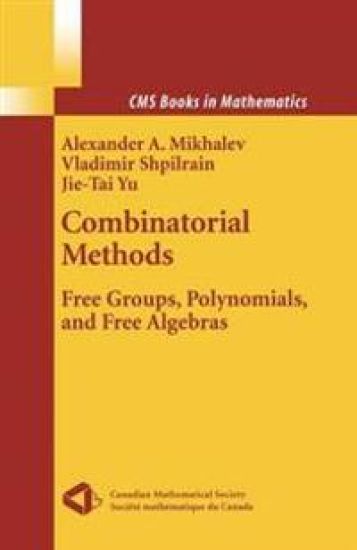
Combinatorial Methods

Combinatorial Methods

Vladimir Shpilrain; Alexander Mikhalev; Jie-tai Yu

Springer-Verlag New York Inc.
2011
nidottu
This book is about three seemingly independent areas of mathematics: combinatorial group theory, the theory of Lie algebras and affine algebraic geometry. Indeed, for many years these areas were being developed fairly independently. Combinatorial group theory, the oldest of the three, was born in the beginning of the 20th century as a branch of low-dimensional topology. Very soon, it became an important area of mathematics with its own powerful techniques. In the 1950s, combinatorial group theory started to influence, rather substantially, the theory of Lie algebrasj thus combinatorial theory of Lie algebras was shaped, although the origins of the theory can be traced back to the 1930s. In the 1960s, B. Buchberger introduced what is now known as Gröbner bases. This marked the beginning of a new, "combinatorial", era in commu­ tative algebra. It is not very likely that Buchberger was directly influenced by ideas from combinatorial group theory, but his famous algorithm bears resemblance to Nielsen's method, although in a more sophisticated form.
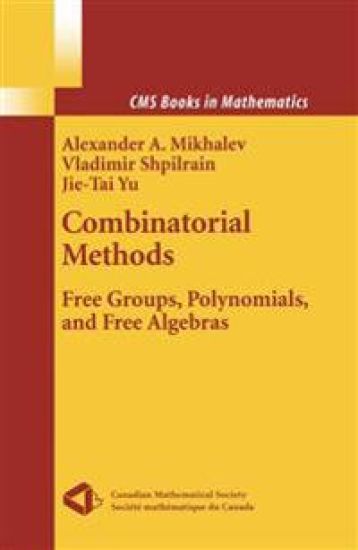
Combinatorial Methods

Combinatorial Methods

Vladimir Shpilrain; Alexander Mikhalev; Jie-tai Yu

Springer-Verlag New York Inc.
2003
sidottu
This book is about three seemingly independent areas of mathematics: combinatorial group theory, the theory of Lie algebras and affine algebraic geometry. Indeed, for many years these areas were being developed fairly independently. Combinatorial group theory, the oldest of the three, was born in the beginning of the 20th century as a branch of low-dimensional topology. Very soon, it became an important area of mathematics with its own powerful techniques. In the 1950s, combinatorial group theory started to influence, rather substantially, the theory of Lie algebrasj thus combinatorial theory of Lie algebras was shaped, although the origins of the theory can be traced back to the 1930s. In the 1960s, B. Buchberger introduced what is now known as Gröbner bases. This marked the beginning of a new, "combinatorial", era in commu­ tative algebra. It is not very likely that Buchberger was directly influenced by ideas from combinatorial group theory, but his famous algorithm bears resemblance to Nielsen's method, although in a more sophisticated form.