Kirjojen hintavertailu – 12 876 058 kirjaa ja 26 kauppaa

Kirjailija

Alexander Nicoll

Kirjat ja teokset yhdessä paikassa: 9 kirjaa, julkaisuja vuosilta 2007–2025, suosituimpiin kuuluu BibliothecÃ] BodleianÃ] Codicum Manuscriptorum Orientalium ... Catalogus ....... Vertaile teosten hintoja ja tarkista saatavuus suomalaisista kirjakaupoista.

9 kirjaa

Kirjojen julkaisuvuodet: 2007–2025.

Atomic Attack

Atomic Attack

Alexander Nicoll; John Grehan

PEN SWORD BOOKS LTD
2025
nidottu
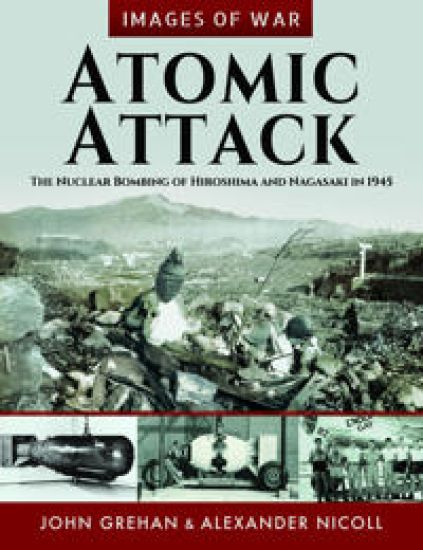
At 08.15 hours on 6 August 1945, one of the most seismic events in human history unfolded over the Japanese city of Hiroshima. An atomic bomb, nicknamed _Little Boy_, exploded about 1,500 feet above the city with a force of 15,000 tons of TNT. Around five square miles of the city were destroyed in seconds and tens of thousands of its citizens and soldiers were killed. Three days later, a second atomic bomb was unleased against Nagasaki with similar devastating results. Less than a week later Emperor Hirohito announced Japan’s unconditional surrender, bringing the Second World War to an explosive end. The story of the bombing of Hiroshima and Nagasaki begins with the Manhattan Project. From its inception in 1939, the Manhattan Project, which at its height involved more than 125,000 individuals and ultimately cost billions of US dollars, is explored in this book, as is the organisation and training of the bomb crews of 393rd Bombardment Squadron of Colonel Paul Tibbets’ 509th Composite Group. For its attacks on Japan, the squadron was equipped with fifteen dazzling silverplate Boeing B-29 Superfortresses, which had been specially adapted to carry nuclear weapons. It is, of course, the dramatic events of 6 and 9 August 1945, which are featured most prominently in this book. Every step of the attacks, from the arming of _Enola Gay_ and _Bockscar_, which famously carried the two nuclear devices, to their take-off from Runway Able on the tiny island of Tinian, to the flights to the targets and the release of the bombs are revealed. Many are the unmistakable images of the detonation and effects of the two nuclear blasts, portrayed here in graphic contemporary photographs. Portraits of the key individuals are shown, as are the test sites, workshops, aircraft and the weapons themselves to provide a wide-ranging, comprehensive visual study of the steps which led to the first and only deployment of nuclear bombs in warfare.
Battle of Guam 1944

Battle of Guam 1944

Alexander Nicoll; John Grehan

PEN SWORD BOOKS LTD
2025
nidottu
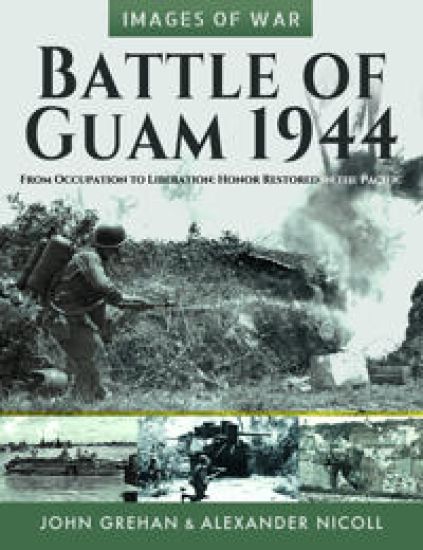
At 16.00 hours on 27 July 1944, the Stars and Stripes were raised over the central Pacific island of Guam. The symbolism of this moment was not lost on the officers and men who saluted the raising of Old Glory. This was because the first American flag to be pulled down by the Japanese in the Second World War was in Guam, on 10 December 1941, just three days after the attack on Pearl Harbor. Before the war three of the four main Mariana Islands – Saipan, Tinian and Rota – had substantial Japanese populations and were considered part of the Japanese empire. On the other hand, the largest island of the group, Guam, had been under American administration since the end of the nineteenth century, and its inhabitants saw themselves as Americans. Their liberation would be a ‘psychological high point’ in the long war against Imperial Japan for the people of the United States. The re-capture of Guam was more than just the recovery of lost territory. It was an essential element of Operation Forager, the US offensive to take the Mariana and Palau islands with the aim of neutralizing Japanese bases in the central Pacific and supporting the Allied drive to retake the Philippines. There was another factor which possibly was of even more significance. Prototypes of the new Boeing B-29 Superfortress were already being flown. The B-29 had an operational range of 3,500 miles, putting the Japanese Home Islands, and even Tokyo itself, well within striking distance of the Marianas. It would be from the Marianas that the strategic bombing campaign which helped bring Japan to its knees in 1945 would be carried out. The US assault upon the Marianas began with the attacks upon Saipan and Tinian. Then, on 21 July 1944, men of the III Marine Amphibious Corps landed on Guam after the longest preparatory bombardment of the war in the Pacific. For the next twenty days the Marines and the US Army’s 77th Division struggled through dense undergrowth and jungle and over rugged, wooded mountains to eliminate an enemy determined to fight to the death – and die they did. Roasted alive by flamethrowers in dugouts and caves, blasted out of ill-prepared pillboxes by artillery and mowed down by the score in senseless, tactically naïve headlong charges, almost the entire 20,000 strong Japanese garrison was killed. In the savage struggle throughout the island, American casualties were in excess of 6,000 and many hundreds of civilians were also killed in the fighting. But, after more than two-and-a-half years of Japanese occupation, honor was finally restored in the Central Pacific.
The Dieppe Raid

The Dieppe Raid

John Grehan; Alexander Nicoll

PEN SWORD BOOKS LTD
2023
nidottu

Halvin toimitettuna 28,40 €

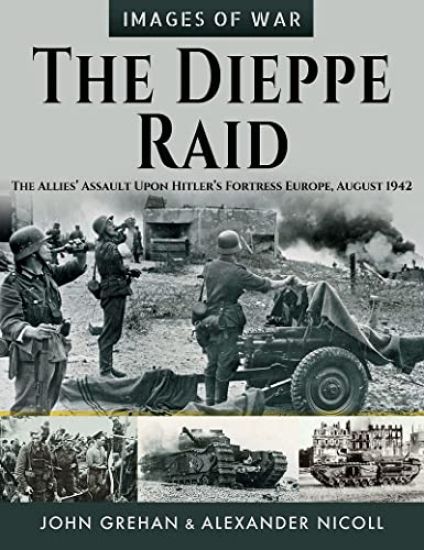
As dawn was breaking on the morning of 19 August 1942, Allied troops leapt ashore to the east and west of the French port of Dieppe. These were British commandoes accompanied by U. S. Rangers, tasked to silence the German gun batteries that flanked Dieppe. Other troops - the men of the 2nd Canadian Division - landed closer to Dieppe to capture the German positions that overlooked the port while, minutes later, the main body of the predominantly Canadian assaulting force began clambering from landing craft that had run onto the beach along Dieppe's seafront. This was the start of Operation Jubilee, the Allies' most ambitious assault upon Hitler's so-called Fortress Europe - it quickly became a bloodbath. The early months of 1942 had been difficult ones for Prime Minister Churchill. Stalin was demanding action in Western Europe to lessen the pressure of the 280 German divisions that were bearing down upon Stalingrad. Roosevelt was insisting that U. S. soldiers must start fighting the Germans in Europe, and Mackenzie King, the Canadian Prime Minister, desperately needed Canadian troops to become involved in the war to keep his politically divided nation together. Churchill's response to these measures was to authorise a super-raid' upon German-held territory, and the target selected by the planners was Dieppe. Apart from the notable success of No.4 Commando, the raid was a disaster with more than 50 per cent of the 6,086 men who landed being killed, wounded, or taken prisoner, plus all the Churchill tanks landed in support of the infantry suffered mechanical failure or were shelled into smoking wrecks. Yet amid the scenes slaughter, of confusion, and communication breakdown, were acts of almost unimaginable heroism, ingenuity, determination, and self-sacrifice to which the awarding of two Victoria Crosses paid a worthy tribute. There were also special missions associated with the raid, the details of which remained a closely guarded secret until long after the war. This book opens a window on Operation Jubilee, allowing the reader a rare insight into the death and destruction inflicted upon the Allied force during just a few hours, and of the damage done to Dieppe itself, with many of the photographs being taken by the victorious German defenders. The raid saw the heaviest casualty figures experienced by Canadians in the Second World War, and the photographs in this book are a stark reminder of that fateful day in late summer of 1942.
Corregidor: Siege and Liberation, 1941-1945

Corregidor: Siege and Liberation, 1941-1945

John Grehan; Alexander Nicoll

Frontline Books
2021
nidottu
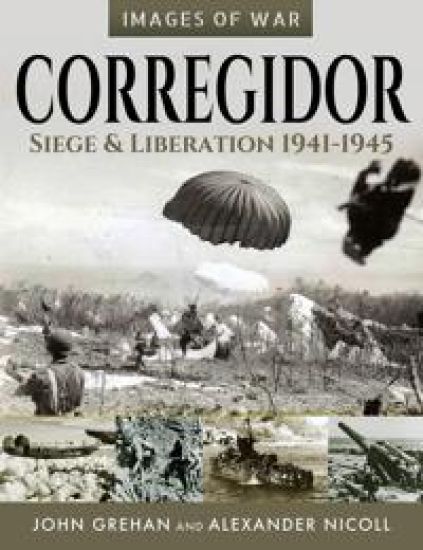
Singapore and Hong Kong had fallen to the forces of Imperial Japan, Thailand and Burma had been invaded and islands across the Pacific captured. But one place, one tiny island fortress garrisoned by a few thousand hungry and exhausted men, refused to be beaten. That island fortress was Corregidor which guarded the entrance to Manila Bay and controlled all sea-borne access to Manila Harbour. At a time when every news bulletin was one of Japanese success, Corregidor shone as the only beacon of hope in the darkness of defeat. The Japanese 14th Army of Lieutenant General Masaharu Homma, threw everything it had at Corregidor, officially named Fort Mills. But deep within the island's rocky heart, a tunnel had been excavated into Malinta Hill and there the US troops, marine, naval and army, endured the terrible onslaught. At their head was General Douglas MacArthur who became a national hero with his resolute determination never to surrender, until ordered to evacuate to Australia to avoid such a senior officer being captured by the enemy. Bur with his departure, the rest of the garrison knew that there was no possibility of relief. They would have to fight on until the bitter end, whatever form that might take. That end came in May 1942\. The defenders were reduced to virtually starvation rations with many of them wounded. Consequently, when, on 5 May the Japanese mounted a powerful amphibious assault, the weakened garrison could defy the enemy no longer. Corregidor, the 'Gibraltar of the East', finally fell to the invaders. Those invaders were to become the invaded when MacArthur returned in January 1945\. For three weeks, US aircraft, warships and artillery hammered the Japanese positions on Corregidor. Then, on 16 February, the Americans landed on the island. It took MacArthur's men ten days to hunt down the last of the Japanese, after many had chosen to commit suicide rather than surrender, but Corregidor was at last back in Allied hands. In this unique collection of images, the full story Corregidor's part in the Second World War is dramatically revealed. The ships, the aircraft, the guns, the fortifications and the men themselves, are shown here, portraying the harsh, almost unendurable, realities of war.
The Blessed Memory of the Righteous

The Blessed Memory of the Righteous

Alexander Nicoll

Gale Ecco, Print Editions
2018
sidottu
The 18th century was a wealth of knowledge, exploration and rapidly growing technology and expanding record-keeping made possible by advances in the printing press. In its determination to preserve the century of revolution, Gale initiated a revolution of its own: digitization of epic proportions to preserve these invaluable works in the largest archive of its kind. Now for the first time these high-quality digital copies of original 18th century manuscripts are available in print, making them highly accessible to libraries, undergraduate students, and independent scholars. The Age of Enlightenment profoundly enriched religious and philosophical understanding and continues to influence present-day thinking. Works collected here include masterpieces by David Hume, Immanuel Kant, and Jean-Jacques Rousseau, as well as religious sermons and moral debates on the issues of the day, such as the slave trade. The Age of Reason saw conflict between Protestantism and Catholicism transformed into one between faith and logic -- a debate that continues in the twenty-first century.++++The below data was compiled from various identification fields in the bibliographic record of this title. This data is provided as an additional tool in helping to insure edition identification: ++++National Library of ScotlandT190257Dundee: printed by J. Chalmers, 1800. 27, 1]p.; 4