Kirjojen hintavertailu – 12 859 819 kirjaa ja 27 kauppaa

Kirjailija

Alexander Pope

Kirjat ja teokset yhdessä paikassa: 572 kirjaa, julkaisuja vuosilta 1956–2026, suosituimpiin kuuluu Selected Poems of Alexander Pope. Vertaile teosten hintoja ja tarkista saatavuus suomalaisista kirjakaupoista.

572 kirjaa

Kirjojen julkaisuvuodet: 1956–2026.

Scriblerus

Scriblerus

Alexander Pope

Alma Classics
2018
nidottu
Alexander Pope was, at one time, the world’s most celebrated poet. His trenchant satirical works – in which the foibles of all the critics, hacks and bad poets of his day are exploded – and his masterful heroi-comic poem The Rape of the Lock continue to inspire generations of writers and readers to this day. Alongside his more prominent poetical production, Pope engaged with some of the sharpest wits of his era – including Jonathan Swift and John Gay, the author of The Beggar’s Opera – in writing a number of satirical prose works, of which Scriblerus is perhaps the greatest achievement. As he prepares to become a father for the first time, the scholar Cornelius is determined to settle on nothing less than a child of the “learned sex” – a boy – and give him the most thorough education so that he can become the greatest critic who ever lived. An account of the birth, the infancy, the schooling, the diet-planning, the unconventional love affairs and the attainments of this child prodigy, The Memoirs of Martinus Scriblerus is surely the funniest imaginary biography ever written.

An Essay on Criticism

An Essay on Criticism

Alexander Pope

Createspace Independent Publishing Platform
2018
nidottu
An Essay on Criticism was the first major poem written by the English writer Alexander Pope (1688-1744). However, despite the title, the poem is not as much an original analysis as it is a compilation of Pope's various literary opinions. A reading of the poem makes it clear that he is addressing not so much the ingenuous reader as the intending writer. It is written in a type of rhyming verse called heroic couplets. The poem first appeared in 1711, but was written in 1709. It is clear from Pope's correspondence that many of the poems ideas had existed in prose form since at least 1706. It is a verse essay written in the Horatian mode and is primarily concerned with how writers and critics behave in the new literary commerce of Pope's contemporary age. The poem covers a range of good criticism and advice. It also represents many of the chief literary ideals of Pope's age. Pope contends in the poem's opening couplets that bad criticism does greater harm than bad writing: 'Tis hard to say, if greater Want of Skill Appear in Writing or in Judging ill, But, of the two, less dang'rous is th' Offence, To tire our Patience, than mis-lead our Sense: Some few in that, but Numbers err in this, Ten Censure wrong for one who Writes amiss; A Fool might once himself alone expose, Now One in Verse makes many more in Prose. Despite the harmful effects of bad criticism, literature requires worthy criticism. (Quote from wikipedia.org)
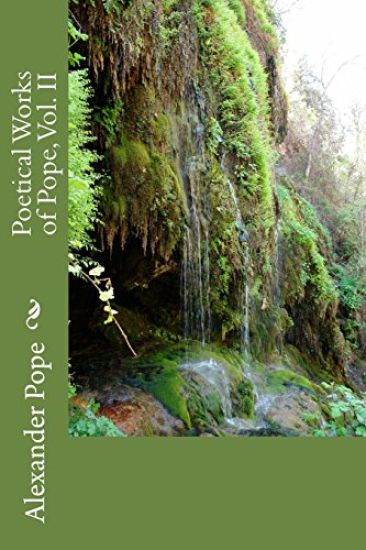
Poetical Works of Pope, Vol. II

Poetical Works of Pope, Vol. II

Alexander Pope

Createspace Independent Publishing Platform
2018
nidottu
Unlike some other reproductions of classic texts (1) We have not used OCR(Optical Character Recognition), as this leads to bad quality books with introduced typos. (2) In books where there are images such as portraits, maps, sketches etc We have endeavoured to keep the quality of these images, so they represent accurately the original artefact. Although occasionally there may be certain imperfections with these old texts, we feel they deserve to be made available for future generations to enjoy.
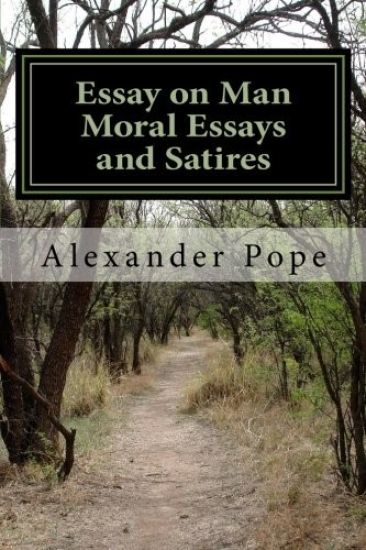
Essay on Man Moral Essays and Satires

Essay on Man Moral Essays and Satires

Alexander Pope

Createspace Independent Publishing Platform
2018
nidottu
CLASSIC BOOKS ON PHILOSOPHY - An Essay on Man, Moral Essays and Satires - NEW EDITION, By Alexander Pope. An Essay on Man is a poem published by Alexander Pope in 1734. It is a rationalistic effort to use philosophy in order to "vindicate the ways of God to man" (l.16), a variation of John Milton's claim in the opening lines of Paradise Lost, that he will "justify the ways of God to men" (1.26). It is concerned with the natural order God has decreed for man. Because man cannot know God's purposes, he cannot complain about his position in the Great Chain of Being (ll.33-34) and must accept that "Whatever IS, is RIGHT" (l.292), a theme that was satirized by Voltaire in Candide (1759). More than any other work, it popularized optimistic philosophy throughout England and the rest of Europe. Pope's Essay on Man and Moral Epistles were designed to be the parts of a system of ethics which he wanted to express in poetry. Moral Epistles have been known under various other names including Ethic Epistles and Moral Essays. On its publication, An Essay on Man met with great admiration throughout Europe. Voltaire called it "the most beautiful, the most useful, the most sublime didactic poem ever written in any language". citation needed] In 1756 Rousseau wrote to Voltaire admiring the poem and saying that it "softens my ills and brings me patience". Kant was fond of the poem and would recite long passages of the poem to his students. Later however, Voltaire renounced his admiration for Pope and Leibniz's optimism and even wrote a novel, Candide, as a satire on Pope and Leibniz's philosophy of ethics. Rousseau also critiqued the work. He questioned "Pope's uncritical assumption that there must be an unbroken chain of being all the way from inanimate matter up to God.
An Essay on Man; Moral Essays and Satires

An Essay on Man; Moral Essays and Satires

Alexander Pope

Createspace Independent Publishing Platform
2018
nidottu
This volume contains a rich selection of Pope's work, including such well-known poems as the title selection-a philosophical meditation on the nature of the universe and man's place in it-and "The Rape of the Lock," a mock-epic of rare charm and skill. Also included are "Ode on Solitude," "The Dying Christian to His Soul," "Elegy to the Memory of an Unfortunate Lady," "An Essay on Criticism," "Epigram Engraved on the Collar of a Dog," "Epistle IV] to Richard Boyle, Earl of Burlington: Of the Use of Riches," "Epistle to Dr. Arbuthnot; or, Prologue to the Satires" and more.
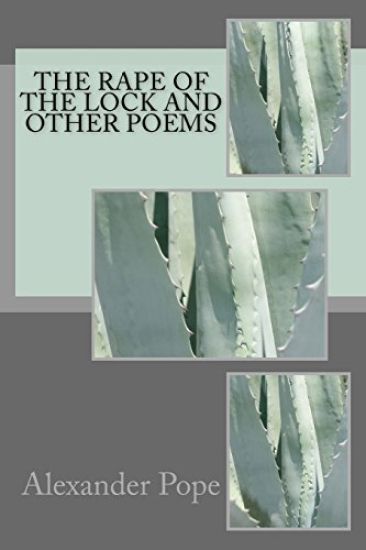
The Rape of the Lock and Other Poems

The Rape of the Lock and Other Poems

Alexander Pope

Createspace Independent Publishing Platform
2018
nidottu
Presented here are many of Pope's principal works, including the delightful mock-epic, The Rape of the Lock, Windsor Forest, Essay on Man, Elo sa to Abelard, Essay on Criticism, and his satirical masterpiece, The Dunciad. Together, they represent the writings of one of the Enlightenment's greatest poets. Alexander Pope enjoyed in his lifetime a fame and fortune that few poets have received. Known for his brilliant epigrams, he was an uncompromising social critic and razor-sharp satirist of fashionable society's foibles. His poetry was characterized by a graceful mastery of the English language, a biting wit, and a moral alertness that ranged from contemptuous to compassionate to dryly humorous. Considered England's greatest living poet by the age of 25, Pope would be hailed by Lord Byron as "the greatest name in our Poetry." Includes an Introduction by Christopher Miller and an Afterword by Elliott Visconsi
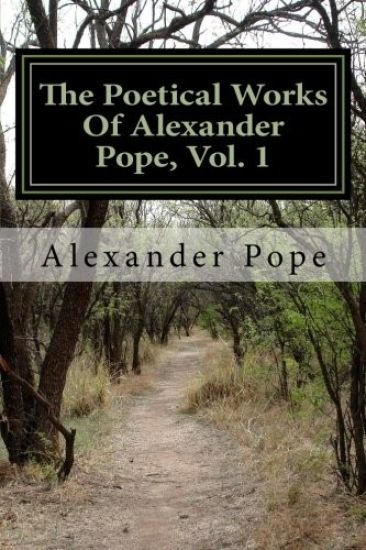
The Poetical Works Of Alexander Pope, Vol. 1

The Poetical Works Of Alexander Pope, Vol. 1

Alexander Pope

Createspace Independent Publishing Platform
2018
nidottu
Unlike some other reproductions of classic texts (1) We have not used OCR(Optical Character Recognition), as this leads to bad quality books with introduced typos. (2) In books where there are images such as portraits, maps, sketches etc We have endeavoured to keep the quality of these images, so they represent accurately the original artefact. Although occasionally there may be certain imperfections with these old texts, we feel they deserve to be made available for future generations to enjoy.
Works

Works

Alexander Pope; Joseph Warton

Hansebooks
2018
pokkari
Works - With notes and illus. by Joseph Warton, and others. Vol. 9 is an unchanged, high-quality reprint of the original edition of 1797. Hansebooks is editor of the literature on different topic areas such as research and science, travel and expeditions, cooking and nutrition, medicine, and other genres. As a publisher we focus on the preservation of historical literature. Many works of historical writers and scientists are available today as antiques only. Hansebooks newly publishes these books and contributes to the preservation of literature which has become rare and historical knowledge for the future.
Works

Works

Alexander Pope; Joseph Warton

Hansebooks
2018
pokkari
Works - With notes and illus. by Joseph Warton, and others. Vol. 5 is an unchanged, high-quality reprint of the original edition of 1797. Hansebooks is editor of the literature on different topic areas such as research and science, travel and expeditions, cooking and nutrition, medicine, and other genres. As a publisher we focus on the preservation of historical literature. Many works of historical writers and scientists are available today as antiques only. Hansebooks newly publishes these books and contributes to the preservation of literature which has become rare and historical knowledge for the future.
Works

Works

Alexander Pope; Joseph Warton

Hansebooks
2018
pokkari
Works - With notes and illus. by Joseph Warton, and others. Vol. 2 is an unchanged, high-quality reprint of the original edition of 1797. Hansebooks is editor of the literature on different topic areas such as research and science, travel and expeditions, cooking and nutrition, medicine, and other genres. As a publisher we focus on the preservation of historical literature. Many works of historical writers and scientists are available today as antiques only. Hansebooks newly publishes these books and contributes to the preservation of literature which has become rare and historical knowledge for the future.
Works

Works

Alexander Pope; Joseph Warton

Hansebooks
2018
pokkari
Works - With notes and illus. by Joseph Warton, and others. Vol. 6 is an unchanged, high-quality reprint of the original edition of 1797. Hansebooks is editor of the literature on different topic areas such as research and science, travel and expeditions, cooking and nutrition, medicine, and other genres. As a publisher we focus on the preservation of historical literature. Many works of historical writers and scientists are available today as antiques only. Hansebooks newly publishes these books and contributes to the preservation of literature which has become rare and historical knowledge for the future.
An Essay on Man

An Essay on Man

Alexander Pope

Createspace Independent Publishing Platform
2017
nidottu
Voltaire called it "the most sublime didactic poem ever written in any language." Rousseau rhapsodized about its intellectual consolations. Kant recited long passages of it from memory during his lectures. And Adam Smith and David Hume drew inspiration from it in their writings. This was Alexander Pope's Essay on Man (1733-34), a masterpiece of philosophical poetry, one of the most important and controversial works of the Enlightenment, and one of the most widely read, imitated, and discussed poems of eighteenth-century Europe and America. This volume, which presents the first major new edition of the poem in more than fifty years, introduces this essential work to a new generation of readers, recapturing the excitement and illuminating the debates it provoked from the moment of its publication. Echoing Milton's purpose in Paradise Lost, Pope says his aim in An Essay on Man is to "vindicate the ways of God to man"--to explain the existence of evil and explore man's place in the universe. In a comprehensive introduction, Tom Jones describes the poem as an investigation of the fundamental question of how people should behave in a world they experience as chaotic, but which they suspect to be orderly from some higher point of view. The introduction provides a thorough discussion of the poem's attitudes, themes, composition, context, and reception, and reassesses the work's place in history. Extensive annotations to the text explain references and allusions. The result is the most accessible, informative, and reader-friendly edition of the poem in decades and an invaluable book for students and scholars of eighteenth-century literature and thought.
An Essay on Man. Moral Essays and Satires

An Essay on Man. Moral Essays and Satires

Alexander Pope

Createspace Independent Publishing Platform
2017
nidottu
An Essay on Man is a poem published by Alexander Pope in 1734. It is a rationalistic effort to use philosophy in order to "vindicate the ways of God to man" (l.16), a variation of John Milton's claim in the opening lines of Paradise Lost, that he will "justify the ways of God to men" (1.26). It is concerned with the natural order God has decreed for man. Because man cannot know God's purposes, he cannot complain about his position in the Great Chain of Being (ll.33-34) and must accept that "Whatever IS, is RIGHT" (l.292), a theme that was satirized by Voltaire in Candide (1759). More than any other work, it popularized optimistic philosophy throughout England and the rest of Europe. Pope's Essay on Man and Moral Epistles were designed to be the parts of a system of ethics which he wanted to express in poetry. Moral Epistles have been known under various other names including Ethic Epistles and Moral Essays. On its publication, An Essay on Man met with great admiration throughout Europe. Voltaire called it "the most beautiful, the most useful, the most sublime didactic poem ever written in any language". citation needed] In 1756 Rousseau wrote to Voltaire admiring the poem and saying that it "softens my ills and brings me patience". Kant was fond of the poem and would recite long passages of the poem to his students. Later however, Voltaire renounced his admiration for Pope and Leibniz's optimism and even wrote a novel, Candide, as a satire on Pope and Leibniz's philosophy of ethics. Rousseau also critiqued the work. He questioned "Pope's uncritical assumption that there must be an unbroken chain of being all the way from inanimate matter up to God.