Kirjojen hintavertailu – 12 859 818 kirjaa ja 27 kauppaa

Kirjailija

Alexander R. Thomas

Kirjat ja teokset yhdessä paikassa: 18 kirjaa, julkaisuja vuosilta 2003–2027, suosituimpiin kuuluu Inequality at the Urban-Rural Nexus. Vertaile teosten hintoja ja tarkista saatavuus suomalaisista kirjakaupoista.

Nimi esiintyy myös muodoissa: Alexander R Thomas

18 kirjaa

Kirjojen julkaisuvuodet: 2003–2027.

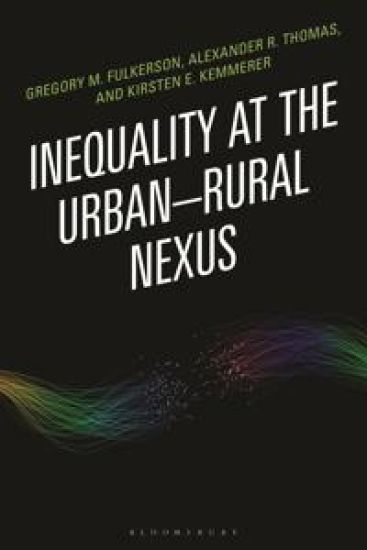
Inequality at the Urban-Rural Nexus: The Neglected Dimension

Inequality at the Urban-Rural Nexus: The Neglected Dimension

Gregory M. Fulkerson; Alexander R. Thomas; Kirsten Kemmerer

BLOOMSBURY ACADEMIC
2025
sidottu
This book examines the systemic and structural nature of social inequalities, focusing on how the urban-rural divide intersects with race, class, gender, ethnicity, and sexuality to shape identities and access to opportunities. It offers valuable insights for sociologists and scholars of inequality seeking to broaden the scope of current research. Ultimately, the authors argue that it will be impossible to build a more just and equitable society without addressing the urban-rural nexus.
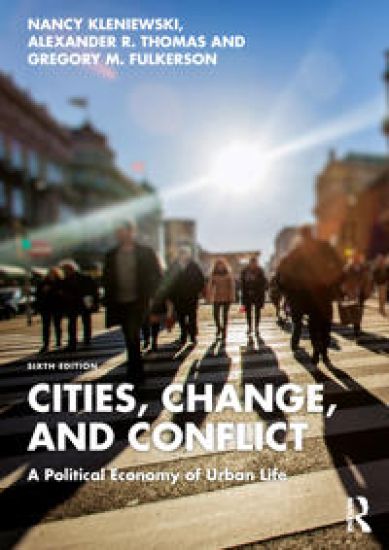
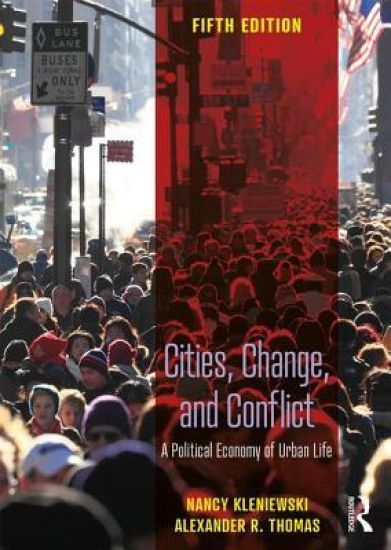
Cities, Change, and Conflict

Cities, Change, and Conflict

Nancy Kleniewski; Alexander R. Thomas; Gregory Fulkerson

TAYLOR FRANCIS LTD
2024
nidottu
Cities, Change, and Conflict was one of the first texts to embrace the perspective of political economy as its main explanatory framework, and then complement it with the rich contributions of human ecology as well as perspectives derived from critical approaches to social theory. Although its primary focus is on North American cities, the book contains several chapters on cities in other parts of the world, including the Global North and Global South. It provides both historical and contemporary accounts of the impact of globalization on urban development and urban institutions. This sixth edition features a new, groundbreaking chapter on the relationship between the physical environment and human settlements, including the urban-rural nexus. This edition also expands and updates coverage of recent trends such as the establishment and evolution of gay neighborhoods, the suburbanization of immigrant groups, the situation of the immigrant youth known as "Dreamers," the reverse migration of Blacks from the North to the South, and the proliferation of exurban communities. Beyond examining the dynamics that shape the form and functionality of cities, the text surveys the experience of urban life among different social groups, including a new perspective on intersectionality as it affects people’s experiences in cities. It illuminates the workings of the urban economy, local and federal governments, and the criminal justice system while addressing policy debates and decisions that affect almost every aspect of urbanization and urban life.
Cities, Change, and Conflict

Cities, Change, and Conflict

Nancy Kleniewski; Alexander R. Thomas; Gregory Fulkerson

TAYLOR FRANCIS LTD
2024
sidottu
Cities, Change, and Conflict was one of the first texts to embrace the perspective of political economy as its main explanatory framework, and then complement it with the rich contributions of human ecology as well as perspectives derived from critical approaches to social theory. Although its primary focus is on North American cities, the book contains several chapters on cities in other parts of the world, including the Global North and Global South. It provides both historical and contemporary accounts of the impact of globalization on urban development and urban institutions. This sixth edition features a new, groundbreaking chapter on the relationship between the physical environment and human settlements, including the urban-rural nexus. This edition also expands and updates coverage of recent trends such as the establishment and evolution of gay neighborhoods, the suburbanization of immigrant groups, the situation of the immigrant youth known as "Dreamers," the reverse migration of Blacks from the North to the South, and the proliferation of exurban communities. Beyond examining the dynamics that shape the form and functionality of cities, the text surveys the experience of urban life among different social groups, including a new perspective on intersectionality as it affects people’s experiences in cities. It illuminates the workings of the urban economy, local and federal governments, and the criminal justice system while addressing policy debates and decisions that affect almost every aspect of urbanization and urban life.
Big Rural

Big Rural

Crystal Cook Marshall; Alexander R. Thomas; Gregory M. Fulkerson

BLOOMSBURY PUBLISHING PLC
2023
sidottu
In Big Rural: Rural Industrial Places, Democracy, and What Next, Crystal Cook Marshall unveils the rural not as wild and unknowable but as measured and intervened-in as big cities. Drawing international comparisons with a case study centering on the Pocahontas Coalfield, Cook Marshall documents that rural places are often systems among systems that scientists and engineers heavily shape both in landscape and culture. Often single sector economies with consolidated power and automation away of jobs, these rural industrial places compound the problems of their inhabitants, even threatening their capacity to practice democracy. Cook Marshall interacts with rural interveners from industry to Rural Studies and Science and Technology scholars to policy advocates, also detailing the gaps in related scholarship. Building from analysis, she proposes a range of antidotes to the extraction and destruction of “Big Rural” both in material life and in knowledge, such as potential National Rural and Sustainable Agricultural strategies. Through these, in interviews with rural change agents, through research, and through local and federal paths, Cook Marshall asserts a way forward for the rural that is more equitable and just.
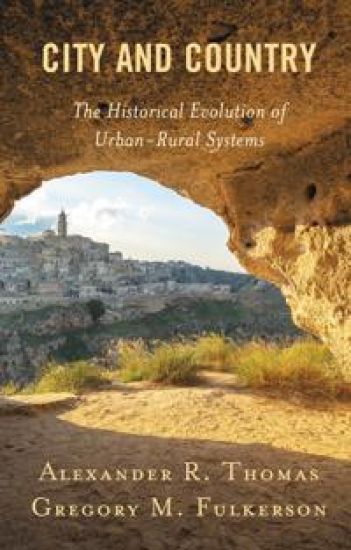
City and Country

City and Country

Alexander R. Thomas; Gregory M. Fulkerson

BLOOMSBURY PUBLISHING PLC
2023
nidottu
City and Country: The Historical Evolution of Urban-Rural Systems begins with a simple assumption: every human requires, on average, two-thousand calories per day to stay alive. Tracing the ramifications of this insight leads to the caloric well: the caloric demand at one point in the environment. As population increases, the depth of the caloric well reflects this increased demand and requires a population to go further afield for resources, a condition called urban dependency. City and Country traces the structural ramifications of these dynamics as the population increased from the Paleolithic to today. We can understand urban dependency as the product of the caloric demands a population puts on a given environment, and when those demands outstrip the carry capacity of the environment, a caloric well develops that forces a community to look beyond its immediate area for resources. As the well deepens, the horizon from which resources are gathered is pushed further afield, often resulting in conflict with neighboring groups. Prior to settled villages, increases in population resulted in cultural (technological) innovations that allowed for greater use of existing resources: the broad-spectrum revolution circa 20 thousand years ago, the birth of agricultural villages 11 thousand years ago, and hierarchically organized systems of multiple settlements working together to produce enough food during the Ubaid period in Mesopotamia seven-thousand years ago—the first urban-rural systems. As cities developed, increasing population resulted in an ever-deepening morass of urban dependency that required expansion of urban-rural systems. These urban-rural dynamics today serve as an underlying logic upon which modern capitalism is built. The culmination of two decades of research into the nature of urban-rural dynamics, City and Country argues that at the heart of the logic of capitalism is an even deeper logic: urbanization is based on urban dependency.
Urbanormativity

Urbanormativity

Gregory M. Fulkerson; Alexander R. Thomas

BLOOMSBURY PUBLISHING PLC
2022
nidottu
This book investigates urbanormativity—a concept that privileges urban normalcy and desirability over rural deviance and undesirability. The “reality” section outlines its foundations—urbanization, urban-rural systems, and urban dependency. The “representation” section explores urbanormative culture by considering cultural capital, media, and identity. The last section, “everyday life,” examines urban-rural disparities in law and politics and in life within different communities. It concludes by calling for a rural justice approach that will revalue the rural.
City and Country

City and Country

Alexander R. Thomas; Gregory M. Fulkerson

Lexington Books
2021
sidottu
City and Country: The Historical Evolution of Urban-Rural Systems begins with a simple assumption: every human requires, on average, two-thousand calories per day to stay alive. Tracing the ramifications of this insight leads to the caloric well: the caloric demand at one point in the environment. As population increases, the depth of the caloric well reflects this increased demand and requires a population to go further afield for resources, a condition called urban dependency. City and Country traces the structural ramifications of these dynamics as the population increased from the Paleolithic to today. We can understand urban dependency as the product of the caloric demands a population puts on a given environment, and when those demands outstrip the carry capacity of the environment, a caloric well develops that forces a community to look beyond its immediate area for resources. As the well deepens, the horizon from which resources are gathered is pushed further afield, often resulting in conflict with neighboring groups. Prior to settled villages, increases in population resulted in cultural (technological) innovations that allowed for greater use of existing resources: the broad-spectrum revolution circa 20 thousand years ago, the birth of agricultural villages 11 thousand years ago, and hierarchically organized systems of multiple settlements working together to produce enough food during the Ubaid period in Mesopotamia seven-thousand years ago—the first urban-rural systems. As cities developed, increasing population resulted in an ever-deepening morass of urban dependency that required expansion of urban-rural systems. These urban-rural dynamics today serve as an underlying logic upon which modern capitalism is built. The culmination of two decades of research into the nature of urban-rural dynamics, City and Country argues that at the heart of the logic of capitalism is an even deeper logic: urbanization is based on urban dependency.
Urban Dependency

Urban Dependency

Gregory M. Fulkerson; Alexander R. Thomas

Rowman Littlefield
2020
sidottu
Urban Dependency investigates the risks of urban populations that cannot survive without the massive consumption of basic rural products like food, textiles, fossil fuels, and other energy-rich goods that are harvested by a shrinking rural base. Thomas and Fulkerson argue that though essential, rural workers and communities are poorly compensated for their labor that is both dangerous and highly exploitative. While the rural population is already shrinking, the authors predict that harsh political-economic conditions will only fuel further rural-urban migration, worsening the problem of urban dependency. The authors apply their theory of the energy economy to explore a balance between the supply and demand of energy resources that promotes rural justice.
Urbanormativity

Urbanormativity

Gregory M. Fulkerson; Alexander R. Thomas

Lexington Books
2019
sidottu

Halvin toimitettuna 133,10 €

Urbanormativity explores a cultural ideology that posits that urban is normal and desirable while rural is deviant, exotic, or undesirable. This work examines the relevance and meaning of this phenomenon in three parts: reality, which discusses the urbanization of the planet and the inherent conflict that emerges from the condition of urban dependency; representations, which discusses the cultural dynamics of urbanormativity; and everyday life, which focuses on the outcomes of urbanormativity in terms of the legal and political landscape, emphasizing the role of spatial inequality in creating urban-rural disparities. The book then examines life in rural communities amid urbanormativity, highlighting such processes as rural gentrification as well as the transformation of the character and tradition of rural communities through the process of place structuration. This book conclude by developing a new rural justice ethic that advocates for the incorporation of Sen’s notion of capability maximization along with a concerted effort to revalue the rural—socially, culturally, politically, and economically.
Cities, Change, and Conflict

Cities, Change, and Conflict

Nancy Kleniewski; Alexander R. Thomas

Routledge
2019
nidottu
Cities, Change, and Conflict was one of the first texts to embrace the perspective of political economy as its main explanatory framework, and then complement it with the rich contributions found in the human ecology perspective. Although its primary focus is on North American cities, the book contains several chapters on cities in other parts of the world, including Europe and developing nations, providing both historical and contemporary accounts on the impact of globalization on urban development. This edition features new coverage of important recent developments affecting urban life, including the implications of racial conflict in Ferguson, Missouri , and elsewhere, recent presidential urban strategies, the new waves of European refugees, the long-term impacts of the Great Recession as seen through the lens of Detroit’s bankruptcy, new and emerging inequalities, and an extended look into Sampson’s Great American City. Beyond examining the dynamics that shape the form and functionality of cities, the text surveys the experience of urban life among different social groups, including immigrants, African Americans,women, and members of different social classes. It illuminates the workings of the urban economy, local and federal governments, and the criminal justice system, and also addresses policy debates and decisions that affect almost every aspect of urbanization and urban life.

Cities, Change, and Conflict

Cities, Change, and Conflict

Nancy Kleniewski; Alexander R. Thomas

Routledge
2019
sidottu
Cities, Change, and Conflict was one of the first texts to embrace the perspective of political economy as its main explanatory framework, and then complement it with the rich contributions found in the human ecology perspective. Although its primary focus is on North American cities, the book contains several chapters on cities in other parts of the world, including Europe and developing nations, providing both historical and contemporary accounts on the impact of globalization on urban development. This edition features new coverage of important recent developments affecting urban life, including the implications of racial conflict in Ferguson, Missouri , and elsewhere, recent presidential urban strategies, the new waves of European refugees, the long-term impacts of the Great Recession as seen through the lens of Detroit’s bankruptcy, new and emerging inequalities, and an extended look into Sampson’s Great American City. Beyond examining the dynamics that shape the form and functionality of cities, the text surveys the experience of urban life among different social groups, including immigrants, African Americans,women, and members of different social classes. It illuminates the workings of the urban economy, local and federal governments, and the criminal justice system, and also addresses policy debates and decisions that affect almost every aspect of urbanization and urban life.

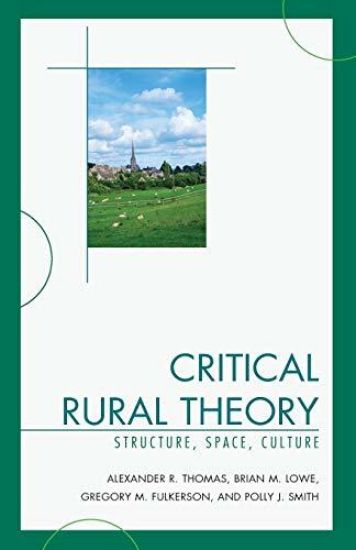
Critical Rural Theory

Critical Rural Theory

Alexander R. Thomas; Brian Lowe; Greg Fulkerson; Polly Smith

Lexington Books
2013
nidottu
Critical Rural Theory is an attempt to bring together the concepts of structure, space, and culture in order to explain the relationship between rural communities and urban society. The overarching theme revolves around the many ways-structural, spatial, and cultural-in which urban systems create and maintain a hegemonic relationship with rural areas and people. Central to this theme is the concept of urbanormativity: the cultural assumption of the dominance and superiority of urban communities and patterns of life. Urbanormativity is an outgrowth of the structural forces in an urban society that favor the interests of cities over those of the countryside, of a generally exploitative relationship between the two. The structure of a society is encoded in the settlement space, which in turn influences one's experience. The experience of social space produces cultural dynamics that are reproduced from generation to generation. These mechanisms are explored through popular culture, physical patterns of urban expansion, and historical patterns of social change.
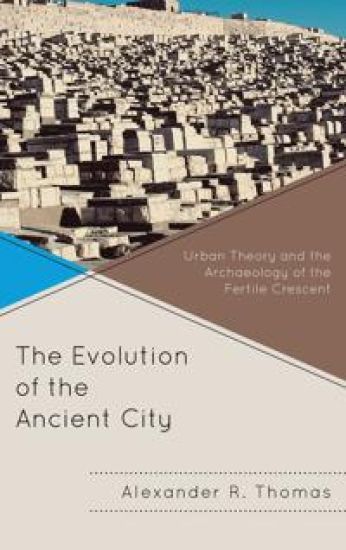
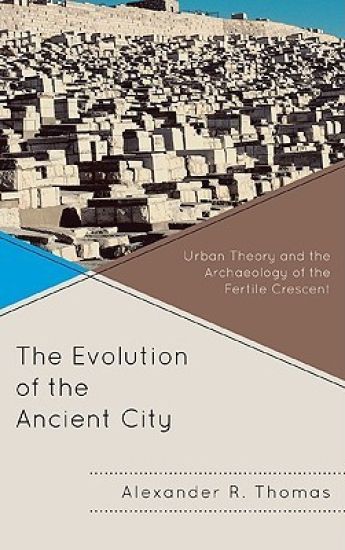
The Evolution of the Ancient City

The Evolution of the Ancient City

Alexander R. Thomas

Lexington Books
2012
nidottu
Urban theory and archaeology merge to create a readable discussion of how ancient cities came to be. Although many consider our modern social ills to be the consequence of Capitalism, many urban problems are traceable to pre-Capitalist times and thus are more related to Urbanization. Ancient cities shared many characteristics with modern cities. For instance, the ancient cities of Rome and Carthage at the time of Christ had population densities approaching that of Manhattan Island today. The Canaanites, fifteen hundred years before, lived in cities oriented toward trade and dependent upon mass production of such items as wine, olive oil, and the pottery to contain such goods. Over three thousand years before the Common Era, the city of Uruk was part of a larger "global system" that resembled in its own way the globalization that we know today. Cities first arose in Mesopotamia about 5,500 years ago, but for 5,500 years before the rise of cities the small agricultural village was the most complex form of human social organization—clearly there was nothing inevitable about the city. The Evolution of the Ancient City explores what we can learn of modern cities by tracing the development of ancient cities.
The Evolution of the Ancient City

The Evolution of the Ancient City

Alexander R. Thomas

Lexington Books
2010
sidottu
Urban theory and archaeology merge to create a readable discussion of how ancient cities came to be. Although many consider our modern social ills to be the consequence of Capitalism, many urban problems are traceable to pre-Capitalist times and thus are more related to Urbanization. Ancient cities shared many characteristics with modern cities. For instance, the ancient cities of Rome and Carthage at the time of Christ had population densities approaching that of Manhattan Island today. The Canaanites, fifteen hundred years before, lived in cities oriented toward trade and dependent upon mass production of such items as wine, olive oil, and the pottery to contain such goods. Over three thousand years before the Common Era, the city of Uruk was part of a larger "global system" that resembled in its own way the globalization that we know today. Cities first arose in Mesopotamia about 5,500 years ago, but for 5,500 years before the rise of cities the small agricultural village was the most complex form of human social organization—clearly there was nothing inevitable about the city. The Evolution of the Ancient City explores what we can learn of modern cities by tracing the development of ancient cities.
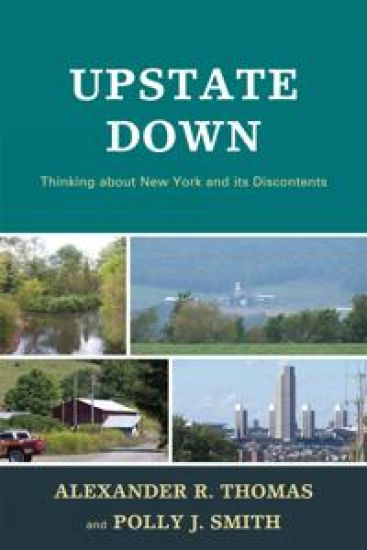
Upstate Down

Upstate Down

Alexander R. Thomas; Polly J. Smith

University Press of America
2009
nidottu
Upstate New York is in a malaise. This husband and wife team of sociologists, Alexander Thomas and Polly Smith, wanted to know why. They take the reader on a tour of New York in order to diagnose the problems affecting the state and what can be done to address the issues. New York was built on the strengths of its strategic location and growing population to become the 'Empire State' during the nineteenth and early twentieth centuries. But a combination of unfortunate decisions and the creation of new technologies in which New York was no more competitive than other states translated into New York losing its dominant position in the world economy. The result has been several decades of deindustrialization and population loss. This book includes recommendations for ideas that can be further developed by the public.
Gilboa

Gilboa

Alexander R. Thomas

University Press of America
2005
nidottu
On the night of October 18, 1925, fire raged through the downtown area of the tiny Catskill Mountain Village of Gilboa, New York. Firefighters came from miles around to fight the inferno while tourists sat on the hilltops to watch the show. In the end, 18 buildings lay in smoldering ruins. Yet, this fire was not the end of Gilboa, merely a climax of events that were razing the community more slowly. Gilboa was in the way of the Schoharie Reservoir, one of the numerous artificial lakes collecting water for thirsty New Yorkers. In order for New York City to growing, the people of Gilboa would be forced to move, and the town would need to be burned to the ground. In Gilboa, Alexander Thomas traces the evolving dynamics between New York and its hinterland. Starting with the role of native inhabitants, their Dutch colonizers, and the role of British manor law, this historical investigation then explores the construction of the original reservoir, battles against a second reservoir in the 1970s, and battles over environmental regulations in the 1990s. Gilboa is a must read for those interested in urban and rural issues, social conflict and social movements, and anyone who enjoys New York-state and city-history.
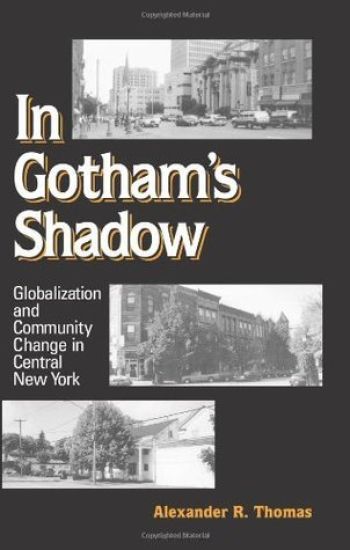
In Gotham's Shadow

In Gotham's Shadow

Alexander R. Thomas

State University of New York Press
2003
pokkari
Examines the effects of globalization on three New York communities—Utica, Cooperstown, and Hartwick. In what may be the first explicitly comparative study of the effects of globalization on metropolitan and rural communities, In Gotham's Shadow examines how three central New York communities struggled over the last half century to survive in a global economy that seems to have forgotten them. Utica, formerly a city of one hundred thousand, experienced the same trends of suburbanization, deindustrialization, and urban renewal as nearly every American city, with the same mixed results. In Cooperstown and Hartwick, two small villages forty miles south of Utica, the same trends were at work, though with different outcomes. Hartwick may be seen as an example of how small towns have lost their core, while Cooperstown may be seen as an example of how a small town can survive by transforming itself into a tourist destination. Thomas provides extensive historical background mixed with newspaper excerpts and lively interviews that add a human dimension to the transformations these communities have experienced.